

Most corporate videos follow the same predictable formula: polished visuals, upbeat music, scripted talking points, and a logo at the end. They look professional, but they rarely make anyone feel anything. A corporate documentary takes a fundamentally different path. Instead of telling audiences what to think about your company, it shows them the real people, real challenges, and real outcomes that define your brand. This guide breaks down exactly what corporate documentaries are, how they’re produced, why authenticity is their most powerful ingredient, and how your organization can use them to create lasting business impact.
Table of Contents
- Understanding corporate documentaries
- Stages of corporate documentary production
- Authenticity and narrative: Why it matters
- Business benefits and strategic impact
- Our perspective: Why strategic authenticity trumps traditional promotion
- Take your corporate documentary to the next level
- Frequently asked questions
Key Takeaways
| Point | Details |
|---|---|
| Authentic storytelling | Corporate documentaries use real narratives to build trust and engagement. |
| Structured production process | Successful documentaries follow clear stages from research to post-production. |
| Business impact | Documentaries drive brand visibility, recruitment, and culture with long-lasting value. |
| Strategic workflow | Scalable workflows and structured briefs keep costs controlled and maximize quality. |
Understanding corporate documentaries
A corporate documentary is a nonfiction narrative film that authentically tells a company’s story, distinguishing it sharply from scripted promotional content. Where a standard corporate promo video is built around a message the company wants to deliver, a documentary is built around a story worth telling. That distinction changes everything, from how you approach pre-production to how your audience responds when they watch the final cut.
The table below captures the core differences clearly:
| Feature | Corporate documentary | Promo video |
|---|---|---|
| Narrative style | Authentic, story-driven | Scripted, message-driven |
| Subjects | Real employees, customers, partners | Actors or selected spokespeople |
| Tone | Candid and honest | Polished and controlled |
| Primary goal | Build trust and connection | Drive immediate action |
| Typical length | 10 to 45+ minutes | 60 seconds to 5 minutes |
Corporate documentaries focus on real people navigating real challenges. A manufacturing company might document the journey of bringing a new product to market. A healthcare organization might follow the caregivers and patients whose lives intersect with their mission. A tech startup might capture the tension and breakthrough of a critical product launch. These are not stories you can write from a boardroom. They emerge from access, observation, and honest filmmaking.
Why does this matter for your brand? Because audiences, including B2B buyers and enterprise stakeholders, have grown skeptical of curated marketing. When your company needs corporate video content that actually resonates, authenticity is not optional. It’s the foundation.
Here are the defining characteristics of a strong corporate documentary:
- Real subjects: Employees, customers, and partners speak on camera without heavily scripted lines
- Conflict and resolution: The story acknowledges real challenges, not just successes
- Emotional arc: Viewers follow a journey with a clear beginning, middle, and outcome
- Evidence-based narrative: Data and facts support the story without overwhelming it
- Long-form depth: The format allows for nuance that shorter videos cannot deliver
“The most effective corporate documentaries don’t market a company. They reveal it.”
When you create impactful corporate production videos, the goal is not to impress. It’s to connect.
Stages of corporate documentary production
Having defined what corporate documentaries are, the next step is understanding how they’re made. Production methodologies follow standard stages: pre-production, production, and post-production. Each stage plays a distinct role in shaping the final film, and skipping steps in any of them is where most projects run into trouble.
Here is how each stage breaks down:
- Discovery and research: The production team studies your organization, identifies compelling story angles, and interviews internal stakeholders to find the human threads worth following.
- Script and storyboard development: Unlike scripted promos, documentary storyboards outline themes and sequences rather than exact lines. This keeps the filming flexible enough to capture genuine moments.
- Pre-production logistics: Location scouting, talent scheduling, release forms, equipment planning, and shoot days are all mapped out in structured briefs before a single camera rolls.
- Principal photography: On-camera interviews, b-roll footage, and observational filming are captured. Natural lighting is often prioritized to maintain the authentic feel that makes documentaries credible.
- Post-production: Footage is reviewed, stories are shaped in the edit suite, music and graphics are added, and the film is color-graded and mixed for final delivery.
The data below shows approximate time investments for a standard corporate documentary:
| Stage | Typical duration |
|---|---|
| Discovery and research | 1 to 2 weeks |
| Pre-production | 2 to 4 weeks |
| Principal photography | 2 to 5 shoot days |
| Post-production | 3 to 6 weeks |
| Review and delivery | 1 to 2 weeks |
One element that separates good corporate documentaries from great ones is the corporate interview workflow. Candid interviews require a skilled interviewer who can put subjects at ease, ask open-ended questions, and let the story unfold naturally rather than forcing predetermined answers.
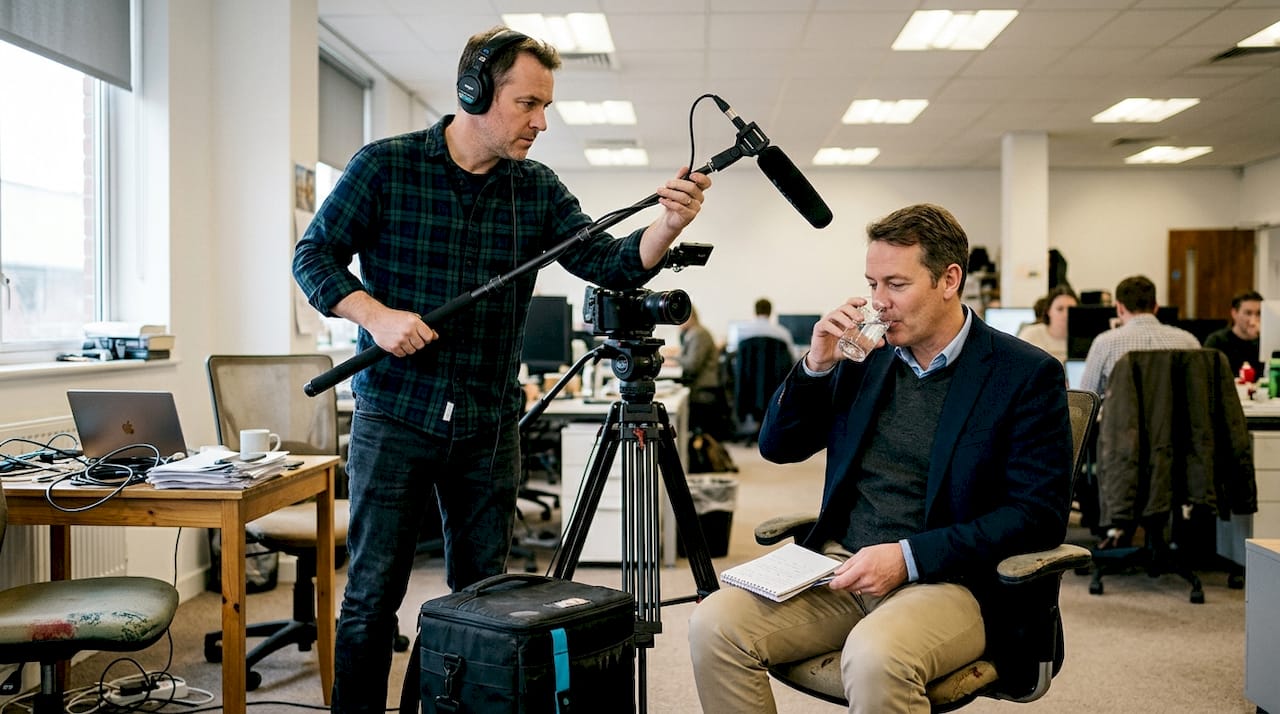
Pro Tip: Build your production brief before your first creative meeting. A structured brief that captures your objectives, target audience, key messages, and distribution plan will cut revision cycles significantly and keep your production team aligned from day one. Strong storytelling in video always starts with clarity on paper.
Authenticity and narrative: Why it matters
Beyond production mechanics, let’s examine what truly sets successful corporate documentaries apart. Authenticity drives engagement in B2B marketing more reliably than any scripted alternative. Buyers, executives, and stakeholders are trained to filter out marketing noise. What breaks through is the feeling that something is real.
The challenge most organizations face is that they want authenticity, but they also want control. That tension is natural, but the companies that produce the most impactful documentaries learn to trust the process. They allow cameras into spaces where real work happens. They let employees speak candidly. They don’t over-coach their subjects.
Here are the key narrative techniques that consistently elevate corporate videos from forgettable to memorable:
- Character-driven structure: Anchor the story around one or two individuals the audience can follow throughout the film
- Conflict as an asset: Don’t shy away from the obstacles your team has faced. Struggle makes resolution meaningful
- Specificity over generality: Concrete details, names, places, and numbers make a story feel real and credible
- Emotional peaks and valleys: Vary the emotional pacing so that viewers stay engaged rather than drifting
- A clear resolution: End with purpose. Audiences need to understand what changed and why it matters
Pro Tip: One of the most common pitfalls we see is over-scripting interview subjects. When a subject sounds rehearsed, the audience feels it immediately. Brief your people on the themes, not the exact words. Let them speak from experience, and your editor will find the gold in the unscripted moments.
The most persuasive corporate documentary is the one that makes a viewer forget they’re watching a piece of branded content. That happens when narrative technique and genuine access work together.
Business benefits and strategic impact
Once authenticity and narrative are prioritized, it’s essential to understand the real-world advantages these documentaries offer. Corporate documentaries highlight real challenges and impact, supporting culture, recruitment, and external communications in ways that standard marketing materials simply cannot match.
The business case is strong across multiple objectives:
- Brand visibility: Long-form documentaries perform well on owned channels, streaming platforms, and at industry events. They generate shared viewing and longer session times than short-form content.
- Recruitment and employer branding: Top talent wants to understand a company’s culture before they apply. A documentary that shows real work environments, leadership styles, and team dynamics gives candidates meaningful insight.
- Culture building: Internally, documentaries reinforce values and create shared narratives that align distributed teams around a common purpose.
- Investor and partner communications: A well-produced documentary can convey growth, stability, and mission more effectively than a slide deck.
- Media and PR support: Documentary-style content is frequently picked up by trade publications and industry media, extending your reach without additional ad spend.
One metric worth tracking is watch time. Research consistently shows that video content with strong storytelling holds viewer attention far longer than branded short-form content. For corporate video production teams, this directly correlates with message retention and brand recall.
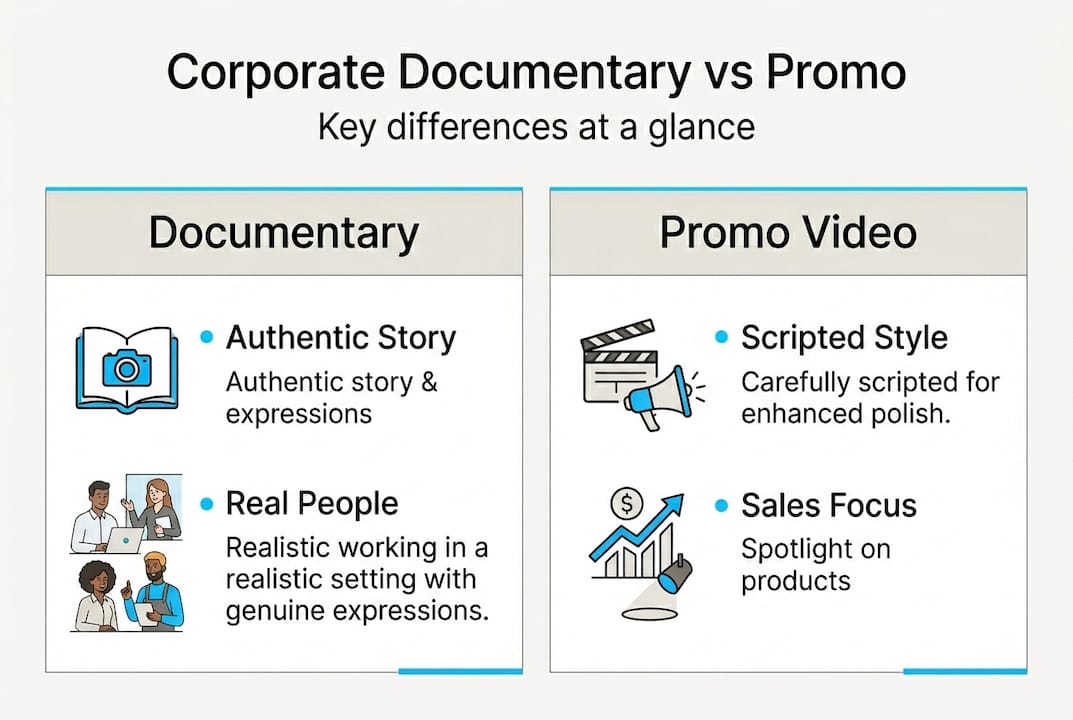
Across industries, from financial services to consumer goods, companies that have invested in documentary-style content report stronger stakeholder alignment and more consistent brand perception. When you boost your brand’s image through authentic storytelling, the returns compound over time because the content remains relevant long after launch.
Our perspective: Why strategic authenticity trumps traditional promotion
With all the strategic benefits covered, here’s an honest perspective from years in professional documentary production. Most companies approach corporate video production backwards. They start with the message they want to deliver and then look for footage to support it. That approach produces content that feels like what it is: a marketing exercise.
The organizations that consistently produce exceptional documentaries start with access, not messaging. They open their doors, introduce their people, and trust the story that emerges. Campaigns built this way don’t just perform better. They last longer. They generate organic sharing. They attract media attention. They become internal culture artifacts.
We’ve also seen well-funded promotional campaigns fail because the audience could feel the artifice. A $500,000 commercial can underperform a $50,000 documentary if the documentary is built on genuine storytelling for brand impact. Strategic authenticity is not a creative preference. It’s a business discipline that requires leadership buy-in, access, and the willingness to let the real story lead.
Take your corporate documentary to the next level
If you’re ready to make your story unforgettable, here’s how expert producers can help. Producing a corporate documentary that actually moves your audience requires more than good equipment and a shooting schedule.
At Bonomotion, we’ve guided brands through the full production process since 2003, from structured discovery sessions to polished final cuts that perform on every platform. Whether you need corporate video production in Hollywood or a full suite of corporate video solutions tailored to your market, our experienced producers align with your objectives from day one. If you’re looking for a corporate videographer in Miami with the depth to handle complex, multi-stakeholder projects, let’s talk about what your brand’s story deserves.
Frequently asked questions
How is a corporate documentary different from a corporate promo video?
Corporate documentaries tell authentic nonfiction stories using real people and genuine challenges, while promo videos rely on scripted messaging designed to drive a specific sales or marketing outcome.
What are the main stages involved in creating a corporate documentary?
The process follows three core stages, pre-production, production, and post-production, with candid interviews and authentic access forming the backbone of the filming phase.
Why is authenticity important in corporate documentaries?
Authenticity drives engagement in B2B contexts because stakeholders and buyers can recognize scripted or manufactured content quickly, making genuine storytelling far more persuasive and memorable.
How can a corporate documentary support recruitment and company culture?
By showing real challenges and impact, a documentary gives prospective employees an honest view of your culture, values, and work environment, attracting talent that truly fits your organization.