

Contents
Nearly 91% of businesses now use video as part of their marketing strategy, yet most organizations treat every video format as interchangeable. That assumption is costly. An explainer video that performs brilliantly on YouTube will fall flat when repurposed as a LinkedIn ad without adaptation. A polished brand film may build emotional connection but won’t convert a prospect who needs hard proof. This guide breaks down the major video content types, explains where each fits in your marketing funnel, and gives you a clear framework for choosing the right format for your goals, audience, and platform.
Table of Contents
- Why video content matters for modern brands
- The core video content types explained
- Choosing the right video type for your strategy
- Maximizing results: Best practices and trends for 2026
- An industry perspective: What most brands miss in video strategy
- Need expert help producing or scaling your video strategy?
- Frequently asked questions
Key Takeaways
| Point | Details |
|---|---|
| Video is essential | Over 90% of businesses use video, making it a must-have for modern marketing. |
| Match content to goals | Selecting the right video type depends on target audience, objectives, and platform. |
| Short-form drives engagement | Vertical and short videos deliver high completion rates and social reach. |
| Authenticity builds trust | User-generated and less polished content often outperforms produced ads for trust. |
| Combine formats for best results | Mixing video types across the funnel maximizes branding and lead generation impact. |
Why video content matters for modern brands
Video is no longer a supplemental channel. It has become the primary medium through which brands communicate value, build trust, and generate qualified leads. The numbers reflect this shift clearly.
| Metric | Stat |
|---|---|
| Businesses using video in strategy | 91% |
| B2B buyers who prefer video | 96% |
| Lift in LinkedIn completions under 30s | 200% |
| Lead conversion rate for long-form webinars | 65% |
The 96% of B2B buyers who prefer video over other content formats are not just passively watching. They are using video to evaluate vendors, understand solutions, and build confidence before making purchase decisions. That means your video content is doing sales work whether you plan for it or not.
Viewer behavior has also shifted in ways that demand format adaptation. Audiences now toggle between short vertical clips on mobile and longer deep-dive content on desktop, often within the same research session. Static content simply cannot match the engagement dynamics that business video benchmarks consistently show for video across industries.
For marketing and communication professionals, this creates both an opportunity and a challenge. The opportunity: video gives your brand more surface area to connect with buyers at every stage of the funnel. The challenge: deploying the wrong format at the wrong moment can waste budget and dilute your message.
Here is what we consistently observe working across B2B video content strategies:
- Brand awareness: Short-form video and brand films drive top-of-funnel recognition
- Lead generation: Webinars and case study videos capture high-intent prospects
- Trust building: Testimonials and UGC (user-generated content) validate claims with social proof
- Retention and loyalty: Behind-the-scenes and event recap videos deepen existing relationships
Understanding video marketing insights at this level allows you to allocate production resources strategically rather than reactively. Now that we have set the big-picture context for video content adoption, let us break down the main types.
The core video content types explained
With the strategic reasoning established, it is essential to understand what specific video types you can deploy and where each belongs in your marketing ecosystem.
- Explainer videos: Typically 60 to 90 seconds, these videos simplify complex products or services using animation or live action. They perform best at the top of the funnel and are ideal for homepage placements, paid social, and onboarding sequences.
- Testimonial videos: Customer-led proof content that builds credibility. These work powerfully in the consideration stage, particularly on landing pages and in email nurture sequences.
- Case study videos: Longer narrative-driven content (2 to 5 minutes) that walks through a client challenge, solution, and measurable result. These are high-value assets for late-stage buyers.
- Live stream videos: Real-time broadcasts for product launches, executive Q&As, or industry panels. Live content drives immediate engagement and can be repurposed into multiple assets post-broadcast.
- Event recap videos: Condensed highlights from conferences or corporate events. These extend the life of your event investment and serve as social proof of your brand’s industry presence.
- UGC and creator-style videos: Informal, authentic content that mirrors organic social posts. Short-form vertical video dominates engagement on platforms like Instagram and TikTok, and creator-style formats are increasingly effective even in B2B contexts.
| Video type | Funnel stage | Primary outcome |
|---|---|---|
| Explainer | Awareness | Education and reach |
| Testimonial | Consideration | Trust and credibility |
| Case study | Decision | Conversion |
| Live stream | Awareness/Engagement | Real-time interaction |
| Event recap | Retention | Brand authority |
| UGC/Creator-style | Awareness/Trust | Authenticity and reach |
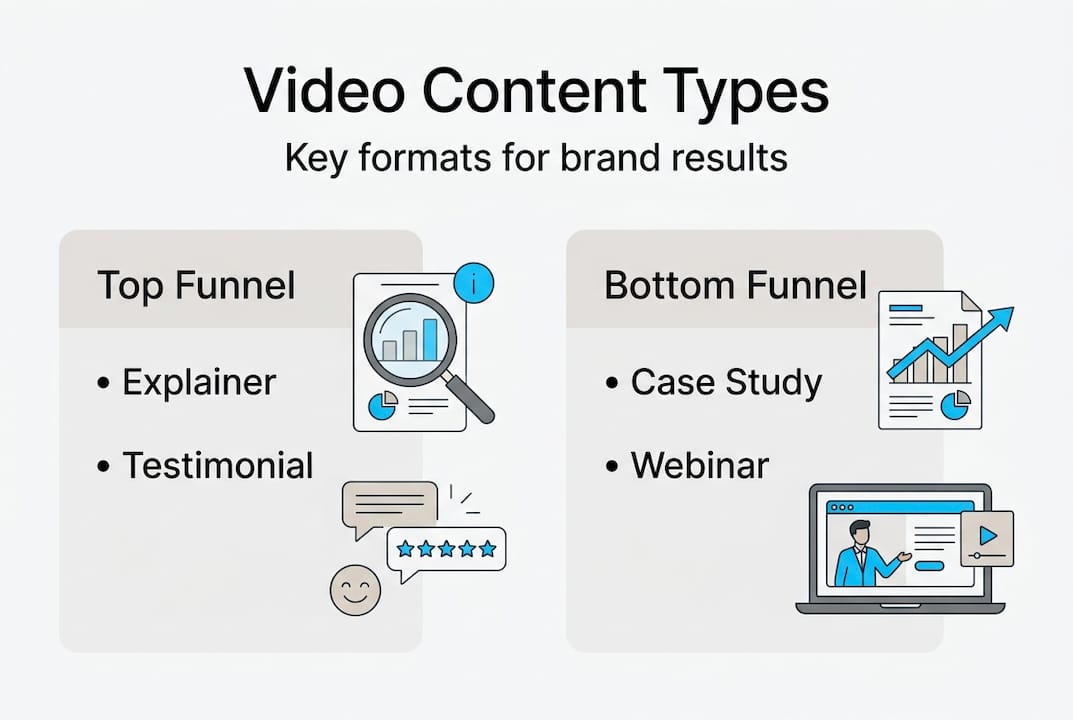
Pro Tip: When mapping video types to your content calendar, plan at least one format for each funnel stage. Brands that only invest in awareness-level video often struggle to convert the interest they generate.

You can explore the full range of explainer video types and production formats to see which aligns with your current content gaps. Also, check the latest video format trends to understand how platform algorithms are rewarding specific formats in 2026.
Choosing the right video type for your strategy
Once you know the main categories of video content, the next step is identifying which to use for your specific goals and audience. This is where many brands lose focus, chasing formats that look impressive but do not align with what their buyers actually need.
Start with your primary business objective:
- Brand awareness: Invest in short-form vertical video, brand films, and event content. These formats prioritize reach and memorability over immediate conversion.
- Lead generation: Webinars, gated case study videos, and product demos attract high-intent prospects willing to exchange contact information for value.
- Trust building: Testimonial and UGC-style videos are your strongest assets here. Authenticity signals matter more than production polish in this context.
- Nurturing and retention: Long-form educational content, behind-the-scenes videos, and personalized executive messages keep existing clients engaged and reduce churn.
Platform context shapes format decisions just as much as your goals. LinkedIn rewards professional, insight-driven content. Videos under 30 seconds on LinkedIn generate 200% higher completion rates than longer formats, making brevity a competitive advantage on that platform. Instagram and YouTube favor different length dynamics, with YouTube supporting longer educational content and Instagram prioritizing vertical short-form for discovery.
For B2B brands specifically, authenticity and trust are the currencies that matter most. Buyers are sophisticated. They can identify a sales pitch dressed as a thought leadership video. The formats that perform best in B2B are those that lead with genuine insight, real client outcomes, or transparent process visibility.
Pro Tip: Resist the urge to produce one video type and distribute it everywhere. Repurposing is smart, but adaptation is essential. A 3-minute case study video should be cut into a 30-second LinkedIn teaser, a 90-second YouTube pre-roll, and a static quote graphic for email, each optimized for its platform.
If you work with or manage video strategies for agencies, this multi-format thinking is especially valuable for client campaigns. You can also review effective corporate video tips to sharpen your execution across formats.
Maximizing results: Best practices and trends for 2026
With your video mix defined, putting best practices in place ensures maximum ROI and continued relevance as platform algorithms and viewer expectations evolve.
Prioritize authenticity, even in polished productions. UGC and creator-style content consistently outperforms highly produced ads for trust and engagement. This does not mean abandoning production quality. It means building authenticity into the narrative, the casting, and the tone, regardless of budget.
Pair short-form with long-form intentionally. Short videos create awareness and drive traffic. Long-form content converts that traffic into leads. Long-form webinars and case studies yield a 65% lead conversion rate, even with a 42% average completion rate, because the viewers who stay are highly qualified. That is the audience worth investing in.
“The brands winning in video are not the ones with the biggest budgets. They are the ones who understand that every format serves a specific job in the buyer’s journey, and they build their content ecosystems accordingly.”
Here are the execution priorities we recommend for 2026:
- Aspect ratios: Produce in 9:16 for social-first distribution and 16:9 for YouTube and website embeds. Shooting in 4K gives you flexibility to reframe for both.
- Interactivity: Add clickable CTAs, chapter markers, and embedded polls where platforms support them. Interactive video consistently lifts engagement time.
- Captions: Over 85% of social video is watched without sound. Captions are not optional. They are a baseline accessibility and engagement requirement.
- First 3 seconds: Platform algorithms and viewer behavior both reward videos that hook immediately. Your opening frame must communicate value before the viewer can scroll past.
- Consistency over volume: A predictable publishing cadence builds audience trust faster than sporadic bursts of high-volume content.
For teams looking to improve their pitch and internal buy-in process, understanding how to sell video production services internally can help you secure the budget and stakeholder alignment your video strategy needs.
An industry perspective: What most brands miss in video strategy
After more than two decades producing video for brands across industries, we have seen one pattern repeat itself: organizations invest in video formats because they are trending, not because they serve a defined strategic purpose. Chasing trends is not a strategy. It is a budget drain.
The brands that consistently outperform their competitors in video are not necessarily the ones with the largest production budgets. They are the ones who sequence their video types deliberately, mapping each format to a specific moment in the buyer’s journey and measuring outcomes at each stage.
Over-investment in production value is a real trap. We have seen brands spend heavily on cinematic brand films while neglecting the mid-funnel testimonial content that actually moves prospects to a decision. Authenticity, when stripped away by excessive polish, costs you trust.
The hardest lesson we share with clients: trust your audience data over your internal instincts. What your team thinks looks impressive and what your buyers find credible are often different things. Build a winning B2B video strategy by letting performance data guide format decisions, not assumptions.
Need expert help producing or scaling your video strategy?
Building a video content strategy that actually performs across channels requires more than a camera and a concept. It requires strategic planning, format expertise, and production experience that translates brand objectives into measurable results.
At Bonomotion, we have spent over 20 years helping organizations from startups to Fortune 100 companies develop and execute video strategies that drive real outcomes. Whether you need corporate video production for executive communications, scalable business video solutions for ongoing content programs, or full-service commercial production services for brand campaigns, our team works as a true extension of yours. Let us help you build a video content mix that connects with your audience and performs at every stage of the funnel.
Frequently asked questions
What is the most effective video content type for B2B brands?
Explainer videos and short-form vertical video lead for awareness, while long-form webinars and case studies drive high-quality lead conversions, with 65% lead conversion reported for qualifying audiences.
How long should business videos be for maximum engagement in 2026?
Under 30 seconds on LinkedIn for reach, where completions are 200% higher than longer formats; 60 to 90 seconds for most platforms; and 30-plus minutes for deep-dive content targeting qualified audiences.
Does user-generated content outperform professional videos for brand trust?
Yes. UGC and creator-style videos consistently outperform polished ads for authenticity and trust-building, particularly in social-first environments where buyers are skeptical of overt brand messaging.
Why are long-form webinars still valuable if completion rates are lower?
Despite a 42% average completion rate, long-form webinars yield 65% qualified lead conversion because the viewers who engage fully are high-intent prospects already deep in the consideration stage.