

Video audience engagement is defined as the measurable combination of attention, interaction, and conversion that video content drives across any platform or event context. The most effective ways to engage audiences with video combine purposeful storytelling, format selection matched to viewer intent, and delivery optimizations that remove friction between content and action. Wistia’s 2026 research confirms that educational videos under five minutes hold viewers through roughly half their runtime, while webinars retain over half of all attendees for the full session. Hootsuite’s data on caption impact and Social Media Examiner’s work on curiosity loops round out the core framework this article covers.
1. Ways to engage audiences with video: choose the right format first
Format is not a cosmetic decision. It determines whether your audience stays or leaves within the first three seconds.
- Educational videos and webinars hold attention best when audience intent matches content promise. Wistia’s 2026 report shows webinars retain more than half of all attendees through the entire session, a retention rate most written content cannot match.
- Short-form videos with curiosity loops (YouTube Shorts, Reels, TikTok clips) increase watch time by creating narrative tension viewers want resolved. Social Media Examiner documents how raising an unanswered question early and closing it late keeps viewers watching longer.
- Live streams drive real-time interaction through chat, reactions, and polls. Hootsuite identifies live video as the highest-engagement format on Facebook, particularly when captions are active.
- Testimonial videos placed near CTAs build trust at the decision moment. Pairing them with explainer videos on landing pages improves retention and conversions in B2B SaaS contexts specifically.
- Challenge and UGC formats on TikTok and Instagram generate community participation that extends organic reach without production overhead.
“The format you choose signals your intent to the viewer before a single word is spoken. Match the format to the moment, and engagement follows naturally.” — Bonomotion production team
The practical takeaway: map your video format to the stage in the buyer or attendee journey. Webinars serve mid-funnel education; short-form serves top-of-funnel discovery; testimonials close decisions.
2. Use storytelling structures that hold attention from frame one
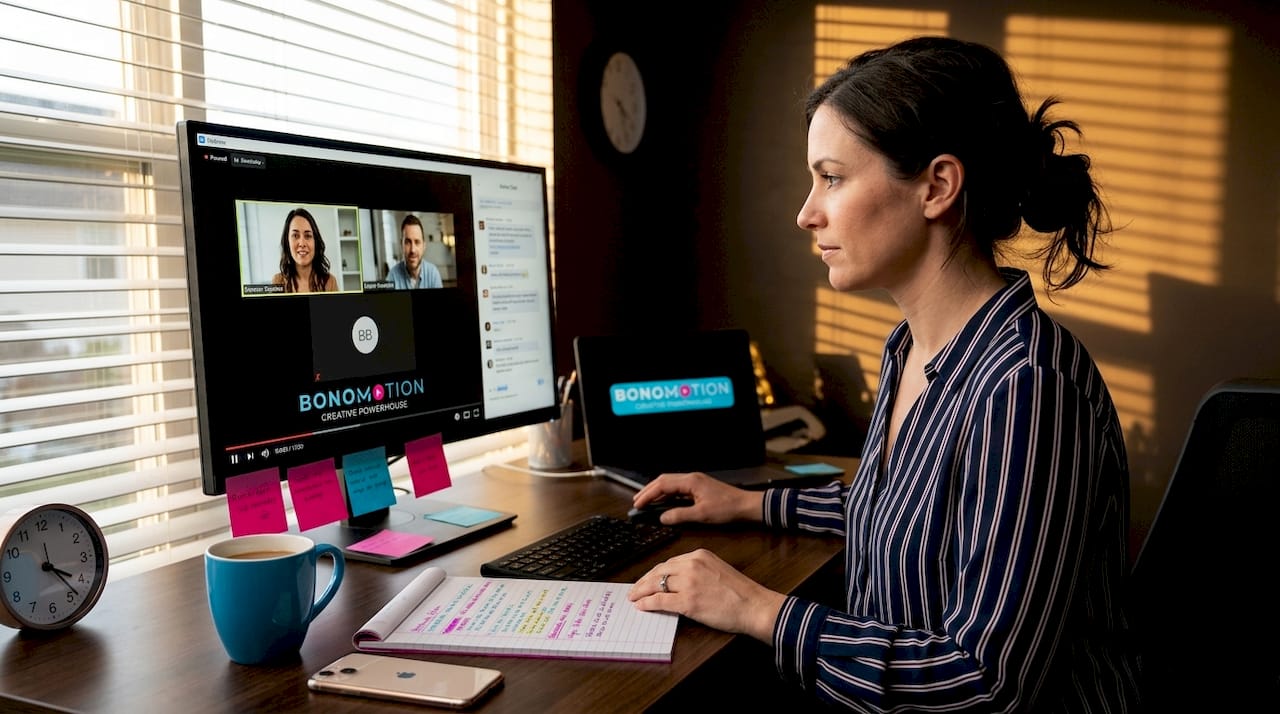
Storytelling in video is not about narrative polish. It is about engineering tension that makes leaving feel like a loss.
The most reliable structure for short-form video engagement follows three steps:
- Open with a hook that creates a knowledge gap. State a counterintuitive claim, a surprising statistic, or a direct question in the first two seconds. Social Media Examiner’s research on curiosity loops in YouTube Shorts confirms that raising an unanswered question early and resolving it late is the single most effective watch-time driver in short-form content.
- Build conflict through a problem-solution arc. Viewers stay when they recognize their own challenge on screen. Name the friction, then move toward resolution without detours.
- Delay the CTA until the payoff moment. Inserting a call to action before the narrative resolves kills momentum. Place it after the viewer has received value, not before.
For event marketers, this structure applies directly to recap videos, speaker highlight reels, and promotional content for upcoming conferences. A 60-second event promo that opens with “Here’s what most attendees miss about this conference” outperforms a generic agenda overview every time.
Pro Tip: Record a 10-second hook test before committing to a full production. Show it to three people who match your audience profile and ask whether they want to keep watching. If fewer than two say yes, rewrite the hook.
3. Add captions and optimize for muted viewing
92% of mobile viewers watch video with sound off. That single statistic reframes every production decision you make for social platforms.
Captions are not an accessibility add-on. They are the primary delivery mechanism for your message on Facebook, LinkedIn, and Instagram feeds. Hootsuite recommends captions on all Facebook video specifically to capture attention from silent browsers scrolling through their feeds. Without captions, your video competes as a silent film with no intertitles.
For event marketers distributing session clips or speaker soundbites on social media, burned-in captions (text embedded directly into the video file) outperform auto-generated platform captions in accuracy and visual consistency. Tools like Kapwing and Descript generate accurate transcripts quickly, but a human review pass before publishing catches the errors that damage credibility.
4. Place videos in formats that convert, not just formats that fit
Where and how a video appears on a page changes its conversion rate more than the video content itself in many cases.
Lightbox modal placement lifts landing page conversion from roughly 6.5% to 13%, compared to 11% for inline embedded video. That difference compounds significantly at scale. A landing page receiving 10,000 monthly visitors converts 650 more people simply by changing the video container, not the video itself.
Pro Tip: Use click-to-play with a thumbnail featuring a human face rather than autoplay. Foundry’s benchmarks confirm click-to-play outperforms autoplay on conversion, and a face in the thumbnail signals human connection before the viewer commits to watching.
The engagement curve for landing page videos peaks between 30 and 60 seconds. Producing separate short and long cuts for different audience intent levels, a 45-second version for cold traffic and a three-minute version for warm leads, optimizes performance across the funnel without requiring entirely new shoots.
| Placement type | Conversion impact | Best use case |
|---|---|---|
| Lightbox modal | ~13% conversion rate | Lead generation landing pages |
| Inline embedded | ~11% conversion rate | Product pages, blog content |
| Autoplay (muted) | Lower engagement | Brand awareness only |
| Click-to-play with face thumbnail | Highest CTR | Any conversion-focused page |
Vertical video formats produce 10 to 20% more conversions on mobile placements compared to horizontal formats. For event marketers running paid social campaigns, shooting a vertical cut during production is a low-cost decision with measurable upside.
5. Build interactive elements into live video
Live video without interaction is a broadcast. Live video with interaction is a conversation, and conversations hold attention longer.
The most effective interactive elements for live event video include:
- Live chat moderation with a dedicated host responding to questions in real time, which signals to viewers that their participation matters
- Polls and quizzes inserted at natural content breaks, which increase dwell time and give organizers data on audience knowledge and preferences simultaneously
- Reaction tracking as a real-time signal of which content segments resonate, enabling on-the-fly adjustments during multi-session events
- Q&A segments scheduled at predictable intervals so viewers stay through content they might otherwise skip
Minute-by-minute retention tracking during live events identifies the exact moments where audiences drop off or re-engage. This data is more useful than aggregate view counts because it tells you what to fix, not just that something underperformed. Attentive.live recommends tracking reaction density alongside retention curves to build a complete picture of live audience behavior.
Statistic to note: Vimeo event data shows session dwell time averaged 20 minutes at a one-day event, outperforming multi-day events. This benchmark gives event marketers a concrete target for live session design.
6. Repurpose live content to extend engagement beyond the event
The live session is the beginning of your content’s life, not the end.
Webinar replay videos continue generating views for three months after the live event, according to Wistia’s 2026 data. That long tail represents audience engagement you have already paid for in production costs. Treating webinars as upstream content systems, where repurposing is planned before the camera rolls, maximizes downstream value across every channel.
A single 60-minute conference session can yield a two-minute highlight reel for LinkedIn, five 30-second speaker clips for Instagram Reels, a written recap with embedded video for your blog, and a gated replay for lead generation. Each asset serves a different audience segment and platform norm without requiring additional shoots. This approach is particularly valuable for event marketers managing post-event content calendars with limited production budgets.
For B2B brands, the social video engagement metric is rising fastest as a success indicator, with 69% of U.S. adults taking action after seeing social posts with video. Repurposed event content feeds that pipeline directly.
7. Match your video strategy to platform norms
The same video that performs on LinkedIn will underperform on TikTok, and vice versa. Platform norms are not suggestions. They are the operating conditions your content must work within.
- LinkedIn favors B2B long-form content and short clips with professional framing. Wistia’s data shows educational content performs particularly well here because the audience arrives with professional development intent.
- TikTok rewards authentic, short UGC-style content and trend participation. Polished corporate production values often signal inauthenticity to TikTok audiences, reducing organic reach.
- Facebook prioritizes live video in its algorithm and benefits most from captions, given the platform’s high muted-viewing rate.
- YouTube supports longer educational content and benefits from curiosity loop structures that sustain watch time through the full video.
For event marketers, this means your social video strategy should specify a platform-first content plan before production begins, not after. Shooting for LinkedIn repurposing and TikTok distribution simultaneously requires different framing, pacing, and tone decisions that are far easier to make on set than in post-production.
Pro Tip: Shoot a “native” version of your key message for each platform during the same production day. A LinkedIn cut with a formal opening and a TikTok cut with an immediate hook cost almost nothing extra when planned in advance.
8. Use data to optimize, not just measure
Measurement without optimization is record-keeping. The goal is to use engagement data to make the next video perform better than the last.
Minute-by-minute retention data from live events identifies show moments that lose or gain attention, enabling micro-format testing between sessions or events. If your retention curve drops sharply at the two-minute mark of every webinar, that is a structural problem in your content design, not a random audience behavior. Fix the structure.
For event marketers using platforms like Vimeo, Wistia, or YouTube Studio, heatmap data shows exactly where viewers rewatch, skip, or exit. Rewatched segments are your strongest content. Skipped segments are candidates for removal or restructuring in future productions. This feedback loop, applied consistently, compounds into measurably better video content performance over time.
9. Prioritize authentic connection over production perfection
Video quality with authentic human connection is increasingly valued over generic polish, reflecting a clear cultural shift in 2026 audience expectations. Viewers across every platform are developing strong pattern recognition for content that feels manufactured versus content that feels real.
This does not mean low production values are acceptable. It means that a perfectly lit, color-graded video featuring a speaker who sounds scripted will underperform against a slightly less polished video where the speaker speaks with genuine conviction and specific knowledge. For event marketers, this translates directly to speaker coaching and pre-production preparation. The camera captures authenticity or its absence with equal precision.
Combining authentic delivery with professional production, the approach Bonomotion has refined across two decades of corporate and event video work, produces content that holds attention because it earns trust. That combination is the foundation of every effective video engagement strategy.
Key takeaways
Effective video audience engagement requires matching format to viewer intent, optimizing delivery placement, and using data to continuously improve content performance.
| Point | Details |
|---|---|
| Format drives retention | Match video format to audience intent: webinars for education, short-form for discovery, testimonials for conversion. |
| Captions are non-negotiable | 92% of mobile viewers watch with sound off; burned-in captions protect your message on every platform. |
| Placement changes conversion | Lightbox modal placement nearly doubles landing page conversion compared to inline embedding. |
| Live interaction extends dwell time | Polls, chat, and quizzes increase dwell time and provide real-time optimization data. |
| Repurpose every live session | Webinar replays generate views for three months post-event; plan repurposing before the camera rolls. |
What I’ve learned after 20 years of event video production
The most common mistake I see event marketers make is treating video as a deliverable rather than a system. They produce a highlight reel, post it once, and move on. The production budget gets spent, the content gets one cycle of distribution, and the ROI conversation becomes uncomfortable.
What actually works is treating every live event as a content production day with a repurposing plan already mapped out. When you walk into a conference knowing you need a 90-second LinkedIn recap, five speaker clips, and a gated replay for lead generation, the entire shoot changes. Camera placement, interview framing, and session coverage decisions all improve because you know what you are building toward.
The other thing I would push back on is the idea that more polish equals more engagement. I have seen Fortune 100 companies produce technically flawless videos that generated almost no interaction, and I have seen a founder’s unscripted two-minute walkthrough of a product problem generate thousands of comments. The difference was not production value. It was specificity and conviction. Viewers respond to someone who clearly knows what they are talking about and cares about the outcome.
My honest recommendation: invest in pre-production preparation and post-production distribution planning at least as much as you invest in the shoot itself. The camera day is the middle of the process, not the whole thing.
— Bernard
Take your event video further with Bonomotion
Bonomotion has been producing high-impact corporate and event video since 2003, working with startups, growing brands, and Fortune 100 companies across Florida and nationwide. We understand that engagement does not happen by accident. It is the result of deliberate format choices, production decisions, and distribution strategies working together.
Whether you need live event streaming that captures real-time audience interaction or a full suite of corporate video solutions built around your conference or brand campaign, our producers work directly with your team from pre-production through final delivery. Every project is guided by an experienced producer who understands your objectives, your audience, and your timeline. Let’s build video content that your audience actually watches.
FAQ
What are the most effective video formats for audience engagement?
Educational videos and webinars hold attention best when audience intent matches content, with Wistia’s 2026 data showing over half of webinar attendees stay for the full session. Short-form videos with curiosity loops and live streams with interactive elements also rank among the top-performing formats.
How long should a video be to maximize engagement?
The engagement curve for landing page videos peaks between 30 and 60 seconds for cold traffic, while webinars and educational content can sustain attention for much longer when the content matches audience expectations. Produce separate short and long cuts to serve different audience intent levels.
Does video placement on a landing page affect conversions?
Lightbox modal placement converts at roughly 13% compared to 11% for inline embedded video, according to Foundry’s 2026 benchmarks. Click-to-play with a human face thumbnail consistently outperforms autoplay on conversion-focused pages.
How do you measure live video engagement effectively?
Minute-by-minute retention tracking and reaction density metrics, as recommended by attentive.live, provide far more useful data than aggregate view counts. These metrics identify the exact content moments where audiences drop off, enabling targeted improvements for future sessions.
What is the best way to repurpose event video content?
Plan repurposing before the event shoots, not after. A single 60-minute session can produce a LinkedIn highlight reel, multiple short-form social clips, a blog embed, and a gated replay asset. Wistia data confirms webinar replays continue generating views for three months after the live event.