

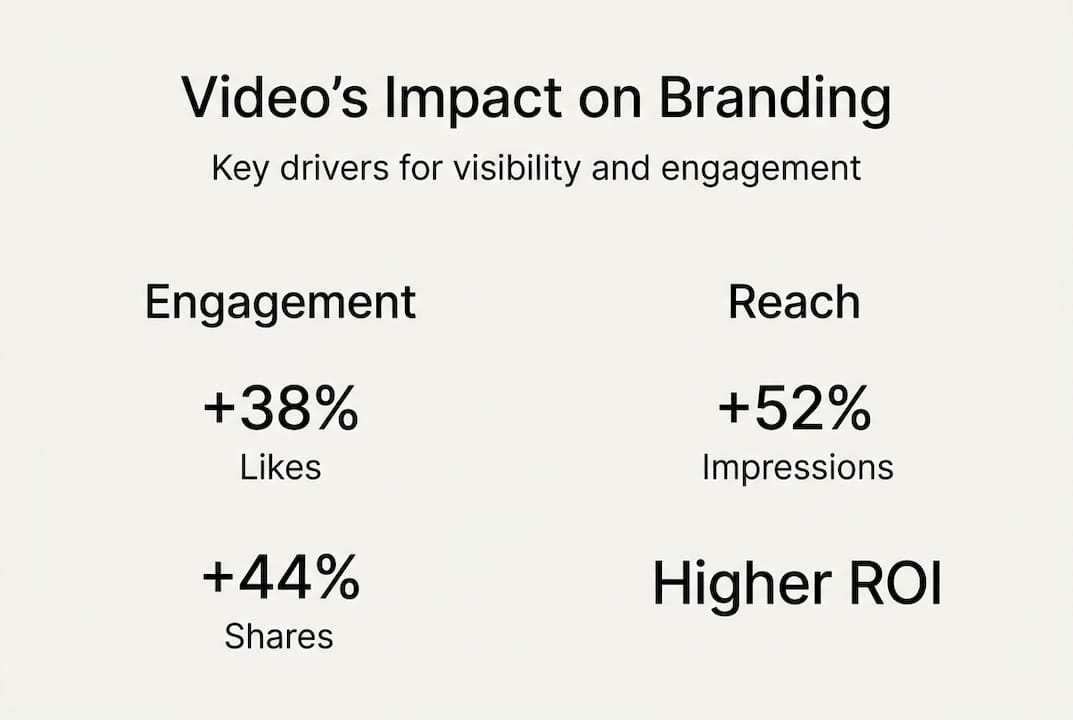
Video is no longer a nice-to-have for your marketing strategy. It’s the engine behind measurable brand growth. Video boosts brand engagement by 38% when leveraged with modern AI tools, while impressions climb by 52% and brand recall improves by 33%. For marketing directors and brand strategists in South Florida’s crowded competitive market, those numbers represent a real strategic advantage. Whether you’re leading a mid-sized firm in Brickell or managing brand presence for a regional enterprise, understanding how video works and why it outperforms static content is the clearest path to measurable visibility gains.
Table of Contents
- Why video transforms brand visibility and engagement
- The mechanics: Storytelling, emotional hooks, and consistent branding
- Tactics: Guidelines, platforms, and authentic adaptation
- Maximizing impact: Distribution strategies and measuring what matters
- Why the best branding videos ignore perfection and prioritize authenticity
- Elevate your brand’s reach with expert video production
- Frequently asked questions
Key Takeaways
| Point | Details |
|---|---|
| Video outperforms static media | Videos deliver much higher brand engagement, recall, and ROI than static content. |
| Emotion and consistency build trust | Storytelling and a recognizable visual style make brands memorable and credible. |
| Short-form wins for recall | Brief, authentic videos deliver the strongest impact on brand awareness and audience retention. |
| Success needs strategy and measurement | Brands must build guidelines, adapt for each platform, and measure ROI to see real results. |
Why video transforms brand visibility and engagement
Now that we’ve set the stage for video’s influence, let’s dig into the core reasons why video outperforms traditional branding approaches.
The numbers are hard to argue with. 91% of businesses now use video marketing, 93% of marketers report strong ROI from it, and 89% say they want more branded video content produced. These aren’t vanity metrics. They reflect a fundamental shift in how audiences absorb brand information and make purchasing decisions.
Video outperforms static content across every major branding metric. The table below shows what consistent, strategic video delivers:
| Metric | Impact with video |
|---|---|
| Brand engagement | +38% |
| Impressions | +52% |
| Shares and likes | +44% |
| Brand recall | +33% |
| B2B buyer trust | 93% influenced by video |
What those numbers represent in practice is this: when your audience sees your brand move, speak, and tell a story, the connection formed is far stronger than what a banner ad or a PDF brochure can create. Trust builds faster. Consistent branding increases revenue by 10 to 20%, and video is the most powerful tool available to reinforce that consistency at scale.
For industries where trust is the product, this matters enormously. Look at how video in professional services reshapes audience perception in sectors like law, finance, and consulting. The same logic applies to every brand competing for attention in South Florida’s dynamic market.
A few core reasons why video accelerates brand visibility:
- Shareability: Video is shared 12 times more often than text and images combined
- Algorithm favorability: Every major social platform prioritizes video in organic reach
- Emotional retention: Viewers retain 95% of a message delivered through video vs. 10% through text
- Cross-channel adaptability: One video asset can fuel content across six or more channels
“Video has become the default trust signal for B2B buyers. If a brand can’t show you who they are, buyers move on.” This reality shapes every video production strategy we develop for clients across South Florida.
The brands winning in 2026 treat video not as a campaign element but as a core brand infrastructure layer. That shift in mindset is where competitive advantage begins. A case study on video engagement growth shows how brands that committed to consistent video production saw compounding gains in visibility and audience loyalty within months, not years.
The mechanics: Storytelling, emotional hooks, and consistent branding
With the big-picture benefits clear, let’s break down what makes video the powerhouse mechanism for branding.
Great brand video is not about production cost. It’s about emotional architecture. Emotional storytelling, human elements, and expert features drive recall and engagement far more reliably than slick visuals alone. When your audience sees real people, real problems being solved, and a brand voice that feels consistent and credible, that’s when loyalty forms.

Consistency in your visual identity is not optional. Your logo placement, color palette, typography, and motion guidelines need to show up uniformly across every video asset. This is what transforms individual pieces of content into a recognizable brand ecosystem. Motion branding best practices show that brands with defined motion guidelines see significantly higher recall than those producing ad-hoc video.
Here’s how different video formats map to specific branding objectives:
| Video type | Best for | Branding objective |
|---|---|---|
| Short-form (under 60 sec) | Social platforms | Awareness and reach |
| Long-form (2 to 10 min) | YouTube, LinkedIn | Loyalty and depth |
| Testimonials | Website, ads | Trust and conversion |
| Behind-the-scenes | Instagram, TikTok | Authenticity and relatability |
| Executive thought leadership | Authority and credibility |
Short-form video excels for top-of-funnel brand awareness. Long-form content builds the kind of depth that turns casual followers into loyal customers. Smart brands use both, guided by branded video frameworks that align format to audience intent at each stage of the funnel.
A few elements every brand video should include:
- A clear, recognizable visual identity from the first frame
- A human story or relatable scenario that mirrors the audience’s experience
- A consistent brand voice in narration, on-screen text, or dialogue
- A specific call to action tied to a measurable outcome
Pro Tip: Your first 30 seconds are everything. Research shows 33% of viewers drop off within the first 30 seconds if the opening fails to deliver value immediately. Cut the slow intros. Lead with the hook. Whether it’s a surprising stat, a bold question, or a visual that stops the scroll, your opening must earn the next 60 seconds. Review impactful corporate video tips to see how this plays out in real brand scenarios.
Effective brand marketing video strategies also account for audience context. A LinkedIn viewer expects different pacing and tone than a TikTok user. Your core story can stay the same, but the delivery must match the platform’s native behavior.
Tactics: Guidelines, platforms, and authentic adaptation
Understanding the mechanics, let’s move into concrete steps your team can execute to see this impact firsthand.
Building a video branding system starts with documented guidelines. Without them, every new video risks inconsistency that erodes brand recognition. Here’s a practical sequence to follow:
- Define your visual identity for video: Logo usage, color grading, lower-thirds style, and font choices
- Establish your brand voice and tone: Narration style, music selection, and on-camera talent guidelines
- Specify platform requirements: Aspect ratios, video length, caption rules, and thumbnail standards per channel
- Create a CTA framework: Standardize how each video ends based on audience and funnel stage
- Build a repurposing workflow: Map how one hero video becomes clips, ads, stories, and email assets
Video branding guidelines should also specify how to measure performance, covering views, watch time, click-through rate, return on ad spend, and brand lift surveys for larger campaigns.
Platform-specific adaptation is where many brand teams lose ROI. The same video published natively on four platforms with no adaptation will underperform. Here’s a quick reference:
| Platform | Ideal length | Format | Key metric |
|---|---|---|---|
| 1 to 2 min | Landscape or square | Shares and comments | |
| 15 to 30 sec | Vertical or square | Saves and reach | |
| TikTok | 15 to 60 sec | Vertical | Watch time and follows |
| YouTube | 5 to 12 min | Landscape | Watch time and subscribers |
Brand awareness is the top goal for 52% of video marketers, and short-form consistently delivers the highest ROI for that objective. Use corporate video creation tips to inform how you structure your long-form anchor content before slicing it into platform-specific assets.
Pro Tip: Hook viewers in the first second. Data shows 40% of viewers decide within the opening second whether to keep watching. That means your first frame is not a title card, it’s your best visual or most arresting statement. Teams working with video production for agencies understand this discipline and build it into every pre-production brief.
Tracking ROI is non-negotiable. Use a dashboard that monitors video marketing metrics like ROAS, brand lift, and engagement rate by platform to give stakeholders the visibility they need to justify continued investment.
Maximizing impact: Distribution strategies and measuring what matters
Having established core tactics, let’s look at how top brands push ROI and visibility to the next level with smart distribution and measurement.
Producing great video is only half the equation. Where and how you distribute it determines whether your investment compounds or stalls. The brands seeing outsized results combine organic publishing with paid amplification, influencer partnerships, and employee advocacy to multiply reach without multiplying production costs.
Video posts on LinkedIn get 20x more shares than other content types, and cultural coding within video boosts engagement by 111%, while human touch elements lift it by 78% and expert features by 40%. For B2B brands, LinkedIn is not a secondary channel. It’s often where the highest-value audience segments live.
The KPIs that matter for brand video performance:
- Views and unique reach: Baseline for brand awareness coverage
- Watch time and completion rate: Indicator of content relevance and quality
- Shares and saves: Strongest signal of resonance and advocacy
- Click-through rate: Measures direct audience response and intent
- Brand lift: Measured through surveys; tracks shifts in awareness and perception
- Return on ad spend: Connects video investment to revenue outcomes
Brands that measure brand lift alongside ROAS see a more complete picture of how video shapes buying behavior over time, not just within a single campaign window.
Video ads outperform static: Meta CTR +100%, ROAS improves by 50%, and TikTok cost-per-click drops by 62% when video replaces static creative. These are not marginal gains. They represent a structural performance advantage for brands willing to commit to video-first paid media.
For your distribution mix, consider:
- Paid social amplification of your highest-performing organic videos
- Employee advocacy programs that extend organic LinkedIn reach
- Influencer co-productions targeting South Florida audience segments
- Email video thumbnails that lift open-to-click rates by up to 65%
Strong B2B video marketing strategies account for both the awareness phase and the nurture phase, using different formats and channels at each stage. Teams that leverage video for business growth build a content calendar that maps assets to funnel stage, ensuring distribution is intentional rather than reactive. Develop your B2B video content with distribution in mind from day one, not as an afterthought.
Why the best branding videos ignore perfection and prioritize authenticity
Even with all the frameworks above, many teams stumble on execution. Here’s a perspective you won’t often hear from agencies or software vendors.
Perfection is the enemy of presence. We’ve seen brands invest significant budgets in highly produced brand films that sit on a website and collect dust, while a 90-second founder story filmed on an iPhone generates thousands of shares and real sales conversations. The difference isn’t production quality. It’s relatability and timing.
Consistency beats excellence every time in branding. A brand that publishes two authentic videos per week for six months will outperform a brand that releases one cinematic masterpiece per quarter. Audiences need repetition to build recall, and they need to see real humans to build trust.
The uncomfortable truth is that over-produced content can actually signal inauthenticity to modern audiences. It feels like a commercial, and people skip commercials. The videos that build real brand equity feel like a conversation. They’re direct, specific, and human. Review what goes into impactful corporate videos and you’ll notice the throughline is always authenticity, not production value for its own sake. Your next brand video doesn’t need to be perfect. It needs to be true.
Elevate your brand’s reach with expert video production
If your team is ready to turn these frameworks into real results, Bonomotion has been doing exactly that for brands across South Florida since 2003.
From corporate video production to commercial video production services, we build video assets with your brand strategy at the center, not as an afterthought. Every project is led by an experienced producer who works directly with your team to align on objectives, audience, and timeline. If you’re ready to explore what a strategic video program looks like for your brand, our business video solutions are a strong starting point for the conversation.
Frequently asked questions
What types of videos are most effective for brand engagement?
Short-form video has the highest ROI for brand awareness, while story-driven and testimonial formats excel at building trust and recall across the full funnel.
How can I measure ROI on branding videos?
Track views, watch time, click-through rate, ROAS, and brand lift to build a complete picture of video performance. Measuring via these metrics gives stakeholders the evidence they need to sustain investment.
Why does authentic video outperform polished productions?
Authentic videos foster trust through relatable storytelling. Human touch boosts engagement by 78%, making genuine content more effective than impersonal, highly polished productions.
How often should we publish brand videos?
Consistency matters more than volume. Consistent branding increases revenue by 10 to 20%, and regular video publishing reinforces audience recall far more effectively than sporadic high-production releases.