

Most corporate event planners invest heavily in the shoot itself, booking top camera crews, securing great venues, and scripting executive messaging down to the minute. Yet the phase that actually determines whether that footage becomes a polished, on-brand asset is post-production, and the person steering it is often the last hire on the list. A skilled post-production supervisor is the difference between a project that lands on time, on budget, and on message, and one that quietly unravels after the cameras stop rolling. This guide breaks down the post-production supervisor role completely so you can make smarter decisions for every media project you manage.
Table of Contents
- What does a post-production supervisor really do?
- Core methodologies and workflow planning
- Handling complexities and edge cases in post-production
- Creative versus logistical: The balance in supervision
- Practical strategies for corporate event planners
- The post-production supervisor: More than a project manager
- Work with expert post-production supervisors for your projects
- Frequently asked questions
Key Takeaways
| Point | Details |
|---|---|
| Crucial coordination role | Post-production supervisors align creative vision, schedules, and budgets to ensure projects run smoothly. |
| Tools drive efficiency | Using modern project management and collaboration tools streamlines processes for both events and film projects. |
| Early involvement benefits | Bringing supervisors on early helps prevent costly mistakes and ensures effective resource planning. |
| Balance of skills needed | A successful post-production supervisor balances logistical expertise with creative judgment, especially in corporate contexts. |
| Adaptable for events | Supervision methods can be streamlined for faster corporate event turnarounds while maintaining quality. |
What does a post-production supervisor really do?
The title sounds administrative, but the reality is far more demanding. A post-production supervisor (PPS) is the central coordinator who keeps every moving part of the editing, sound, color, and delivery pipeline running in sync. They are accountable for outcomes, not just tasks.
Their day-to-day responsibilities span a wide range of project types, from feature films and broadcast TV to corporate event videography insights that require tight turnarounds and brand-specific deliverables. Regardless of format, the core mandate stays consistent.
A PPS oversees all post-production phases, including editing, sound design, VFX, and color grading, ensuring alignment with the creative vision, deadlines, and budgets set at the project’s outset. That single sentence contains an enormous amount of operational weight.
Here is what that looks like in practice:
- Workflow planning: Mapping every stage from raw footage ingest to final delivery, including buffer time for revisions
- Team coordination: Briefing editors, colorists, sound designers, and VFX artists so everyone works from the same version of the project
- Budget oversight: Tracking spend against approved line items and flagging variances before they become problems
- Quality control (QC): Reviewing outputs at each stage to catch technical errors, continuity issues, or brand inconsistencies
- Delivery management: Packaging final files in the correct formats and specs for each distribution channel
“The post-production supervisor is the glue between creative ambition and practical execution. Without that role, even the best footage can get lost in a disorganized pipeline.”
To understand how these responsibilities connect, consider the post-production workflow explained in detail, which shows how each stage feeds into the next. For corporate event planners, the key insight is that a PPS is not a luxury. They are the person who protects your investment once the shoot wraps.
| Responsibility | Film/TV context | Corporate event context |
|---|---|---|
| Workflow planning | Multi-month schedules | Days to weeks post-event |
| Budget tracking | Large, complex budgets | Tighter, fixed budgets |
| QC reviews | Multiple rounds | Streamlined, faster cycles |
| Delivery formats | Theatrical, broadcast | Web, social, internal screens |
Core methodologies and workflow planning of the Post-Production Supervisor Role
Knowing what a PPS does is one thing. Understanding how they do it is where the real value becomes clear for your planning process.
The post-production workflow follows a structured sequence: data management and backup, editorial assembly, picture lock, sound design and mix, color grading, VFX integration, QC, and final delivery. Each stage has dependencies, meaning a delay in one area cascades forward.
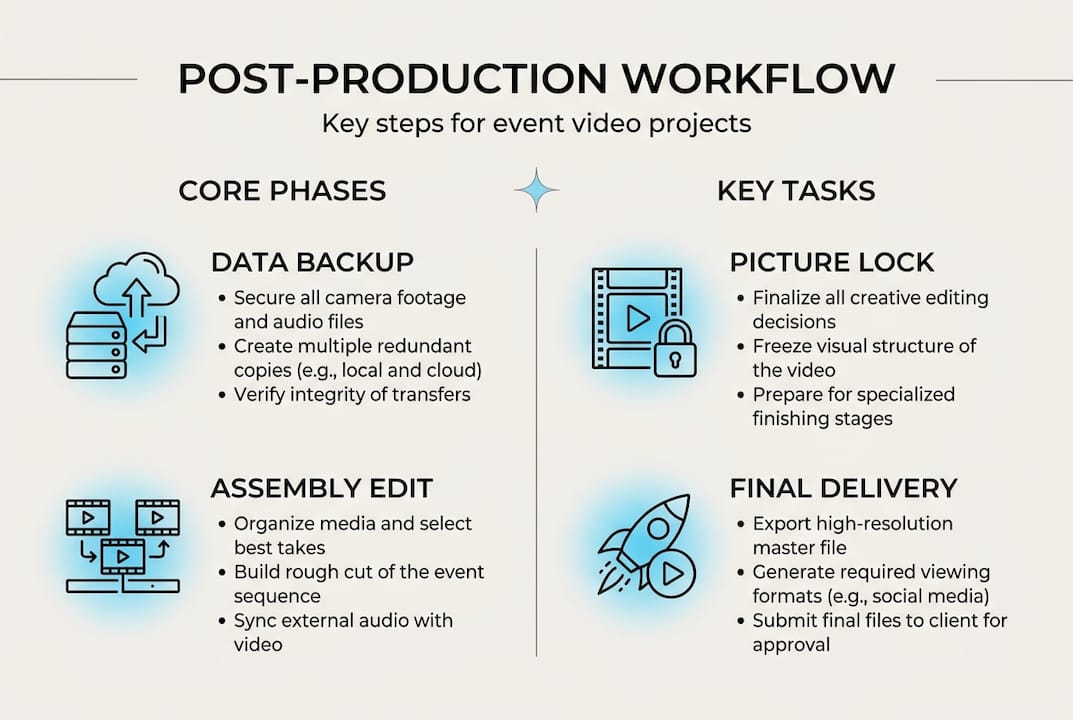
Key methodologies used by experienced supervisors include workflow planning with tools like Asana and Trello, detailed scheduling, budget tracking, team coordination, dailies management, quality control checks, and dedicated project management software. These are not optional extras. They are the operational backbone of any well-run post-production process.
For corporate event scenarios specifically, the workflow adapts to faster timelines. A conference highlight reel may need to be published within 24 to 48 hours. That compression requires the PPS to have systems already in place before the event begins.
Here is a practical numbered sequence for event-focused post-production:
- Pre-event: Establish folder structures, naming conventions, and delivery specs
- Day-of: Coordinate with on-site crew for fast media offload and backup
- Day one post: Begin rough assembly while QC checks raw footage
- Day two to three: Lock edit, begin sound and color passes
- Day four to five: Final QC, client review via Frame.io, revisions
- Delivery: Export in all required formats and distribute
Using video production scheduling tips from the outset helps your team align on realistic timelines before the event date is locked. Similarly, planning corporate event video production well in advance gives the PPS the runway they need to build a tight workflow.
For project management in post, dedicated tools purpose-built for production teams outperform generic software because they account for media-specific tasks like proxy workflows and version control.
Pro Tip: Ask your PPS to share their project management board with you during production. Visibility into task status reduces the number of check-in calls and keeps everyone accountable without micromanaging.
Handling complexities and edge cases in post-production
Even the most organized production hits unexpected turbulence. The PPS is the person who keeps the project from going off the rails when it does.
Complex projects introduce layers that standard workflows cannot anticipate. Animation sequences, multi-camera event coverage, and heavy VFX all require additional coordination loops. Legal clearances for music, archival footage, and on-screen talent add another layer of administrative responsibility that falls squarely on the supervisor’s plate.

Managing reshoots for VFX, legal clearances, multi-project handling, stressful coordination, and early flagging of costly shoot issues are all core competencies of a seasoned PPS. An experienced supervisor typically manages three to four projects per year at the complex end of the scale, which builds the pattern recognition needed to spot problems early.
For corporate event planners, the most common edge cases include:
- Speaker footage with audio issues requiring ADR (automated dialog replacement) or cleanup
- Branding inconsistencies discovered in lower thirds, logos, or slide captures during QC
- Last-minute content additions from executives that require re-editing after picture lock
- Music licensing gaps that could delay delivery or create legal exposure
- Multi-location shoots where footage quality varies significantly between camera operators
The quality control process in film is rigorous for a reason. Even minor technical errors can undermine the credibility of a polished production. For corporate event video, the stakes are equally high because the audience is often internal stakeholders or high-value clients.
Understanding event production challenges before they arise is the mark of a prepared supervisor. The best PPS professionals do not just react to problems. They build contingency time into the schedule so that when issues surface, there is room to address them without blowing the deadline. Reviewing event video coverage best practices also helps align expectations between the production team and the client before post begins.
Pro Tip: Before your event, ask your PPS to run a risk assessment on the post-production plan. Identifying the three most likely failure points in advance gives you a response strategy rather than a scramble.
Creative versus logistical: The balance in supervision
There is an ongoing debate in production circles about whether the PPS role is fundamentally logistical or genuinely creative. The honest answer is that it depends on the project, and the best supervisors are fluent in both.
Contrasting viewpoints exist on this question. Some argue the PPS is primarily a logistics coordinator who ensures the creative team has what they need. Others see the role as requiring active creative judgment, particularly when editorial decisions affect pacing, storytelling, or brand tone.
“The most effective post-production supervisors we’ve worked with know when to protect the creative vision and when to make the practical call that keeps the project moving.”
For corporate event video, the balance tips toward logistics more than it does in narrative film. Your deliverables are defined, your brand guidelines are fixed, and your timeline is non-negotiable. But creative judgment still enters the picture in meaningful ways:
- Deciding which speaker moments carry the most impact in a highlight reel
- Recommending a color grade that reinforces brand identity without looking over-processed
- Advising on pacing so that a 90-second recap holds attention rather than feeling rushed
- Flagging when a script-driven video needs structural changes to land emotionally
For business video solutions, the PPS who understands your brand as well as your budget is the one who adds the most value. The logistical and creative dimensions are not in competition. They are interdependent. A supervisor who only manages tasks without creative awareness produces technically correct but flat content. One who prioritizes creative instincts without operational discipline misses deadlines.
The expert nuance in post-production supervision lies in reading the project correctly and knowing which mode to lead with at each stage.
Practical strategies for corporate event planners
With the full picture of the PPS role in view, here are the most actionable steps you can take to get better outcomes on your next production.
Hire your PPS early for media projects, mirror film and TV efficiency, focus on dailies QC, budget and schedule alignment, and use tools like Frame.io, Asana, and cloud-based platforms to keep teams connected. Early involvement is the single highest-leverage decision you can make.
- Bring the PPS in at least four weeks before the shoot date
- Share your brand guidelines, delivery specs, and stakeholder approval chain upfront
- Require a written post-production schedule before production begins
- Use a cloud review tool so feedback is tracked and version-controlled
To elevate your event with video that actually serves your business goals, the post-production supervisor is your most important hire after the director.
Pro Tip: Build a post-production brief the same way you build a production brief. Define your deliverables, deadlines, review rounds, and approval contacts before the first frame is shot.
The post-production supervisor: More than a project manager
Here is what most event planners still underestimate: the PPS is not a glorified task manager. They are the person who holds the creative and operational tension of a project together when everything is moving fast and the stakes are high.
We have seen productions where the shoot went flawlessly, the footage was exceptional, and the final video still fell flat because no one was stewarding the post process with intent. Missed QC passes, unclear feedback loops, and last-minute format changes all erode the quality of the final product in ways that are hard to trace back to a single decision.
The future of this role is also shifting. Cloud-based workflows, AI-assisted editing tools, and remote collaboration platforms are adding new complexity to an already demanding job. The PPS of 2026 needs to manage not just people and timelines, but also technology ecosystems that change rapidly.
For corporate event video mastery, the takeaway is straightforward: invest in strong post-production supervision early, give your supervisor the authority to flag problems, and treat their workflow plan as a living document that the whole team respects. That combination consistently produces better outcomes than any amount of expensive gear or talent on set.
Work with expert post-production supervisors for your projects
At Bonomotion, every project we take on is guided by an experienced producer who functions as your post-production anchor from day one. We apply the same proven supervisory practices used in high-end film and broadcast production to corporate events, executive messaging videos, and multi-day conference coverage.

Our team manages workflow planning, QC, team coordination, and final delivery so you never have to chase down a status update or wonder if your deadline is at risk. Whether you need corporate video production in Hollywood or a full suite of business and corporate video solutions, we operate as a true extension of your organization. Reach out to discuss your next project and see what structured, expert-led post-production supervision can do for your results.
Frequently asked questions
Does every corporate video project need a post-production supervisor?
Small, single-camera videos may not require a dedicated supervisor, but any project involving multiple shoots, deliverables, or stakeholders benefits significantly from one. As supervisor role complexity grows, the value of dedicated oversight increases proportionally.
How early should a post-production supervisor be brought onto a project?
The most effective supervisors are involved at least one month before filming begins, giving them time to plan schedules, set budgets, and build the workflow before production pressure kicks in.
What tools do post-production supervisors use for event media projects?
Common tools include Asana, Trello, and Frame.io for project management, review, and team communication, along with cloud storage platforms for media sharing and version control.
Is post-production supervision more important for film than for corporate event videos?
Both formats require supervision, but the approach differs. Streamlined film workflows adapted for corporate events still benefit from a supervisor who ensures speed and quality are not traded off against each other.
How does a supervisor manage multiple projects at once?
Experienced supervisors use standardized workflows, delegation, and task-specific software to handle three to four projects per year at the complex level, maintaining quality by building repeatable processes rather than reinventing the wheel each time.