

Not all social video performs equally. TikTok’s median engagement rate sits at 4.25%, more than twice Instagram’s 1.81%, while YouTube and LinkedIn hold steady at 3.06% and 2.94% respectively. These gaps aren’t random. They reflect how platform design, audience behavior, and content strategy interact. For marketing managers investing real budget into video, posting without a deliberate framework means accepting unpredictable results. This guide walks you through a proven, step-by-step approach to social video strategy, covering goal setting, platform-specific creative, engagement tactics, and algorithm dynamics so your team can produce less guesswork and more measurable impact.
Table of Contents
- Laying the groundwork: Setting goals and defining the audience
- Crafting platform-based content: Formats, length, and creative strategy
- Mastering hooks, captions, and engagement-boosting techniques
- Audience dynamics and platform algorithms: The engagement game
- A new way to win: Rethinking conventional wisdom in social video
- Level up your social video strategy with expert production
- Frequently asked questions
Key Takeaways
| Point | Details |
|---|---|
| Set goals first | Clarity on business and video goals leads to higher-performing content across platforms. |
| Tailor for platforms | Optimizing content length, format, and strategy for each platform radically boosts engagement. |
| Master the first seconds | Hooks in the opening moments are essential for capturing viewers before they scroll. |
| Small beats big for engagement | Smaller, authentic accounts consistently achieve better engagement than large ones in 2026. |
| Test, learn, and refine | Continuous analysis and iteration ensure social video strategies stay effective as platforms evolve. |
Laying the groundwork: Setting goals and defining the audience
Every strong social video strategy begins before a single frame is captured. The first step is reverse-engineering your business objective into a video goal. Are you building brand awareness at the top of the funnel, nurturing consideration in the middle, or driving conversions at the decision stage? Each requires a different content approach, and mixing them without clarity leads to messaging that does neither well.
Audience profiling is equally critical. You need to know not just who your ideal customer is, but where they actually watch video. Platform demographics shift frequently, so keep current data in your planning cycle.
| Platform | Primary age group | Dominant use case |
|---|---|---|
| TikTok | 18–34 | Entertainment, discovery |
| 25–44 | Lifestyle, brand following | |
| 30–55 | B2B, professional development | |
| YouTube | 18–54 | Education, long-form content |
| 35–65 | Community, local, events |
Matching your business type to the right platform saves significant budget. B2B brands consistently see stronger ROI on LinkedIn, while B2C brands in retail, food, or lifestyle tend to grow faster on Instagram and TikTok. Aligning social video for your market requires knowing where your audience already spends time, not where you think they should be.
Before production begins, answer these questions as a team:
- What specific business result does this video campaign need to drive?
- Which platform will reach the highest concentration of our ideal buyer?
- What format does that platform reward most: short-form, long-form, or live?
- How will we measure success beyond views and likes?
- What call to action moves the viewer toward the next step?
A well-documented effective B2B video content plan aligned to your funnel stages removes guesswork before the camera rolls. The core strategy steps include setting funnel-aligned goals, choosing platforms deliberately, defining brand themes, batch producing content, and tracking completion rates as a primary KPI.
Pro Tip: Assign one primary metric per campaign before production starts. Completion rate signals content quality. Click-through rate signals offer strength. Choosing one north star keeps your team focused and your reporting honest.
Crafting platform-based content: Formats, length, and creative strategy
With goals and audience set, next comes matching your creative to each platform’s strengths. This is where most teams make their biggest strategic error: creating one version of a video and distributing it everywhere. Platform-native content consistently outperforms repurposed content because each platform rewards different behaviors.
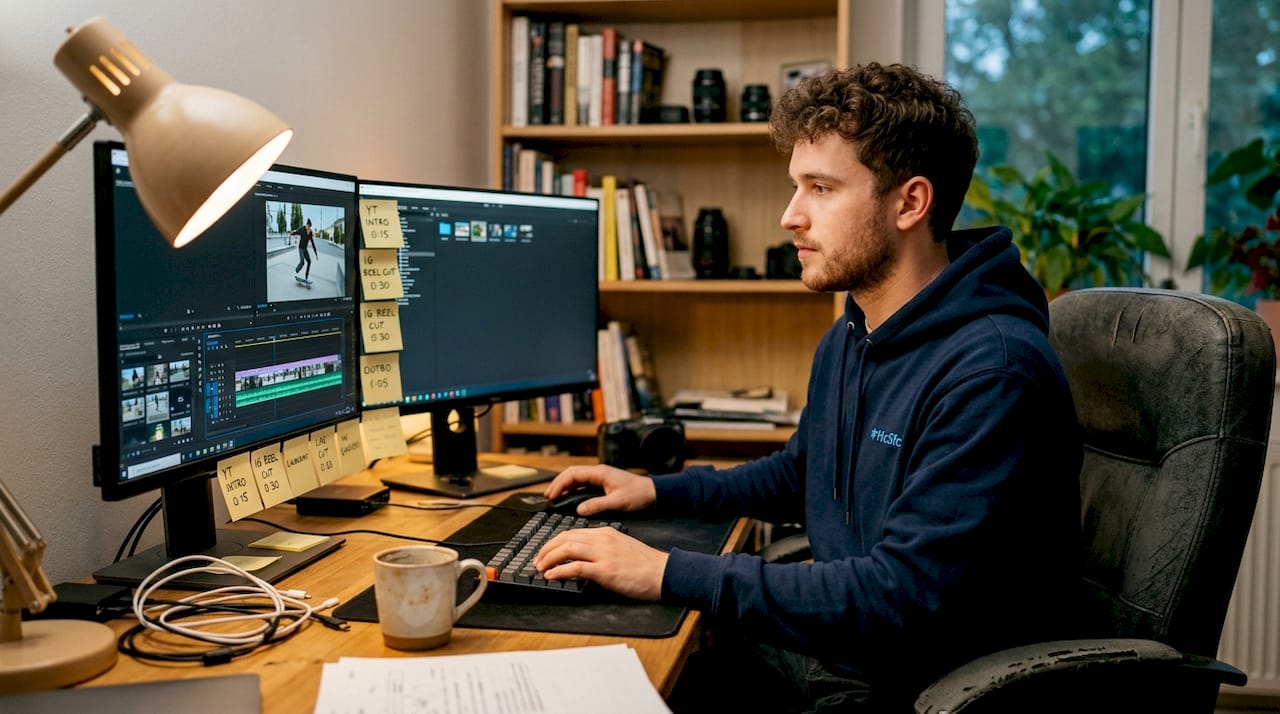
Optimal video lengths vary significantly by platform. Instagram Reels perform best at 60–90 seconds, Facebook Reels at 90–120 seconds, and both TikTok and LinkedIn support up to 2 minutes for content that delivers real depth.
| Platform | Best format | Optimal length | Key creative note |
|---|---|---|---|
| Reels, Carousels | 60–90 seconds | Hook in first 2 seconds | |
| Reels, Live video | 90–120 seconds | Community and storytelling | |
| TikTok | Native vertical video | Up to 2 minutes | Authenticity over polish |
| Native video, posts | Up to 2 minutes | Insight-driven, professional | |
| YouTube | Long-form, Shorts | 8–15 minutes / 60s | Search-optimized titles |
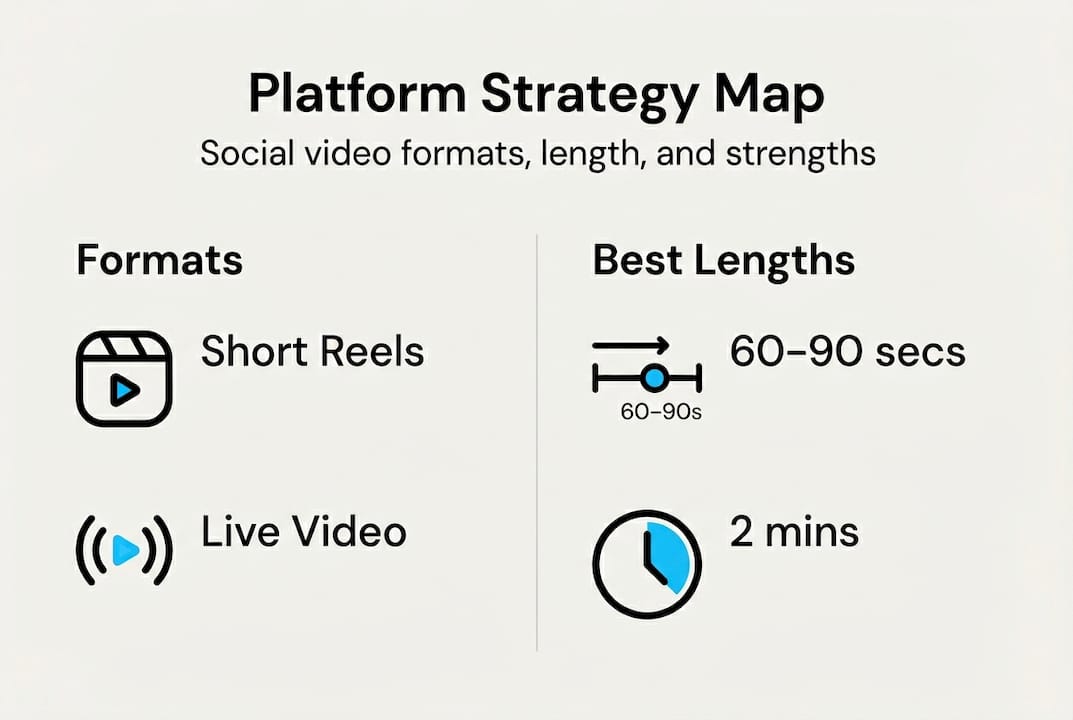
Format selection matters as much as length. Best-performing formats include Reels and Carousels on Instagram, Live video on Facebook, and native video on both LinkedIn and TikTok. Each format signals to the platform’s algorithm that you’re using the channel the way it was designed.
Sequenced content, meaning a planned series rather than standalone posts, dramatically improves audience retention over time. When viewers know a second or third episode is coming, they follow your account and return. This is how smaller brands build loyal audiences without relying on paid amplification.
Here’s a practical content creation sequence for platform alignment:
- Script with the platform’s viewer intent in mind, education for LinkedIn, entertainment for TikTok.
- Shoot vertical 9:16 format by default to maximize screen real estate on mobile.
- Edit for platform pacing: tighter cuts for TikTok, slightly slower for LinkedIn.
- Add captions before publishing, not as an afterthought.
- Review crafting engaging social videos benchmarks after 30 days and adjust.
Short-form dominates volume, but 60–120 second Reels consistently win when a brand needs to tell a story or demonstrate product depth. Use short-form for reach and series-format mid-length video for retention. Both serve different and complementary goals in your ecosystem.
Mastering hooks, captions, and engagement-boosting techniques
Once your creative is platform-matched, execution details separate average results from exceptional ones. The most important: your hook. Hooks in the first 1–3 seconds are make-or-break on TikTok and Instagram. If the opening frame doesn’t stop the scroll, everything that follows goes unseen.
Effective hooks use one of three approaches: a bold visual surprise, a text overlay that poses a direct question, or an immediate demonstration of value. Weak hooks rely on slow intros, logos, or branded bumpers. Your audience hasn’t earned the right to be bored yet.
Beyond the hook, here are the highest-impact engagement techniques we consistently see working:
- Open with the payoff. State what the viewer will gain before the first 5 seconds end.
- Use text captions on every video. A significant portion of mobile viewers watch without sound.
- Place your call to action mid-video, not just at the end, when engagement is still high.
- Ask a direct question in the caption to prompt comments and signal relevance to the algorithm.
- Test two hook variations per video concept to identify what your specific audience responds to.
“Captions aren’t optional. With a large share of social video consumed silently on mobile, captionless content loses a substantial portion of its potential audience before a single word lands.”
For effective brand marketing hooks, the opening visual must communicate the video’s value instantly. Think about the viewer’s mental state: they’re mid-scroll, distracted, and have zero obligation to stay.
Pro Tip: Batch your analytics reviews monthly rather than daily. Daily data creates noise. Monthly patterns reveal what’s actually working across your formats, so you can double down on proven hooks and retire underperformers with confidence.
Consistently boosting engagement with video requires disciplined iteration, not just creative inspiration. Track completion rate, saves, and shares as your primary engagement signals, not just likes.
Audience dynamics and platform algorithms: The engagement game
Nailing the technicals means little if you ignore how each platform really works beneath the surface. One of the most counterintuitive realities in 2026’s social video landscape: smaller accounts frequently outperform large ones on engagement rate.
Instagram Reels engagement by account size shows accounts with 1K–5K followers averaging 0.87%, while accounts with 100K–1M followers drop to 0.45%. The pattern holds across platforms. Algorithms reward content that resonates with a specific audience, not content that’s pushed to the largest possible feed.
| Account size | Instagram Reels | TikTok | |
|---|---|---|---|
| 1K–5K followers | ~0.87% | Higher | Strong |
| 5K–50K followers | ~0.65% | High | Moderate |
| 50K–500K followers | ~0.52% | Moderate | Lower |
| 100K–1M followers | ~0.45% | Moderate | Lower |
The reason is structural. Smaller accounts tend to have audiences that opted in deliberately, which produces stronger engagement signals. Platforms read those signals and distribute the content further. Meanwhile, large accounts often carry passive followers accumulated over years, dragging engagement averages down.
For marketing teams, this means effective video ads for small business growth tactics apply even to established brands. Niche targeting outperforms broad reach when the goal is engagement. TikTok’s 4.25% median engagement reflects how its algorithm aggressively distributes niche content to receptive audiences regardless of account size.
Here’s how to leverage these dynamics practically:
- Define your niche topic cluster and stay within it for 60–90 days to build algorithmic recognition.
- Publish during your audience’s peak activity windows, which your analytics dashboard will surface.
- Engage aggressively in the first 30 minutes after publishing to signal early traction.
- Respond to every comment in the first hour to boost distribution signals.
- Monitor which content earns saves and shares, since those signals carry more algorithmic weight than likes.
Pro Tip: Dedicate 20% of your content calendar to experimental formats. The remaining 80% should be proven formats that consistently perform. This ratio keeps discovery active without risking your core engagement metrics.
A new way to win: Rethinking conventional wisdom in social video
Let’s step back. Most marketing managers are still chasing scale: more followers, more platforms, more volume. The data tells a different story. Smaller pages outperform larger ones because algorithms in 2026 favor niche authenticity over broadcast scale.
We’ve seen this pattern repeatedly across the brands we work with. The accounts that win aren’t always the ones with the biggest budgets. They’re the ones with the tightest focus. A well-crafted series of six videos aimed at a specific decision-maker persona consistently outperforms a month of varied, high-production posts aimed at everyone.
The uncomfortable truth is that vanity metrics, follower count, impressions, total views, often mask weak strategic foundations. B2B social video strategies that prioritize quality hooks, series structure, and audience specificity over raw reach tend to produce leads that actually convert.
Focus beats scale. Depth beats volume. Build a loyal core audience that engages, and the algorithm does the rest.
Level up your social video strategy with expert production
A fresh perspective creates clear direction, but flawless execution makes it real. Strategy frameworks are only as powerful as the creative that brings them to life.
At Bonomotion, we’ve spent over 20 years helping marketing teams at growing brands and Fortune 100 companies turn strategy into standout video content. Whether you need a videography production partner for a series launch, platform-specific scripting, or end-to-end editing optimized for each channel, we operate as a true extension of your team. Our producers work directly with your strategists to ensure every frame serves a measurable goal. If you’re ready to move from framework to finished product, explore our video production for your brand services and let’s start building something that performs.
Frequently asked questions
What is the best length for social media videos in 2026?
Optimal lengths vary by platform: 60–90 seconds for Instagram Reels, 90–120 seconds for Facebook Reels, and up to 2 minutes for TikTok and LinkedIn to support deeper storytelling.
Do smaller accounts really get better engagement rates?
Yes. Smaller accounts achieve higher engagement than larger ones, with Instagram accounts in the 1K–5K range averaging nearly double the engagement rate of accounts above 100K followers.
Which platform delivers the highest engagement for business videos?
TikTok leads with 4.25% median engagement rate, followed by YouTube at 3.06% and LinkedIn at 2.94%, making all three strong choices depending on your audience.
What’s the most important factor for social video success?
A compelling hook in the first 1–3 seconds is the single most critical execution factor, since it determines whether viewers stay or scroll past before your message lands.
Recommended
- How To Create Engaging Social Video Content (Top Strategies)
- Best Digital Marketing Video Production: Boosting Engagement
- Top Social Media Video Production: Crafting Engaging Content
- Effective Strategies For Event Video Promotion (Best Tips)
- How Social Engagement Transforms Your Customer Base | Rule27 Design