

A post-event video promotion guide is a structured system for converting raw event footage into a multi-platform content engine that extends audience reach, accelerates pipeline, and delivers measurable ROI long after the event ends. Most event teams invest heavily in production, then upload a single recap video and move on. That approach leaves the majority of the asset value on the table. Platforms like YouTube, LinkedIn, and TikTok each reward different formats and cadences, and a single well-captured conference can yield 10 to 14 distinct assets per hour of raw footage. The difference between a forgettable event and a three-month content campaign is almost entirely strategic planning, not budget.
What is a post-event video promotion guide and why does it matter?
Post-event video promotion, also called event content repurposing in the broader video marketing strategies field, is the practice of systematically extracting, editing, and distributing video assets from a live event across multiple channels and audience segments. The goal is not just visibility. It is funnel progression, with each asset designed to move a specific audience segment from awareness to consideration to conversion.
The math alone makes the case. A single multi-day event can fuel three months of rolling content when assets are structured correctly. That means a two-day conference with six hours of captured footage could generate 60 to 84 distinct video assets. For event organizers and marketers working with constrained budgets, that multiplier changes the entire economics of event investment.

Without a structured approach, teams default to ad hoc creative decisions, inconsistent formats, and missed distribution windows. With one, every session becomes a deliberate piece of a larger content architecture.
What planning steps are required before the event?
The single most important prerequisite for effective post-event content promotion is a capture brief finalized at least six weeks before the event. This document specifies which sessions are “hero” content (keynotes, panel discussions, high-profile speakers) versus supporting content (breakout sessions, sponsor interviews, attendee testimonials). Without this distinction, editors spend hours sorting through footage with no clear priority.
The capture brief should also define your asset taxonomy upfront. That means deciding in advance which formats you will produce, which platforms each format targets, and which buyer funnel stage each asset serves. Aligning this taxonomy with your content team, demand generation team, and event operations team before a single camera rolls prevents the costly misalignment that kills post-production momentum.
On the personnel side, you need at minimum a videographer, a post-production editor, and a content manager who owns distribution. These three roles can overlap in smaller organizations, but the functions cannot be skipped. Equipment requirements include multi-camera setups for hero sessions, a dedicated audio feed from the venue’s sound board, and a B-roll shot list covering venue atmosphere, networking moments, and speaker close-ups.
- Finalize the capture brief six weeks out, specifying hero vs. supporting sessions
- Define asset taxonomy with formats mapped to awareness, consideration, and conversion stages
- Align content, demand gen, and event teams on deliverables and timelines
- Assign videographer, editor, and content manager roles before the event
- Prepare a B-roll shot list covering atmosphere, speaker reactions, and audience engagement
Pro Tip: Build your distribution calendar before the event, not after. Knowing that you need a 30-second LinkedIn teaser by day three of the event forces your videographer to capture the right moments in real time.
How to create and categorize video assets for multi-platform promotion?
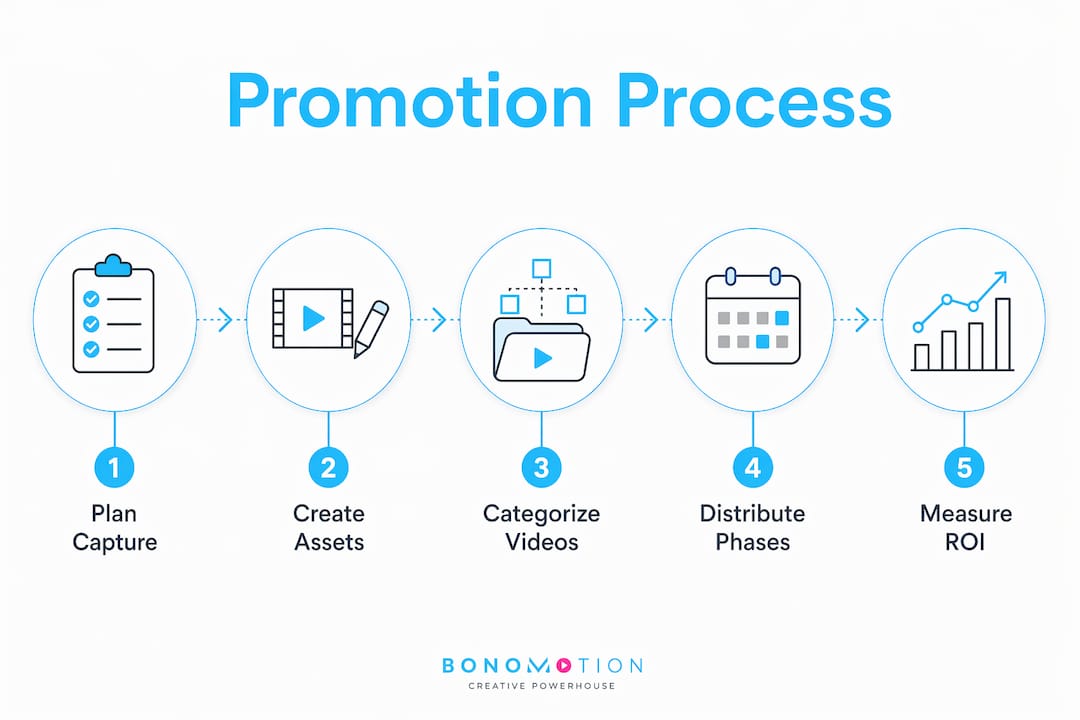
Successful video marketing teams plan assets to target awareness, consideration, and conversion before filming starts. This funnel-mapped approach is what separates organizations that generate pipeline from events versus those that generate views. The three content layers that make this work are long-form, mid-form, and short-form video, each serving a distinct purpose and platform.
| Content Layer | Duration | Primary Platforms | Funnel Stage |
|---|---|---|---|
| Long-form | 8 to 15 minutes | YouTube, website, email | Consideration, conversion |
| Mid-form | 2 to 5 minutes | LinkedIn, YouTube, webinar follow-up | Awareness, consideration |
| Short-form | 15 to 90 seconds | TikTok, Instagram Reels, YouTube Shorts | Awareness, retargeting |
From a single one-hour keynote, a structured system produces: one full session recording, one 3-minute highlight reel, three to five 60-second topic clips, eight to ten 15-second quote clips, and a set of static quote cards for organic social. That is the 10 to 14 asset range in practice, and it is achievable without additional filming.
Short-form assets for TikTok, Instagram Reels, and YouTube Shorts require specific editing discipline. Cuts every three seconds, a strong hook in the first two seconds, and a clear payoff within 30 seconds are the structural requirements for retention on these platforms. A speaker clip that works on LinkedIn at 90 seconds will need a completely different edit for Reels.
Pro Tip: Map each asset to a specific audience segment, not just a platform. A CFO-targeted clip from a finance panel belongs in a LinkedIn campaign targeting finance titles, not in your general event recap email.
For effective video sharing across channels, the asset taxonomy you build before the event becomes your post-production checklist. Every deliverable is accounted for, every editor knows what they are building, and every asset has a home before it is finished.
What are best practices for phased distribution across channels?
Distribution across owned, earned, and paid channels dramatically increases video reach compared to single-platform posting. The same session, cut and distributed strategically, can increase reach by an order of magnitude. The mechanism is sequencing: releasing the right asset to the right audience at the right time in a 12-month phased workflow.
A practical phased rollout works as follows:
- Weeks 1 to 2 (Momentum phase): Release short-form clips and a 2-minute highlight reel across LinkedIn, Instagram, and YouTube Shorts while event energy is still high. Tag speakers and panelists to activate earned reach.
- Weeks 3 to 8 (Engagement phase): Publish mid-form session recaps on YouTube and LinkedIn. Embed clips in email nurture sequences targeting registered attendees and warm leads. Launch retargeting ads on LinkedIn and Meta using event attendee lists.
- Months 3 to 6 (Consideration phase): Deploy long-form session recordings as gated content or webinar replays. Use these assets in sales enablement sequences and CRM workflows targeting prospects in active deal stages.
- Months 7 to 12 (Evergreen phase): Repurpose high-performing clips into paid campaigns targeting cold audiences. Refresh thumbnails and titles on YouTube to maintain organic search visibility.
On the paid side, YouTube ad formats should be sequenced by funnel stage. Skippable in-stream ads work best for storytelling and mid-funnel engagement. Non-skippable bumper ads (six seconds) are most effective for urgent reminders and retargeting warm audiences in the final weeks of a campaign.
Owned channels include your website, YouTube channel, email list, and organic social profiles. Earned channels activate when speakers, panelists, and sponsors share assets with their own audiences, which is why tagging and providing shareable clips directly to speakers is a non-negotiable step. Paid channels amplify what is already working organically, so let two to three weeks of organic data inform which assets you put budget behind.
How to measure and optimize the ROI of post-event video promotion?
Key video marketing metrics that correlate with business objectives provide a far more accurate assessment of video ROI than views or likes alone. The metrics that matter are engagement rate (watch time, click-through rate, comments), conversion rate (form fills, demo requests, content downloads), and pipeline contribution (deals influenced by video touchpoints in the CRM).
Tools like Google Analytics 4, HubSpot, Vidyard, and Adobe Analytics each offer different layers of attribution. Vidyard, in particular, tracks individual viewer behavior at the contact level, which means your sales team can see that a prospect watched 80% of a keynote recap before requesting a demo. That is the kind of signal that accelerates deal velocity.
- Track engagement rate per asset to identify which topics and formats resonate most
- Monitor conversion rate from video landing pages and email embeds
- Use CRM tagging to attribute pipeline to specific video touchpoints
- Run A/B tests on thumbnails, titles, and call-to-action placement
- Review performance data at the 30, 60, and 90-day marks to inform the next event’s capture brief
“Successful organizations employ a buyer-funnel mapped system for video marketing, focusing on lead quality over vanity metrics.” — Monday.com Video Marketing Strategy
For a deeper framework on maximizing video ROI, the key shift is treating each video asset as a measurable business unit, not a creative deliverable. Every asset should have a defined goal, a distribution channel, and a success metric before it goes into post-production.
What common pitfalls should event marketers avoid?
The most common mistake in post-event video promotion is treating it as a post-production task rather than an integral part of event planning. When the capture brief does not exist, editors receive hours of unorganized footage with no asset goals, no distribution plan, and no deadline structure. The result is a single recap video published six weeks after the event, when audience interest has already moved on.
- Skipping segmentation: Uploading full session recordings without editing them into platform-specific formats guarantees low engagement. A 45-minute panel has almost no organic reach on LinkedIn or YouTube without a structured edit.
- Over-relying on the hero video: A single highlight reel is not a strategy. Diversifying into quote clips, topic-specific cuts, and testimonial segments is what sustains reach over months, not days.
- Ignoring ad format variety: Running only one ad format across all paid channels misses the funnel. Skippable in-stream ads and bumper ads serve different purposes and should run in sequence, not simultaneously.
- Neglecting earned distribution: Failing to provide speakers and sponsors with pre-cut, ready-to-share clips leaves significant organic reach untapped. Most speakers will share content if you make it easy for them.
- Measuring vanity metrics only: Optimizing for views without connecting video performance to pipeline contribution makes it impossible to justify production investment to leadership.
Pro Tip: Send speakers a personalized email within 48 hours of the event with two or three pre-cut clips sized for LinkedIn. Include suggested caption copy. Speaker shares consistently outperform brand page posts in organic reach.
My take on making post-event video work at the strategic level
After working with event teams across industries for years, the pattern I see most often is this: organizations invest significantly in event production, then treat the video as a deliverable rather than a distribution asset. The footage gets archived, the recap goes out, and the conversation moves to the next event.
The teams that generate real pipeline from events think differently. They align their content, sales, and demand generation functions around the capture brief before the event starts. They know which assets will go into HubSpot sequences, which clips will fuel LinkedIn retargeting, and which long-form recordings will be used by sales reps in deal-stage follow-up. That alignment is not a creative decision. It is a revenue decision.
What I find most underutilized is the evergreen potential of well-produced event content. A keynote from a respected industry voice does not expire in six months. With a refreshed thumbnail, updated SEO metadata on YouTube, and a new paid push targeting a cold audience, that same asset can generate leads 18 months after the event. The production cost is already sunk. The distribution cost is marginal. That is where the real ROI lives.
Integrating video assets directly into CRM workflows, so that sales reps can see which prospects engaged with which content, is the step that moves video from a marketing function to a sales acceleration tool. When a rep knows a prospect watched a full product demo session from your conference, that changes the conversation entirely.
— Bernard
How Bonomotion can power your post-event video strategy
Bonomotion has been producing high-impact corporate and event video since 2003, working with startups, growing brands, and Fortune 100 companies across Florida and nationwide. We understand that event footage is only as valuable as the system built around it.
Our production teams work from a structured capture brief aligned to your asset taxonomy and distribution plan, so every hour of footage is captured with a specific deliverable in mind. From multi-camera conference coverage to short-form social edits and corporate video production tailored to your funnel strategy, we operate as an extension of your marketing team. If you are ready to turn your next event into a 12-month content engine, explore our event video solutions and let’s build the system together.
FAQ
What is a post-event video promotion guide?
A post-event video promotion guide is a structured plan for converting raw event footage into multiple video assets distributed across owned, earned, and paid channels to extend reach and drive measurable business outcomes. It covers asset creation, platform targeting, phased distribution, and ROI measurement.
How many video assets can one event generate?
A single hour of well-captured event footage typically yields 10 to 14 distinct assets, including full session recordings, highlight reels, short clips, and quote cards. A two-day conference can fuel three months of rolling content across multiple platforms.
Which platforms work best for post-event video distribution?
YouTube works best for long-form session recordings and searchable content; LinkedIn performs well for mid-form professional clips and thought leadership; TikTok, Instagram Reels, and YouTube Shorts are the primary channels for short-form awareness content targeting new audiences.
What metrics should I track for post-event video ROI?
Track engagement rate, conversion rate, and pipeline contribution rather than views alone. Metrics tied to business objectives give a more accurate picture of video ROI, and tools like Vidyard and HubSpot allow contact-level attribution of video engagement to CRM pipeline.
When should post-event video promotion planning begin?
Planning should begin at least six weeks before the event, with a finalized capture brief that specifies hero sessions, asset formats, and distribution channels. Starting earlier allows content, demand generation, and event teams to align on deliverables before filming begins.
Key takeaways
Effective post-event video promotion requires a capture brief, a funnel-mapped asset taxonomy, and a phased 12-month distribution plan built before the event starts.
| Point | Details |
|---|---|
| Start planning six weeks out | Finalize a capture brief specifying hero sessions, asset formats, and distribution channels before filming. |
| Build a layered asset system | Structure footage into long-form, mid-form, and short-form assets to serve every funnel stage and platform. |
| Distribute across all three channel types | Combine owned, earned, and paid channels to multiply reach far beyond single-platform posting. |
| Measure business outcomes, not vanity metrics | Track engagement rate, conversion rate, and pipeline contribution using tools like Vidyard and HubSpot. |
| Treat event video as an evergreen asset | Refresh metadata and paid targeting on high-performing assets to generate leads 12 to 18 months post-event. |