

Most event planners and marketing teams walk into a video project believing the hardest part is the shoot itself. That assumption costs time, budget, and often the final product’s quality. Film production is an end-to-end process that spans concept development, meticulous planning, the actual shoot, editing, and ultimately getting content in front of the right audience. Each stage carries real business weight. This guide breaks down the full film production lifecycle in plain terms, so your team can plan smarter, communicate better with production partners, and protect the ROI of every video project you greenlight.
Table of Contents
- What film production really means
- Breaking down the stages: From development to distribution
- Gray areas: Why film production workflows aren’t always linear
- Best practices for corporate and event filmmakers
- Why most corporate video projects fail before cameras roll
- Take your event or marketing videos to the next level
- Frequently asked questions
Key Takeaways
| Point | Details |
|---|---|
| Film production is multi-stage | It covers everything from planning and shooting to editing and release. |
| Planning prevents failures | Invest most effort in early stages to avoid downstream problems. |
| Expect workflow overlap | Project stages often overlap, so teams must stay flexible and communicate well. |
| Define stage expectations | Clarify deliverables and responsibilities at each phase for smooth handoffs. |
| Apply frameworks to events | Using a pipeline approach boosts creative output and project reliability. |
What film production really means
The word “production” gets used loosely. Ask ten different stakeholders what it means and you’ll get ten different answers. Some think it’s synonymous with filming. Others lump everything together under one vague label. Neither approach serves your project well.
At its core, film production is the end-to-end process from development through distribution. That’s the working definition professionals use, and it’s the one your team should adopt. It treats every phase as a distinct, connected part of a larger system. When one phase is rushed or skipped, every stage after it absorbs the damage.
Here’s the distinction that matters most for planners and marketers: the production stage (the actual filming) is just one chapter inside the broader film production process. Confusing the two leads to misaligned budgets, unclear responsibilities, and stakeholders who don’t know when to weigh in.
In professional usage, “film production” often means the full creative and logistical journey, not just the day the cameras are rolling. That precision of language shapes how teams communicate, how vendors scope their work, and how deliverables are tracked.
Understanding the types of video production that exist also helps. Corporate event coverage, executive messaging, branded lifestyle content, and livestreams each have unique stage requirements, even if they share the same overall framework.
Here’s a high-level look at the main stages every professional film production moves through:
- Development: Concept creation, scripting, and strategic alignment
- Pre-production: Scheduling, casting, location scouting, and logistics
- Production: The actual filming and on-set capture
- Post-production: Editing, sound design, color grading, and graphics
- Distribution: Delivery, publishing, and audience targeting
“Film production is not the shoot. The shoot is a moment inside a much larger process. Treat it that way, and everything else gets easier.”
When your team understands these distinctions, you stop treating the shoot as the finish line and start managing the full race.
Breaking down the stages: From development to distribution
Now that the definition is clear, let’s break down the stages and see how they shape actual video projects.
Each stage has specific responsibilities, outputs, and handoff points. Missing any of them creates gaps that are expensive to close later.
- Development: This is where strategy lives. Goals are defined, audience needs are identified, and the creative concept is built. For corporate and event teams, this often means aligning with marketing leadership and clarifying what success looks like.
- Pre-production: Logistics are locked down here. Scripts are finalized, shoot days are scheduled, crew is hired, and locations are confirmed. This stage is where most quality problems are either prevented or created.
- Production: Cameras roll. This is the stage most people visualize, and it’s often the shortest in duration relative to the entire project timeline.
- Post-production: Raw footage becomes a finished product. Editing, color correction, audio mixing, motion graphics, and versioning all happen here.
- Distribution: The finished video reaches its intended audience through the right channels at the right time, whether that’s a conference screen, a LinkedIn campaign, or a broadcast platform.
A practical methodology used across the industry is to plan early, capture during production, and finalize for distribution. This three-stage mental model is simpler but still captures the essential rhythm of any project.
| Model | Stages | Best for |
|---|---|---|
| 3-stage model | Pre, Production, Post | Simpler internal projects |
| 5-stage model | Development through Distribution | Complex or multi-platform content |
For planning event videos, the five-stage model gives you more control. It forces clarity on who owns what and when feedback is expected. When you’re working with senior stakeholders or tight deadlines, that clarity is non-negotiable.

Pro Tip: Before your next video project kicks off, document which stage model your team will use and assign a clear owner for each stage. Ambiguity in handoffs is where timelines collapse. Use corporate video planning tips to structure your stage ownership early.
Gray areas: Why film production workflows aren’t always linear
Of course, these stages rarely occur perfectly in order. Here’s what every project lead needs to know about gray areas and real-life workflow.
The clean five-stage diagram looks great in a presentation. Reality is messier. Pre-production can begin while development decisions are still being finalized. Post-production often starts before the final shoot day wraps. Pre-production can overlap with other development tasks, and reshoots frequently happen after principal photography has concluded.
These overlaps are not failures. They’re features of a responsive, professional workflow. But they do require deliberate management. Here’s where teams run into trouble:
- Parallel scheduling conflicts: Two stages running simultaneously can create version confusion if file management and communication protocols aren’t established.
- Reshoots (also called pickups): These are additional filming sessions after the main production. They’re common and expected in professional projects, but they need budget and timeline reserves built in from the start.
- Feedback loop delays: When stakeholder reviews straddle stage boundaries, approvals slow down and editors sit idle waiting on notes.
- Scope creep during post-production: New requests that should have been addressed in development get introduced late, inflating costs and pushing delivery dates.
For more detail on how professional crews handle these transitions, reviewing detailed film production stages gives your team a useful operational reference.
Non-linear workflows also require stronger communication norms. Your production partner needs to know immediately when a stage boundary shifts. If pickups are needed, that’s a conversation about budget, scheduling, and priority, not an assumption that it will get absorbed silently.
Pro Tip: Build a 10 to 15 percent buffer into your production timeline specifically for reshoots and late-stage revisions. Review your video interview workflow process as a model for how to structure iterative capture sessions without derailing the broader timeline.
Best practices for corporate and event filmmakers
To move from confusion to clarity, here’s how to apply these staged approaches to real-world corporate and event film production.
The biggest trap teams fall into is treating film production like a single event rather than a pipeline. A common failure mode is skipping or under-investing in early planning, which creates cost overruns and creative compromises in every stage that follows. The fix isn’t more crew on shoot day. It’s more rigor in the stages before anyone picks up a camera.
Here’s a practical checklist approach for each stage:
- Development checklist: Confirm business objective, define target audience, approve creative brief, and align on budget range.
- Pre-production checklist: Finalize script or shot list, confirm crew and equipment, secure locations, and schedule stakeholder review windows.
- Production checklist: Brief crew on priorities, monitor against shot list, flag anything that may need a pickup before wrapping.
- Post-production checklist: Establish review rounds in advance, use a centralized feedback tool, and lock versioning before color and audio work begins.
- Distribution checklist: Confirm file specs per platform, align publish date with campaign calendar, and track early performance metrics.
A pipeline mentality with distinct deliverables per stage improves both creative reviews and final results. It gives stakeholders clear windows to provide input without disrupting downstream work.
| Stage | Objective | Typical deliverable |
|---|---|---|
| Development | Define goals and creative direction | Approved creative brief |
| Pre-production | Prepare all logistics | Finalized production schedule |
| Production | Capture content | Raw footage archive |
| Post-production | Build the finished product | Approved final cut |
| Distribution | Deliver to audience | Published assets with tracking |
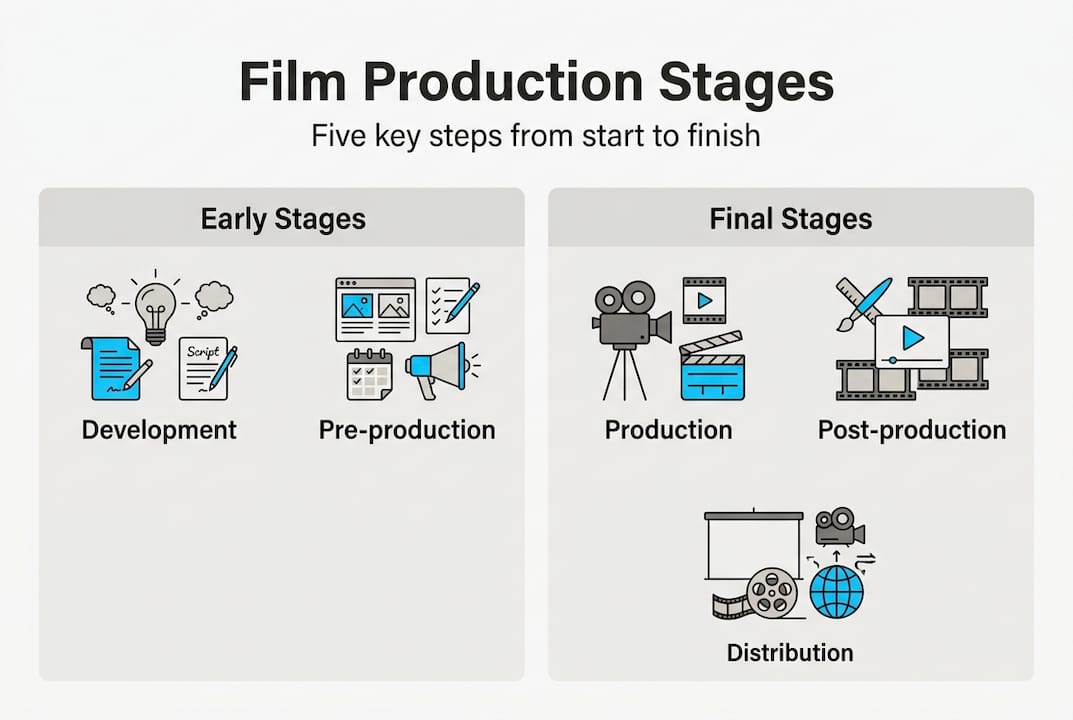
For teams working with online video production services, this table serves as a shared language between your internal team and your production vendor. Sharing it at project kickoff eliminates a significant amount of back-and-forth later.
If you work with a video production for marketing agencies partner, ask how they define each stage handoff. A professional partner should have a clear answer. When choosing a production partner, this alignment on process is as important as evaluating their reel.
Pro Tip: Share your stage model and deliverables table with every stakeholder at the project kickoff. Thirty minutes of alignment at the start prevents hours of correction at the end.
Why most corporate video projects fail before cameras roll
With these best practices in mind, here’s an unfiltered look at what most teams get wrong when producing video content.
We’ve seen it consistently across more than two decades of production work: the projects that struggle aren’t undone by a bad shoot day. They’re undone by what didn’t happen in the weeks before. Teams get excited about the creative, they lock in shoot dates, and they skip the hard work of aligning on objectives, defining deliverables, and building review windows into the timeline.
What sounds unglamorous, specifically the planning stages, is actually where your budget is either protected or eroded. A half-day of pre-production calls can prevent a full day of reshoots. A clear creative brief saves three rounds of post-production revisions. The teams that consistently produce strong video content aren’t more talented. They’re more disciplined in the early stages.
The uncomfortable truth is that most clients come to us after a painful project where this exact dynamic played out. Our job isn’t just to film well. It’s to build the framework that makes filming the easiest part of the process. Review advanced planning tips and you’ll see this pattern clearly: structured early stages lead to predictable, high-quality outcomes every time.
Take your event or marketing videos to the next level
If you want to avoid common pitfalls and ensure professional results, working with a production team that manages every stage with equal rigor makes a measurable difference.
At Bonomotion, we’ve guided corporate, event, and marketing video projects through every stage of production since 2003. Our corporate video production experts bring structure and creative precision to every phase, from development through distribution. Whether you need commercial video production specialists for a branded campaign or full-scale business video solutions for your next conference, we operate as a true extension of your team. Let’s make your next project the one that sets the standard.
Frequently asked questions
What are the five main stages of film production?
Film production spans five stages: development, pre-production, production, post-production, and distribution. Each stage has distinct deliverables and owners.
What is the biggest mistake in corporate film production?
Most teams under-invest in planning and pre-production, which leads to creative misalignment and budget overruns that become very difficult to fix during or after the shoot.
Can filming and editing overlap in a film project?
Yes. Stage boundaries can overlap, and reshoots (pickups) can happen while post-production is already underway on earlier footage, which is a normal part of professional production.
How do I ensure everyone understands their role during production?
Clearly communicate your stage framework and assign a named owner for each stage before the project begins. A shared deliverables table at kickoff removes ambiguity fast.
Why use a stage-based approach for event and marketing videos?
Treating filmmaking as a pipeline with clear stage deliverables controls cost, protects quality, and gives every stakeholder a defined window to contribute without disrupting momentum.
Recommended
- Planning A Successful Corporate Event Video Production
- Creating Impactful Event Promo Videos: A Comprehensive Guide
- Video Production Schedule: Creating An Efficient Template
- 9 Pro Tips On Video Production For Events And Management
- Jak zorganizować event fotograficzny: poradnik 2026 – Coolheads – Fotografia biznesowa