

Corporate videos drive real business results when done right. Companies using professional video content see 49% faster revenue growth than those without it.

Creating corporate videos requires strategic planning, technical expertise, and flawless execution. We at Bonomotion Video Agency have spent over 20 years perfecting this process for Miami businesses and beyond.
The difference between amateur and professional corporate videos often determines whether your message resonates with your audience or gets ignored.
How Do You Plan Corporate Video Production?
Successful corporate video production starts with three non-negotiable elements that separate professional results from amateur footage. Companies must define specific measurable objectives before they touch any equipment. Organizations that set clear goals like increasing website conversions by 25% or generating 500 qualified leads achieve 73% better results than those with vague aims like brand awareness. Your target audience must be precisely identified down to job titles, pain points, and viewing preferences. A procurement manager watches videos differently than a C-suite executive, and your content must reflect this reality.
Script Development That Converts
Professional scripts follow the three-act structure with a compelling hook in the first 15 seconds, since video ads under 15 seconds see a 53% higher completion rate than ads over 30 seconds. Write conversational dialogue that addresses specific customer challenges rather than listing product features. Include clear calls-to-action every 60 seconds for longer videos. Storyboards prevent costly reshoots and communication gaps during production. Create detailed visual references that show camera angles, talent positioning, and key messaging moments.
Budget and Timeline Realities
Many video production companies charge between $100 and $149 per hour for their services. Allocate 40% for pre-production planning, 30% for filming, and 30% for post-production editing. Rush projects cost 50% more and compromise quality. Plan 2-3 weeks for script approval, 1-2 days for filming, and 2-4 weeks for editing and revisions. Companies that follow structured timelines complete projects 60% faster than those that make decisions during production.
Location and Talent Selection
Choose locations that reinforce your brand message and provide optimal lighting conditions. Indoor locations offer more control over variables like sound and lighting, while outdoor settings can add authenticity but require weather contingency plans. Professional talent delivers consistent performance and understands camera presence, while employee testimonials provide authenticity but need more direction and preparation time.
The foundation you build during pre-production directly impacts the technical execution phase, where equipment selection and setup determine your video’s professional quality.
What Equipment Actually Matters for Corporate Videos
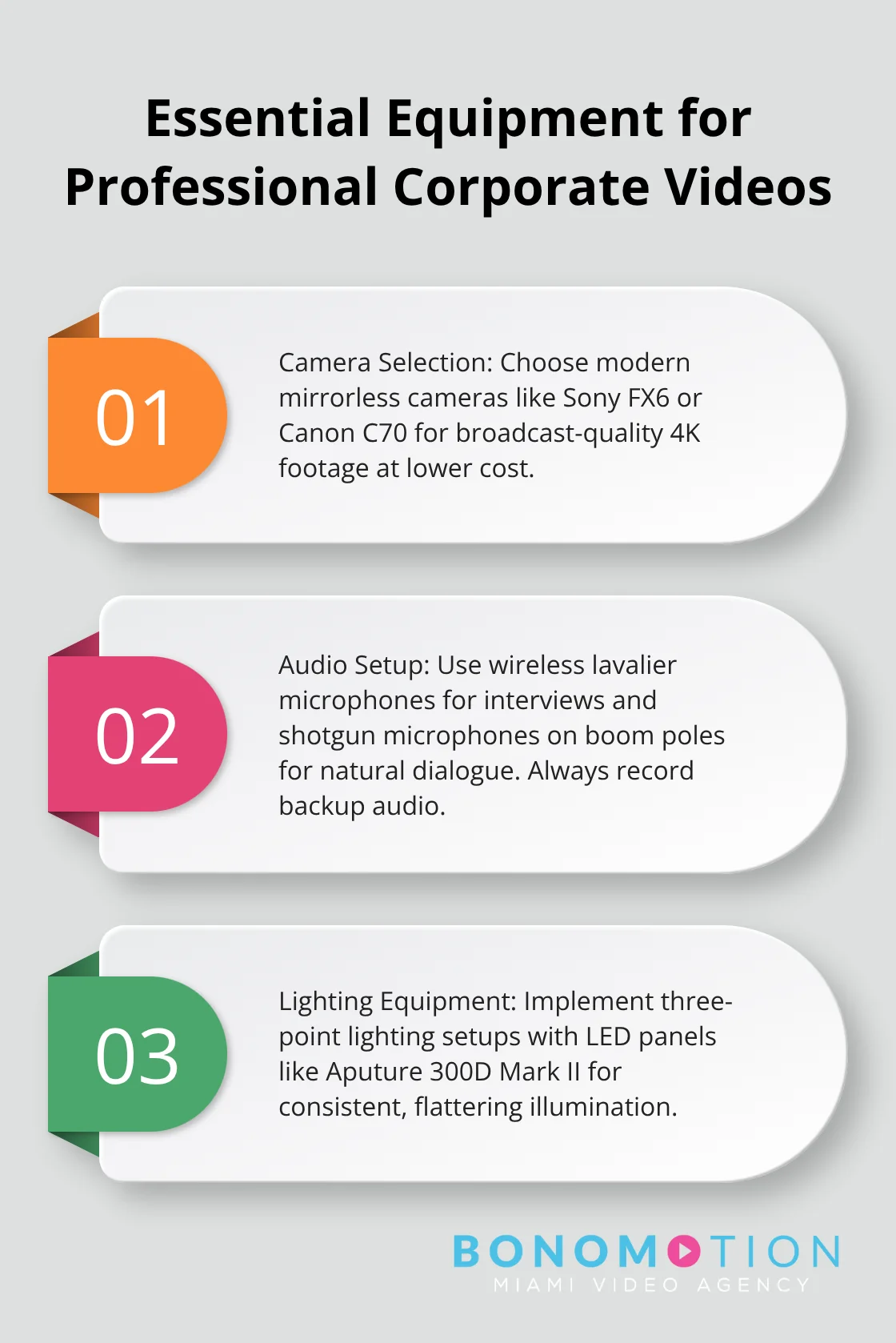
Professional corporate video production relies on three technical pillars that separate amateur footage from content that converts viewers into customers. Camera selection determines your visual foundation, with modern mirrorless cameras like the Sony FX6 or Canon C70 that deliver broadcast-quality 4K footage at half the cost of traditional cinema cameras. These cameras excel in low-light conditions and offer internal recording capabilities that eliminate external recorder complexity. Audio quality matters more than most realize, since viewers spend an average of 361.7 minutes weekly watching video content, making audio clarity essential for retention.
Professional Audio Setup That Viewers Actually Hear
Wireless lavalier microphones provide consistent audio for talking head interviews, while shotgun microphones mounted on boom poles capture natural dialogue during presentations or meetings. The Rode Wireless Pro system offers 32-bit float recording that prevents audio clipping, while the Sennheiser MKE 600 shotgun microphone delivers broadcast-quality sound for under $400. Always record backup audio directly to camera and use external recorders for primary audio tracks. Room acoustics affect audio quality more than microphone selection, so scout locations for hard surfaces that create echo and plan acoustic treatment accordingly.
Lighting Equipment That Creates Professional Results
Three-point lighting setups with LED panels create consistent, flattering illumination that matches natural skin tones. The Aputure 300D Mark II provides daylight-balanced light powerful enough for large spaces, while smaller panels like the Aputure MC series offer portable color-changing options for accent lighting. Soft boxes and diffusion materials eliminate harsh shadows that make subjects appear unprofessional on camera.
Post-Production Software That Streamlines Your Workflow
Post-production workflows with DaVinci Resolve or Adobe Premiere Pro should follow color-managed pipelines that maintain consistency across different viewing devices and platforms. Professional editors focus heavily on audio mixing and color correction rather than flashy transitions. Export settings must match your distribution platform requirements, with H.264 compression for web delivery and ProRes formats for broadcast applications.
Equipment selection directly impacts your on-camera talent performance and interview quality, which forms the backbone of effective corporate video production.
How Do You Execute Professional Production?
Professional on-camera presence starts with proper talent preparation 48 hours before filming begins. Corporate executives benefit significantly from advance coaching on camera techniques, with 91% of businesses using video as a marketing tool in 2024.

Schedule pre-interviews with all subjects to discuss key messaging points and identify natural speech patterns. Position talent 8-10 feet from the camera to create flattering perspective and reduce lens distortion. Maintain consistent eye contact with the interviewer rather than looking directly at the lens, which creates more authentic conversation flow.
Talent Preparation and Wardrobe
Professional makeup reduces shine and evens skin tone under studio lighting, while wardrobe choices should avoid busy patterns, bright whites, or all-black clothing that creates contrast issues. Interview subjects retain information better when questions progress from general company topics to specific personal experiences (this allows natural storytelling to emerge). Provide talent with key talking points 24 hours in advance, but avoid over-scripting responses that sound rehearsed.
Direct Authentic Testimonials
Effective testimonial direction requires open-ended questions that prompt specific examples rather than yes-or-no responses. Replace generic questions like “How do you like our product?” with targeted inquiries such as “Walk me through the exact moment you realized our software saved you time.” Record multiple takes of key soundbites to provide editing flexibility, since most testimonial videos require audio adjustments during post-production. Create comfortable interview environments by maintaining room temperature between 68-72 degrees and providing water bottles off-camera.
Position Cameras and Audio Equipment
Position the interviewer slightly off-axis from the camera lens to encourage natural eye contact while maintaining proper framing. Professional testimonials capture specific metrics, timeframes, and measurable results rather than emotional statements alone. Use wireless lavalier microphones for consistent audio levels and backup recording devices to prevent technical failures during critical interviews.
Coordinate Production Logistics
Production coordination requires detailed call sheets distributed 24 hours before filming that specify arrival times, parking instructions, and contact information for all crew members. Assign specific roles to prevent overlap and confusion: one person manages talent, another handles equipment setup, and a third coordinates scheduling. Buffer 30% extra time between interview segments to account for lighting adjustments and talent preparation (this prevents rushed sessions that compromise quality). Professional productions maintain detailed shot lists that specify camera angles, lens choices, and audio requirements for each segment.
Final Thoughts
Creating corporate videos that drive measurable business results requires strategic planning, professional equipment, and flawless execution. Companies that invest in quality video production see 49% faster revenue growth and generate 66% more qualified leads annually than competitors who use amateur content. The technical foundation matters significantly when you want professional results.
Professional cameras, wireless audio systems, and three-point lighting setups separate amateur footage from content that converts viewers into customers. Post-production workflows with color-managed pipelines maintain consistency across platforms and devices. On-camera talent preparation and authentic testimonial direction create the emotional connections that build trust with your target audience (professional makeup and proper wardrobe selection enable natural storytelling that resonates with viewers).
We at Bonomotion Video Agency have spent over 20 years perfecting these processes for Miami businesses and beyond. Our team helps brands create compelling visual narratives that drive success. Start your next project by defining specific measurable objectives and invest in proper planning and execution for long-term business growth.