
If your shoot uses public property anywhere in Miami-Dade County, such as a street, sidewalk, park, beach or public building, you need a film permit. Miami-Dade County runs a one-stop permitting system through its Office of Film & Entertainment (Film Miami), while the City of Miami and Miami Beach also operate their own permit offices. This guide explains which office to call, what you pay, what insurance you need and how to plan your timeline, so your crew spends the day filming instead of negotiating with a police officer on the curb.
TL;DR
- Film, video and still photo shoots on public property across Miami-Dade County require a permit. The City of Miami and Miami Beach also require permits for some shoots on residential or private property.
- Miami-Dade County charges a non-refundable $150 application processing fee, valid for 28 days of filming starting on the first production day (Implementing Order effective October 1, 2025). Miami Beach does not charge permit fees.
- Plan on a certificate of insurance with at least $1,000,000 in general liability coverage, naming the county or municipality as additionally insured.
- The City of Miami asks for applications at least 3 business days ahead, or 7 business days if the shoot involves street closures.
- Very small, handheld productions are often exempt, but the exemption is narrow. Confirm with the permitting office before you roll.
Table of Contents
- Who issues film permits in Miami
- When you need a film permit in Miami
- When you may not need one
- What a Miami film permit costs
- How long approval takes
- Insurance and paperwork you will need
- Rules for filming on streets, parks and public property
- A practical permit checklist
- How a producer makes permitting painless
- Perspective: permits are part of the creative plan
- Let us handle the production side
- FAQ
Who issues film permits in Miami
The first surprise for most producers is that there is more than one door. Miami-Dade County’s Office of Film & Entertainment, known as Film Miami, operates as a cooperative one-stop system for the county and multiple participating municipalities. That means a single application can cover several jurisdictions, which matters when a commercial moves from a Wynwood wall to a waterfront shot in a neighboring city.
Three offices cover most of what our clients film:
- Film Miami (Miami-Dade County): the central office for county-wide permitting and the best first call when your locations span more than one city.
- City of Miami: issues permits for shoots inside city limits, including street closures. Once the required department approvals are in and invoices are paid, the permit is issued by email.
- City of Miami Beach: its Film & Print Office handles shoots on the Beach and works to move quickly on production needs.
If you are unsure where a location falls, start with Film Miami at 305-375-3288 or film@miamidade.gov. Municipal boundaries in South Florida do not follow the neighborhood names on a location scout’s spreadsheet, and a quick call settles it.
When you need a film permit in Miami
The county’s rule is straightforward: film, video or still photo shoots conducted on public property, including roads, sidewalks, parks, beaches and public buildings, require a permit throughout Miami-Dade County. Certain municipalities, including the City of Miami and Miami Beach, extend that requirement to shoots on residential or private property as well.
In practice, you should assume a permit is needed when your production involves any of the following:
- Setting up lights, stands, dollies or grip equipment on a sidewalk, street, park or beach
- Closing or restricting a lane, parking spots or a sidewalk
- Using generators, which Miami Beach’s citywide permit does not allow
- Stunts, pyrotechnics, weapons or animals
- A cast and crew that goes beyond a couple of people
- Filming inside a public building, where you must also go through Film Miami rather than contacting the facility directly. Historic county courthouses, for example, direct every request to Film Miami first.
Corporate, commercial and event productions almost always cross at least one of these lines. A branded lifestyle shoot on Ocean Drive with a crew, talent and lighting is a permit project from the first scout.
When you may not need one
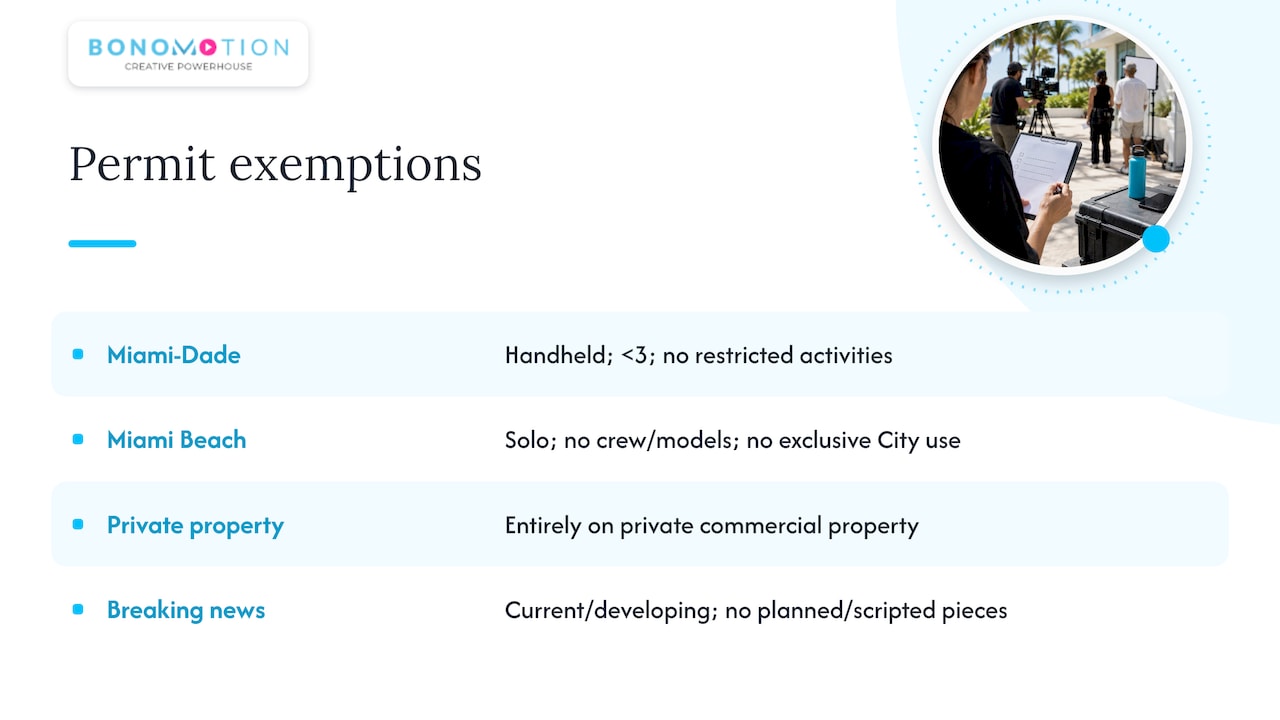
Exemptions exist, but they are narrow and worded carefully.
Miami-Dade County: small, handheld, non-exclusive productions with a cast and crew of fewer than three people are generally exempt, provided there are no stunts, pyrotechnics, weapons, animals or other restricted activities.
Miami Beach: a single camera operator using a handheld camera or tripod, with no assistants, crew or models and no exclusive use of City property, is exempt. Most filming contained entirely within private commercial property does not require a City permit.
Breaking news: the county limits the news exemption to events that are currently occurring or developing. A pre-arranged interview or a scripted piece does not qualify, even when a news organization is behind it. If your company is producing a testimonial or executive interview, treat it as a permitted shoot whenever it touches public property.
Our advice: if you are even slightly in doubt, ask. A two-minute call costs less than a shoot shut down halfway through a call sheet.
What a Miami film permit costs
Costs depend on the jurisdiction, so budget for each one your shoot touches.
| Jurisdiction | Permit cost | Good to know |
|---|---|---|
| Miami-Dade County (Film Miami) | $150 application processing fee | Non-refundable. Valid for a 28-day period beginning on the first day of production. Effective with the Implementing Order of October 1, 2025. |
| City of Miami Beach | No permit, square footage or usage fees | You pay separately for services such as meter rentals and off-duty police officers. |
| City of Miami | Confirm on the City’s permit page | Invoices for required services must be paid before the permit is issued. |
Two details from the county’s order are worth underlining. First, the $150 fee is non-refundable, so submit once your dates and locations are reasonably firm. Second, if your anticipated permitted activities change, the permit and fee need to be modified. A script rewrite that adds a rooftop scene or a vehicle shot is a reason to call the office before the shoot day, not after.
The permit fee is rarely the largest line item. Insurance, police staffing, parking and meter fees, and location fees for private venues usually add up to more. Build those into the production budget at the proposal stage, which is how we scope projects for clients.
How long approval takes
Permits are not instant, so work backward from your shoot date.
- City of Miami: applications involving street closures should be submitted at least 7 business days before the shoot. All other applications should be in at least 3 business days ahead.
- Miami Beach: timelines depend on the request. Citywide requests generally need at least 3 business days, commercial districts 5 business days and residential areas 10 working days. Expedited requests can be accommodated. The office tries to issue permits within a few hours of receiving all deliverables, and first-time citywide permits average about 3 business days of coordination, though they can be pulled within a day.
- Miami-Dade County: apply as early as your locations are confirmed, particularly for public buildings or anything that needs police staffing.
The pattern is clear: most delays come from incomplete paperwork, not slow offices. A complete package with insurance and signed agreements moves quickly.
Insurance and paperwork you will need
Expect to assemble the same core documents for every Miami application.
- Certificate of insurance. Every permit application must include a certificate naming the applicable municipality or Miami-Dade County as an additionally insured party, with a minimum of $1,000,000 in general liability coverage.
- Police staffing endorsement. Effective January 7, 2025, any permit that requires Miami-Dade Police staffing needs an additional insurance certificate naming the Office of the Sheriff of Miami-Dade County as additionally insured.
- Indemnity agreement. City of Miami applicants submit an Indemnity/User Agreement with the application and provide proof of insurance to finalize the permit. Miami Beach requires a signed and sealed Indemnity Agreement that is notarized or carries a corporate seal, and it is valid for 3 years.
- Production details. Locations, dates, hours, crew and cast size, equipment, vehicles and any special activity. Be specific, since the office evaluates the footprint of what you describe.
Send your insurance broker the exact wording early. Additional insured endorsements are the most common reason a Miami permit sits unfinished.
Rules for filming on streets, parks and public property
A permit is not a blank check. Filming on public property comes with site plans, timelines and vehicle access rules, and complex setups or stunts often require police or fire staffing.
Miami Beach illustrates how this works. Its citywide permit is built for small-scale, handheld work on streets and parks. It does not allow blocking traffic or using generators. Small citywide shoots, typically 12 or fewer people with portable equipment, generally do not need a police escort. Anything bigger, such as a branded commercial with a truck, lighting package or a rolling lane closure, moves into location-specific permitting with officers and a site plan.
A few habits keep shoots on the right side of the rules:
- Keep a printed or digital copy of the permit with your production assistant at each location.
- Brief the crew on the permitted hours, parking zones and areas that are off limits.
- Plan for South Florida weather. A rain delay is easier to handle if you have already asked about backup dates.
- Never improvise a location. A new spot needs its own approval.
A practical permit checklist
- Lock your locations and rough dates, then confirm which jurisdiction covers each one.
- Call Film Miami if you span multiple municipalities or need a public building.
- Decide whether your crew and equipment fit an exemption. If it does not clearly fit, apply.
- Request the insurance certificate and any police staffing endorsement from your broker.
- Prepare the indemnity agreement, notarized or sealed where required.
- Submit with the lead time above: 3 or 7 business days in the City of Miami, and 3 to 10 in Miami Beach depending on the area.
- Pay the county’s $150 fee and any invoices for services before the shoot.
- Keep the permit on set and call the office at once if your plans change.
Check the official Film Miami, City of Miami and Miami Beach pages for current forms and fees before you apply. Rules and fee schedules get updated.
How a producer makes permitting painless
The permit process is where an experienced local producer earns their keep. Knowing which office to call, how a Miami Beach residential request differs from a commercial district request, and what a broker needs to put on the certificate keeps a production on schedule. If your project is a corporate story, a branded campaign or a multi-location shoot, our Miami video production services are built around that kind of planning. For shoots in the Beach, see our South Beach video production page. If you would rather film indoors and skip street permitting altogether, a production studio rental in Miami is a controlled alternative with no sidewalks to manage.
Perspective: permits are part of the creative plan
After more than 20 years producing in Miami, we have seen the same pattern: the shoots that go smoothly treated permitting as part of pre-production, never as a last-minute chore. A permit shapes the schedule, the crew size and sometimes the creative itself.
When we plan a corporate film, an event or a lifestyle campaign, a dedicated producer maps every location to its jurisdiction, confirms what is needed and builds lead time into the calendar. That is the difference between a crew that waits on a curb and a crew that captures the golden hour.
If you are unsure whether your shoot needs a permit, treat that as a reason to talk to a producer early. It costs nothing to ask, and it protects your budget, your talent and your brand.
Bernard Bonomo
Let us handle the production side
From executive interviews to multi-day events and branded campaigns, Bonomotion has been producing in Miami and across South Florida since 2003. A producer works with your team on objectives, audience, timeline and locations, so permitting is planned from day one.
Tell us about your project and we will scope the shoot, locations and schedule with you. Explore our full list of video and photography services or visit Bonomotion to request a proposal.
FAQ
Do I need a permit to film in Miami if I only use a handheld camera?
Often not, but only in narrow cases. In Miami-Dade County, small, handheld, non-exclusive productions with a cast and crew of fewer than three people are generally exempt if they involve no stunts, weapons, animals or similar activities. In Miami Beach, a single operator with a handheld camera or tripod and no assistants, crew or models is exempt. Add a crew member, a model or exclusive use of a space and you should apply.
How much is a film permit in Miami-Dade County?
Miami-Dade County charges a non-refundable $150 application processing fee under the Implementing Order effective October 1, 2025. It covers a 28-day period starting on the first day of production. Miami Beach does not charge permit fees, though you pay separately for services such as meter rentals and off-duty police officers.
How far in advance should I apply for a Miami film permit?
The City of Miami asks for at least 7 business days when the shoot involves street closures, and at least 3 business days for everything else. Miami Beach generally needs 3 business days citywide, 5 for commercial districts and 10 working days for residential areas, with expedited requests possible. Applying earlier is always safer, especially for public buildings or police staffing.
What insurance do I need for a Miami film permit?
All applications need a certificate of insurance naming the county or municipality as additionally insured, with at least $1,000,000 in general liability coverage. If your permit requires Miami-Dade Police staffing, you also need a certificate naming the Office of the Sheriff of Miami-Dade County as additionally insured. Ask your broker to match the wording the permitting office requires.
Do I need a permit to film on private property in Miami?
It depends on the city. Countywide, the permit requirement centers on public property, but the City of Miami and Miami Beach also require permits for certain shoots on residential or private property. In Miami Beach, most filming contained within private commercial property does not require a City permit. Confirm with the permitting office for your exact address.