
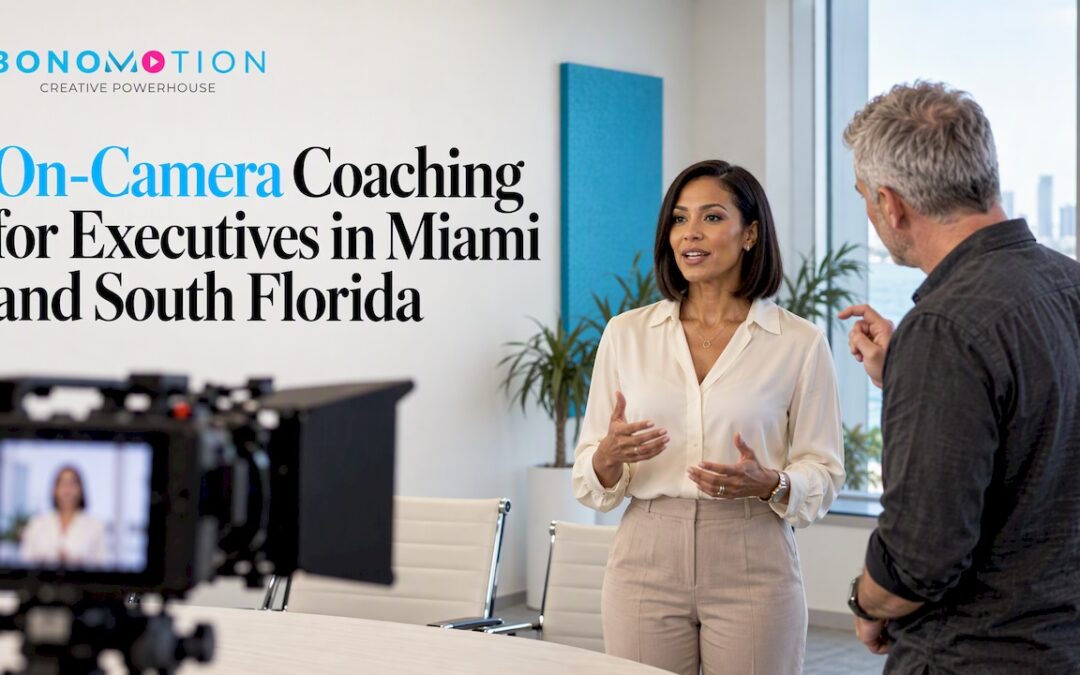
On-camera coaching teaches you to deliver your message on video with clarity, ease and credibility. It covers what you say, how you say it, where you look, how you sit and what you wear. For executives, it is the difference between a video that builds trust and one that quietly costs you it. This guide explains what coaching involves, how to practice before a shoot, how to look your best on screen, and how to get the most from a professional production day in Miami, Fort Lauderdale, Coral Gables or Palm Beach.
TL;DR
- On-camera coaching trains your message, delivery and presence together, using recorded practice and feedback rather than theory.
- The lens keeps everything: pauses, fidgeting, false starts. Preparation matters more on video than in a conference room.
- Practice with video, not a mirror. Watch a take, keep what works, change one thing, record again.
- Good light, an eye-level camera, a clean background and solid, comfortable clothing do half the work before you say a word.
- A producer-led shoot with a studio, teleprompter and a patient crew gives executives the best conditions to perform.
Table of Contents
- What on-camera coaching actually is
- Why video is less forgiving than a meeting room
- Coaching versus media training: what is the difference?
- What good coaching covers
- How to practice being on camera
- How to look good on camera
- On-camera tips for executives in particular
- Where coaching shows up in business video
- Our perspective: coaching belongs inside the production
- A simple preparation plan for shoot day
- Work with Bonomotion in Miami and across South Florida
- FAQ
What on-camera coaching actually is
On-camera coaching is structured practice in front of a camera with an expert watching. A coach assesses how you come across now, picks the habits that help or hurt, and runs targeted exercises until the better version becomes your default. Then you apply it to the real situation: a brand film, a customer testimonial, a livestream, a investor update or a television interview.
The session usually moves through four stages:
- Baseline recording. You speak naturally on a familiar topic so the coach and you can see your starting point.
- Review. You watch together. The first job is to spot what already works, such as a warm opening or a natural gesture.
- Targeted exercises. Eye line, pace, filler words, posture and energy are worked on one at a time.
- Real-world application. You rehearse the actual script, talking points or interview questions, with feedback after each take.
People often assume this is only for the camera shy. In practice, confident speakers benefit too. A great keynote speaker can still look flat on a lens, because a room gives you energy back and a camera does not.
Why video is less forgiving than a meeting room
In a room, people read your whole presence and forgive small stumbles. On video, the frame is tight and the recording is permanent. A long pause that felt thoughtful looks like hesitation. A shifting posture looks like nerves. A glance at your notes looks like you are not sure of your own message. Clothing, movement and speech all need attention beyond ordinary presentation skills.
There is also the audience to consider. A video may be watched on a phone, muted, in a hurry, by a prospect who has never met you. You have a few seconds to look like someone worth listening to. That is why corporate leaders increasingly treat video delivery as a skill to be trained, not a talent to be hoped for.

Coaching versus media training: what is the difference?
The two overlap, and people search for both, so it helps to separate them.
- On-camera coaching focuses on presence and performance: how you look, sound and connect on video. It suits brand films, company profile videos, testimonials, webinars and social video.
- Media training focuses on handling interviews with journalists and other outside interviewers. A typical program develops three or four key messages, simulates interviews of rising difficulty, records them and replays them to work on body language, filler words, eye contact and delivery.
If you face hostile questions, a crisis or a press tour, a dedicated media training program is the right tool. If your goal is a strong corporate video, a confident testimonial or a polished livestream, on-camera coaching built around the production itself is usually what you need. Many executives need both at different points in the year.
What good coaching covers
Message before performance
No amount of polish rescues a muddy message. Before you worry about your hands, decide what the viewer should remember. Two or three priority points is plenty for most videos. Write them as plain sentences you would say to a customer across a table. Then build short, memorable lines around them.
Eye line and connection
Look into the lens, not at your own image and not at the crew. The lens is your viewer. Beginners find this unnatural because nobody is there. The trick is to picture one specific person, a client or a new hire, sitting just behind the glass. Speaking to one person warms your voice and your face at once.
Voice, pace and pauses
Most people speak too fast on camera when nervous. Slow down by about ten percent, breathe at the end of sentences, and let your voice finish downward on statements instead of drifting up like a question. A deliberate pause reads as authority. A filled pause (um, you know, so) reads as doubt.
Posture and gesture
Sit or stand tall, with shoulders relaxed and open. Keep gestures at chest height so they stay inside the frame, and make them smaller than you would in a room. Blink naturally, keep a friendly, alert expression, and avoid swiveling in a chair.
Energy
The camera flattens energy. Aim to feel about a notch more animated than normal, so you land as yourself on screen. Coaches often call this raising your volume knob by one click, not five.
How to practice being on camera
You can improve a great deal before anyone coaches you, with a phone and 15 minutes. The method that works is practicing with video, not a mirror. A mirror makes you judge yourself mid-sentence. A recording lets you perform first and evaluate afterward.
- Set up like the real thing. Use the same camera, lighting, microphone and app you will use on the day. If you will be livestreaming, rehearse on the platform.
- Record a full take. Answer a real question or deliver your actual opening, and time it. Do not stop to fix mistakes. Recovering gracefully is a skill worth practicing.
- Watch it once for what works. Note two or three things you like. This keeps you from piling on self-criticism.
- Choose one change. Eye line, pace, filler words or gestures. Just one.
- Record again with that single focus. Compare the takes side by side.
- Repeat across several days. Even five minutes of recorded practice reveals habits you never noticed, like looking away to think, rushing endings or gesturing out of frame.
Two more habits help. Practice the structure rather than memorizing every word: know your opening, your transitions, your toughest explanation and your close, and let the sentences in between be conversational. And do a test recording at least a day before any important video, checking audio and playback while there is still time to fix them.
If you read from a script on shoot day, a teleprompter changes how you practice. Our guide to using a teleprompter for interviews explains how to sound natural while reading.
How to look good on camera
Looking good on video is mostly setup. Get these six things right and your delivery does the rest.
| Element | What works | What to avoid |
|---|---|---|
| Light | Soft light facing you, from behind or beside the camera | A window or lamp behind you, harsh overhead light |
| Camera height | Eye level or slightly above | Looking up from a low laptop |
| Framing | Chest-up or waist-up, modest headroom, eyes near the upper third | Cropped foreheads, huge empty space above |
| Background | Quiet, uncluttered, indoors | Public spaces, cars, busy shelves |
| Clothing | Solid colors, slightly more polished than your usual office dress, good contrast with the background | Tight patterns, shiny jewelry, colors that match the wall |
| Posture | Upright, open, hands visible | Slouching, crossed arms, leaning into the lens |
South Florida adds its own quirks. Bright midday sun through glass, humidity and air-conditioned rooms all affect how you look. Arrive cool and unrushed, bring a backup shirt or jacket, and ask your producer about powder or touch-ups for shine under lights. Waterfront offices in Brickell and Fort Lauderdale are beautiful, but the glare off the water can wreck exposure, which is one reason many leaders prefer a controlled studio.
On-camera tips for executives in particular
Executives face pressures that other speakers do not. Your words are quoted, your face represents the company and your team will watch the video for signals about strategy and culture. These habits help.
- Lead with the point. Say the conclusion first, then support it. Viewers drop off quickly.
- Use plain language. Replace internal jargon with the words your customer uses.
- Tell one short story. A single customer example beats three abstract claims.
- Be human about uncertainty. Honest, calm answers read as strong. Evasion reads as weak.
- Prepare for the hard question. Know the two questions you would least like to be asked, and rehearse answers that are truthful and brief.
- Know your format. A live call allows a conversational one to two minute answer. A one-way recording has a fixed time limit, so aim to finish with a few seconds to spare.
- Keep your closing line ready. A strong last sentence, delivered slowly, is what people remember.
Where coaching shows up in business video
Different formats ask for different things from the person on camera.
- Corporate and company profile videos. You represent the brand’s story, so warmth and clarity matter most. See how a corporate video production project is planned from concept to delivery.
- Testimonials and interviews. The goal is natural, specific speech, not a recited script. Good interview technique, with open questions and a relaxed pace, pulls it out of you. Our interview and testimonial video production service is built around that.
- Live streams and hybrid events. There are no retakes, so rehearsal on the actual platform is essential. A live streaming company in Miami can run technical checks and a dress rehearsal with you.
- Event keynotes and panels. You need to play to both the room and the camera. Learn where the cameras sit and glance at them at key moments.
- Headshots and executive portraits. The same principles of posture, expression and light apply to stills, and professional photography from the same shoot day gives your team matching assets.
Our perspective: coaching belongs inside the production
We have been producing corporate, event, livestream and lifestyle video since 2003, and we have watched thousands of people step in front of a lens for the first time or the hundredth. Here is what we have learned: the best on-camera performance rarely comes from a lecture. It comes from conditions.
When the producer has taken time to understand your objectives, audience and timeline, you walk in knowing why the video exists and who it is for. When the set is calm, the lighting is already right, the camera is at the correct height and a teleprompter or interview prompts are ready, you can focus on one thing: talking to a person. That is why every Bonomotion project is guided by an experienced producer who works closely with your team and acts as an extension of your organization.
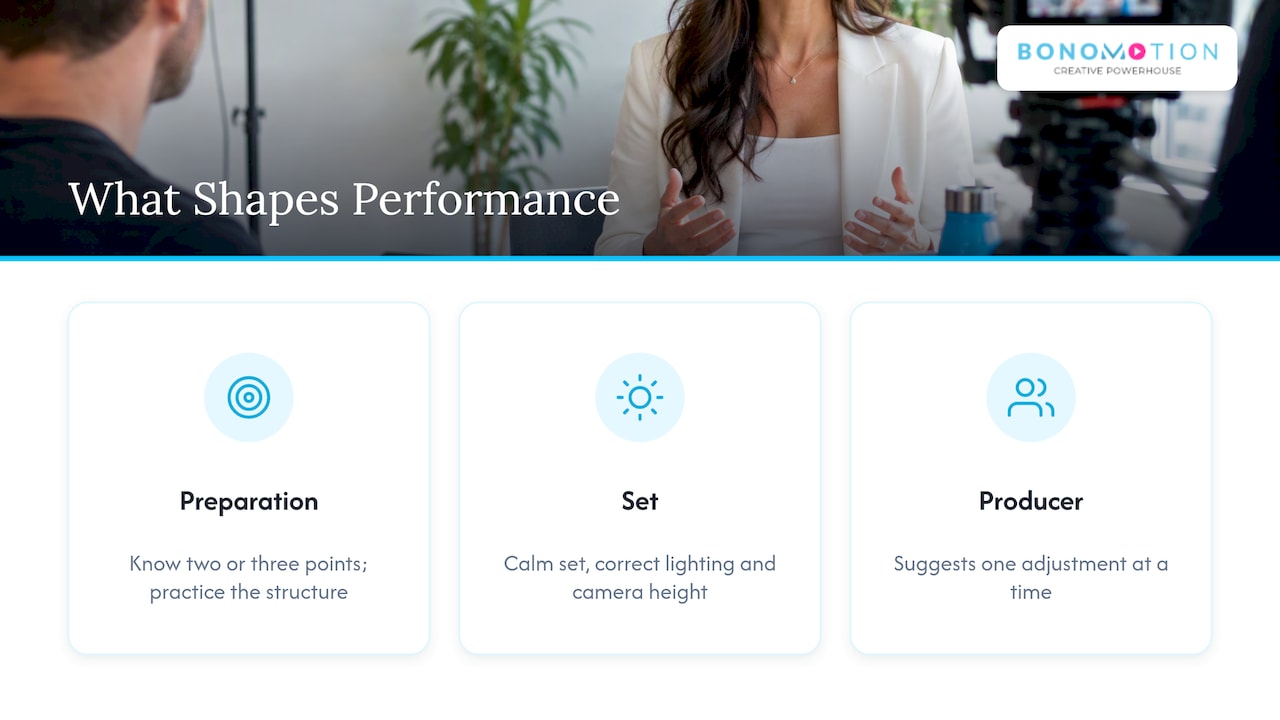
We also believe executives should be prepared, not scripted into stiffness. Know your two or three points, practice the structure, and let your own voice carry them. Our crew is there to make that easy: to reset a take without making you feel judged, to point out what is working, and to suggest one adjustment at a time.
If you need a formal media training program for hostile press, we would tell you to pair us with a specialist in that field. If you need a confident, polished, on-brand video, we will help you walk in prepared and leave with something you are proud to share.
— Bernard Bonomo
A simple preparation plan for shoot day
Use this timeline for any important executive video.
One week before
- Share your goal, audience and distribution plan with the producer.
- Draft your two or three key messages in plain language.
- Choose outfits in solid colors, and bring a second option.
Two to three days before
- Record two full rehearsals on your phone, review them and choose one improvement for each.
- Practice your opening and closing until they feel automatic.
- Prepare short answers to the toughest questions.
The day before
- Run a test recording and check audio and playback.
- Get enough sleep, and hydrate. Limit heavy meals and caffeine right before.
On the day
- Arrive early so you can see the set and meet the crew.
- Do a few warm-up sentences aloud, loosen your shoulders and breathe slowly.
- Treat the first few takes as warm-ups. Most people hit their stride by take three or four.
- Ask for playback. Seeing a good take builds confidence for the next.
Work with Bonomotion in Miami and across South Florida
If you are planning a corporate film, executive interview, testimonial series, livestream or event coverage, we can build the production around making you look and sound your best. Our team serves Miami, Fort Lauderdale, Coral Gables and Palm Beach, with service across Florida and nationwide. We can also bring the shoot into a controlled environment through our studio and equipment rentals, so lighting, sound and backgrounds are never left to chance.
Tell us about your project and your timeline, and a producer will help you plan it. Start at our services overview or visit Bonomotion to ask about studio and rentals.
FAQ
How long does it take to improve on camera?
Most people notice a real difference after a single focused session, because the biggest gains come from a few fixable habits like eye line, pace and filler words. Lasting confidence comes from repeating short recorded practice sessions over a few weeks. Even five minutes of recording and review can reveal problems you never noticed.
What should I wear on camera?
Choose solid colors that contrast with your background and dress slightly more polished than your usual workplace standard. Avoid tight patterns, which can shimmer on video, and shiny accessories that catch the light. Bring a backup outfit so you can swap if something looks off on the monitor.
Where should I look when I am being filmed?
Look into the lens when speaking directly to the viewer, and keep your eyes near the upper third of the frame. In an interview, you may look at the interviewer if the producer directs you to, so ask before the shoot. Picturing one specific person behind the lens makes eye contact feel natural.
Is on-camera coaching the same as media training?
Not quite. On-camera coaching builds presence and delivery for brand, testimonial, livestream and web video. Media training prepares you for interviews with outside journalists, including difficult questions and key message discipline. Some executives need both, depending on the project.
Can a production team help me prepare for a corporate video in Miami?
Yes. A producer who understands your audience and objectives can plan the questions, set, lighting and prompter so you feel prepared and relaxed. At Bonomotion, an experienced producer guides every project from concept to delivery, and we serve businesses throughout South Florida and nationwide.