
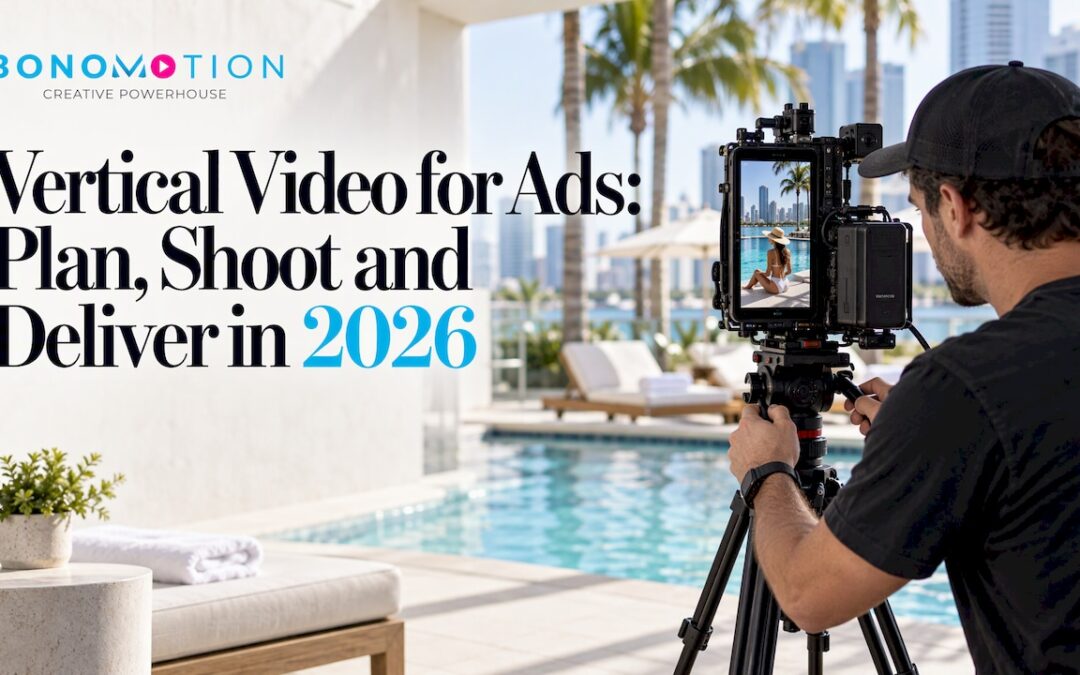
Vertical video for ads is a full-screen, portrait-format spot, usually 9:16 and 1080×1920 pixels, designed for the way people hold their phones. The ads that work are built vertically from the first frame. They open with action, carry one message, stay inside the platform’s safe zones and make sense with the sound off. This guide walks through each step, from concept to export, and shows where a Miami production team fits in.
TL;DR
- Shoot in 9:16 from the start. Cropping a horizontal commercial into a vertical frame almost always leaves weak framing and unreadable text.
- Open with movement or a clear visual in the first one to two seconds, then deliver one simple message and one call to action.
- Keep captions, logos and the CTA away from the top and bottom edges, where app buttons and captions cover your image.
- Build one vertical master, then export variants (4:5, 1:1, 16:9) for placements that need them.
- Plan the vertical version during pre-production. At Bonomotion we shoot a single day for horizontal and vertical deliverables, so you are not paying twice.
Table of Contents
- Why vertical video ads fit mobile viewing
- Vertical video ad examples that work
- Specs: sizes, ratios and file basics
- Plan the message, hook and call to action
- Filming for a vertical frame
- Editing and safe zones
- One master, many placements
- Our perspective on vertical ads
- Where vertical ads pay off in South Florida
- Bring your vertical ad campaign to Bonomotion
- FAQ
Why vertical video ads fit mobile viewing
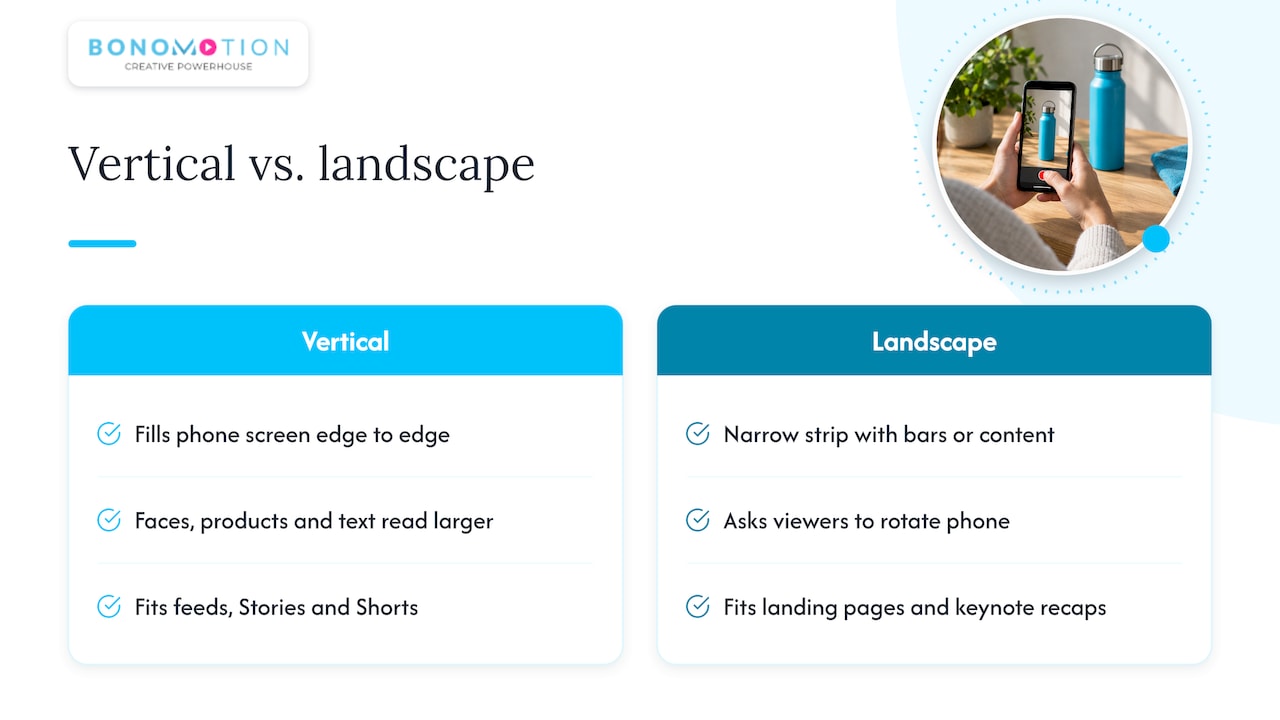
Most people scroll with one hand and the phone upright. A vertical ad fills that screen edge to edge. A horizontal ad sits in a narrow strip in the middle, surrounded by black bars or other content, and asks the viewer to rotate the phone. Most will not.
That is the practical case for vertical. The frame you pay for is the frame the viewer sees. Faces read larger, products read larger, and on-screen text becomes legible without squinting. Big ad platforms have built dedicated full-screen vertical placements for the same reason: short-form feeds, stories and Shorts all assume a portrait screen.
For a business in South Florida, the audience is overwhelmingly mobile. Hotel guests checking restaurant options, buyers browsing a waterfront listing, attendees looking up a conference agenda: all of them are on a phone, often outdoors, often with the sound off. Your ad has to work in that setting.
Vertical is not a replacement for every format. A brand film on a landing page or a keynote recap on a website still belongs in landscape. The point is to match the format to the placement, and for paid social and short-form feeds that format is vertical.
Vertical video ad examples that work
The strongest vertical ads share a structure even when the industries differ. Here are the patterns we see work again and again, with ways they apply to South Florida businesses.
The product-in-hand demo
A hand enters the frame, the product does something useful, and a short line of text names the benefit. This works for retail, hospitality amenities, boat accessories and consumer goods. The vertical frame suits it because hands and products naturally stack from top to bottom.
The customer testimonial cut-down
Take a long customer interview and pull out a single sentence that states a result. Frame the speaker from the chest up, add word-by-word captions and end on a clean card with the offer. A professional services firm, a clinic or a software company can turn one interview shoot into a dozen vertical ads. Our interview and testimonial video production is built with this reuse in mind.
The event recap teaser
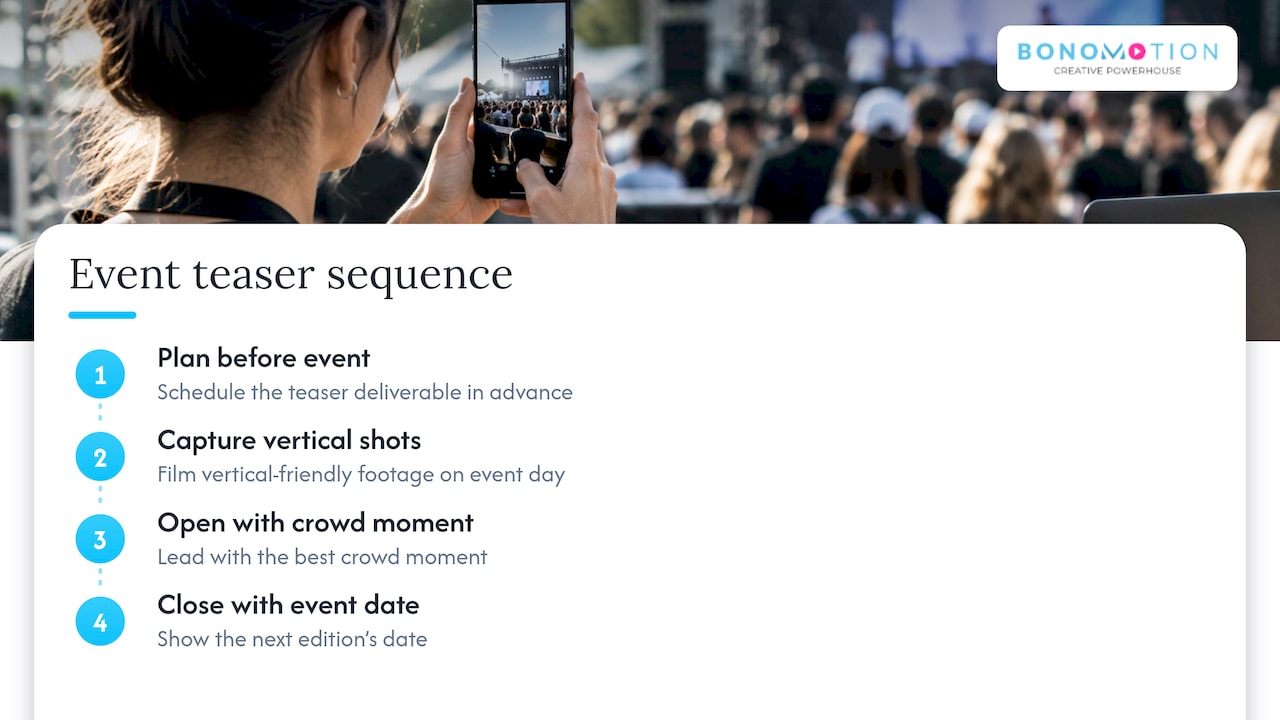
A conference, gala or product launch generates hours of footage. A 10 to 15 second vertical teaser, with the best crowd moment first and the next event’s date at the end, promotes ticket sales for the following edition. If you are an organizer, plan this deliverable before the event, so cameras capture vertical-friendly shots on the day. See how we approach event videography and photography for South Florida planners.
The property or vessel reveal
Real estate and yacht marketing are naturally suited to vertical: a slow upward tilt from the water to a flybridge, or from a front door up to a two-story ceiling, uses the tall frame to its advantage. Our real estate marketing video work includes vertical cuts built for social ads alongside the main listing film.
The animated explainer in portrait
When the subject is abstract, such as software, financial services or a process, animation clarifies it. A vertical explainer can stack icons and short phrases top to bottom, one idea per beat. Our explainer video productions can be delivered in portrait ratios from the beginning of the storyboard.
Specs: sizes, ratios and file basics
Platform requirements change, so confirm the current numbers in each platform’s ad documentation before you export. The table below gives the standard starting points we work from.
| Placement | Recommended ratio | Typical resolution | Sound default |
|---|---|---|---|
| Reels and Stories ads | 9:16 | 1080×1920 | Often muted, design for both |
| TikTok ads | 9:16 | 1080×1920 | Sound on |
| YouTube Shorts ads | 9:16 | 1080×1920 | Sound on |
| Social feed placements | 4:5 or 1:1 | 1080×1350 or 1080×1080 | Often muted |
| YouTube in-stream | 16:9 | 1920×1080 | Sound on |
A few notes on using this table:
- MP4 with H.264 compression is the safest delivery format for most ad platforms.
- Shoot and finish in at least 1080×1920. If you shoot in 4K, you gain room to reframe without losing sharpness.
- Keep a clean audio mix. Even when a placement defaults to muted, viewers who tap for sound should get clear dialogue and music that does not bury it.
- Duration: short wins in paid feeds. Many advertisers aim for roughly 6 to 15 seconds for awareness spots and up to 30 seconds when the story needs it. Check each platform for its maximum and recommended range.
The common question of whether vertical means 1080×1920: yes, that is the standard full-screen vertical resolution at a 9:16 ratio. Some placements accept lower resolutions, but delivering 1080×1920 keeps you compatible.
Plan the message, hook and call to action
A vertical ad gives you very little time. Planning matters more than camera choice.
Write one message
Pick a single idea: a new service, a seasonal offer, an event date, a customer result. If you cannot say it in one sentence, the ad will try to do too much. Everything else belongs on the landing page.
Design the first two seconds
The opening frame decides whether someone keeps watching. Strong openers include:
- A moving subject, such as a hand, a boat leaving a dock or a crowd cheering.
- A face looking at the camera and starting to speak.
- A bold, specific statement in text, such as a result or a question the viewer cares about.
- A surprising visual detail the viewer wants to understand.
Avoid slow logo animations and long establishing shots. Show the brand early, but through the product or setting rather than a title card. For more on how opening moments shape retention, read our guide to video storytelling techniques that drive engagement.
Make the call to action specific
Tell the viewer exactly what to do next: book a tour, reserve a seat, request a quote. Put the call to action in the final beat on a clean end card and, where the platform supports it, in the ad’s own button and caption. Do not rely on the button alone, because viewers who never look at it will miss the instruction.
Write for sound-off viewing
Treat captions as part of the creative, not an afterthought. Word-by-word or short-phrase captions keep the eye moving and carry the message if the phone is muted. Record clean audio anyway, for viewers who do listen.
Filming for a vertical frame
Filming vertically is a different discipline from filming landscape and then cropping.
- Frame for height. With no wide horizon, depth comes from layers: a foreground element, a subject, a background. Tilts and vertical camera moves feel natural.
- Move closer. Faces and products should fill the frame. A medium shot in landscape is often too distant in portrait.
- Use a gimbal or stable rig. Small shakes are more noticeable on a phone-sized screen, unless a handheld, native look is the goal.
- Light for faces. Because people dominate vertical ads, soft key light and clean backgrounds matter. Our studio and equipment rentals are useful here, whether you need a controlled setup or a camera package for your own team.
- Shoot extra coverage. Capture close-ups, cutaways and a few alternate openings. They give you material for testing different hooks.
If the same shoot must also deliver a landscape film, tell the producer early. We frame key shots with both in mind, using separate setups when a single frame cannot serve both ratios.
Editing and safe zones
Every platform overlays its own interface on your video: the account name, the caption, the like and share buttons, the call-to-action bar. If your text sits underneath them, nobody reads it.
A working rule of thumb is to keep important text, logos and faces inside the central area of the frame, leaving generous margins at the top and especially the bottom, plus a little at the sides. The exact margins vary by platform and change over time, so check each platform’s current ad guide and set guides in your editing timeline. Export a test file and view it inside the actual app on a real phone before you approve it.
Other editing habits that help:
- Cut faster than you would for landscape. New visuals every one to three seconds hold attention in short-form feeds.
- Use large, high-contrast type. If you must squint, it is too small.
- Keep one idea per caption line. Long sentences blur the rhythm.
- Match the platform’s native feel. Short-form feeds like TikTok tend to reward a casual, authentic look. Placements such as feed ads and in-stream video often reward more polished production. Decide where the ad will run before you choose the style.
- End clean. Hold the final card for a beat so viewers can read the offer.
One master, many placements
The most efficient workflow is to treat vertical as the master and derive everything else from it.
- Build the 9:16 master with safe margins, captions and a mix that works with or without sound.
- Export a 4:5 version for feed placements, and a 1:1 version where square inventory is useful.
- Create a 16:9 cut for in-stream or website use when needed. This is often a re-edit rather than a simple crop.
- Make two or three hook variants. Change only the first few seconds and the caption, and keep the rest identical.
- Test one variable at a time. Compare hooks, then offers, then lengths. Keep what wins.
This approach diversifies your creative across ratios without losing the message, and it keeps the production budget focused. Our guides to social video strategy and creating engaging micro videos go deeper on cadence and format planning.
Our perspective on vertical ads
Vertical video ads fail when they are treated as an afterthought: a landscape commercial squeezed into a portrait frame at the last minute. They succeed when the producer, the director and the editor all know on day one that the ad will live on a phone.
After more than 20 years producing corporate, event and commercial video, we have seen formats come and go. What has not changed is that clear messaging, strong faces and honest storytelling win attention. Vertical is simply a new frame for the same craft.
That is why every Bonomotion project is guided by an experienced producer who works with your team on objectives, audience and timeline. When vertical is part of the plan, we shape the shot list, the interviews, the animation and the edit around it, so one production day yields a library of ads rather than a single spot.
Bernard Bonomo
Where vertical ads pay off in South Florida
South Florida’s economy is full of businesses that sell visually and locally. Some practical uses:
- Events and conferences in Miami and Fort Lauderdale: teaser clips for registration campaigns, speaker announcements and sponsor shout-outs, all built from footage captured at the previous edition.
- Real estate in Miami, Coral Gables and Palm Beach: vertical walk-throughs and neighborhood clips promoted to targeted audiences.
- Yacht and marine marketing: short reveals of vessels, interiors and the water, which are naturally cinematic in portrait.
- Professional services: testimonial clips and short expert answers that build trust before the first call.
- Hospitality and lifestyle brands: quick, appetizing, atmospheric spots for seasonal promotions.
If you want a wider view of how video ads support small and midsize companies, our article on effective video ads for small business growth is a good next step. For campaign-level work, see our page on commercial video production in Miami.
Bring your vertical ad campaign to Bonomotion
We produce corporate, commercial, event, testimonial and animated video from our base in Miami, serving Fort Lauderdale, Coral Gables, Palm Beach and the rest of Florida, with nationwide reach. A dedicated producer takes you from concept to delivery, and we can plan vertical and landscape deliverables in the same production.
Tell us what you are promoting, where the ad will run and when you need it. We will recommend the shoot, the formats and the edit that fit. Start on our services page or explore corporate video production to request a custom proposal.
FAQ
Is vertical video 1080×1920?
Yes. The standard full-screen vertical resolution is 1080×1920 pixels at a 9:16 aspect ratio. Most short-form ad placements, including Reels, Stories, TikTok and YouTube Shorts, work best with this size. Some placements accept smaller files, but delivering 1080×1920 keeps your ad compatible across them.
Is horizontal or vertical video better for Facebook content?
It depends on the placement. Full-screen placements such as Stories and Reels favor 9:16 vertical, while the main feed often performs well with 4:5 or square video. Landscape still suits some in-stream and desktop placements. The simplest approach is to produce a vertical master and export the ratios you need.
How can I create a vertical video ad?
Start with one message and a strong first two seconds, then film in 9:16 with faces and products close to the camera. Add large captions, keep key elements away from the top and bottom edges, and export an MP4 at 1080×1920. A production team can plan all of this before the shoot so the footage works across several placements.
How long should a vertical video ad be?
Shorter is usually better in paid feeds. Many advertisers aim for roughly 6 to 15 seconds for awareness and up to 30 seconds when the story needs more time. Always check the maximum and recommended length in the platform’s current ad guide before you finalize the edit.
Can one shoot produce both vertical and horizontal ads?
Yes, if it is planned in advance. The producer sets up key shots for each ratio, captures extra close-ups and coverage, and the editor builds separate cuts instead of cropping a single one. Tell your production team about every placement before the shoot day.