
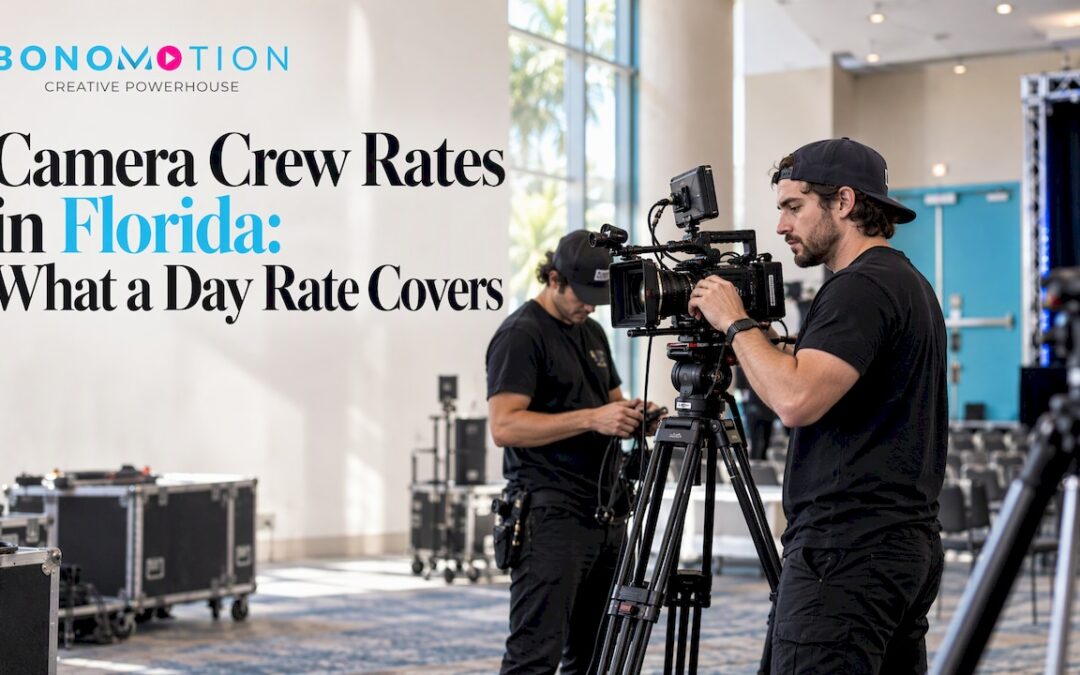
Camera crew rates in the U.S. run from roughly $500 to $1,500 per day for a solo freelance videographer to $2,000 to $7,000 or more per day for an agency crew, according to a 2026 industry guide. Florida sits close to the national baseline. What moves your number is the crew size, the roles on set, the hours, and what the day includes. This guide breaks down each of those so you can budget a shoot in Miami, Fort Lauderdale, Coral Gables or Palm Beach with confidence.
TL;DR
- A solo videographer is commonly quoted at $500 to $1,500 per day, while a full agency crew is commonly quoted at $2,000 to $7,000+ per day.
- A standard day is usually 8 to 10 hours. Overtime is billed on top, and a half day typically lands at 60 to 70% of the full day rate.
- The shoot day is often only 40 to 60% of total project cost. Editing, graphics, music, travel and permits make up the rest.
- Rates rise with each added role: operator, assistant camera, sound, lighting, producer.
- The fastest way to a firm number is a short brief. We scope every project around your goals, audience and timeline.
Table of Contents
- What a camera crew day rate actually is
- Typical day rates by role
- What affects camera crew rates in Florida
- Overtime, half days and other add-ons
- Worked example: a one-day corporate shoot in Miami
- Freelancer, small crew or full production team
- What a camera operator earns, and why it matters to you
- How to get an accurate quote fast
- Crew needs by project type
- Book a crew that comes with a producer
- FAQ
What a camera crew day rate actually is
A day rate is a flat fee for a block of working hours, normally 8 to 10 on the clock. It covers the person’s time on set. Whether it also covers gear, travel, prep, and post-production depends on how the quote is written, and that is where two quotes that look different turn out to be the same.
Two terms matter most:
- Kit fee (dry hire vs. wet hire): A dry hire is the equipment alone. A wet hire is equipment plus the operator. Many freelancers quote a labor rate and then add a separate kit fee for cameras, lenses, lighting and audio.
- Hours in the day: An 8-hour day and a 10-hour day are not the same product. Always confirm the hours before you compare numbers.
A quote that bundles labor, gear and a producer into one line can look expensive next to a lone operator’s rate. It is usually the more complete package, because the producer is the person who keeps the schedule, talent and deliverables on track.
Typical day rates by role
Published guides show wide ranges because budget tier, market and experience all matter. A non-union crew rate guide for major markets lists daily ranges like these:
| Role | Lower-budget range (per day) | Higher-budget range (per day) |
|---|---|---|
| Director of Photography / Cinematographer | $600 to $1,000 | $2,500 to $5,000+ |
| Camera Operator | $400 to $550 | $800 to $1,200 |
| 1st Assistant Camera (1st AC) | $350 to $450 | $600 to $900 |
What each role does, in plain terms:
- Director of Photography (DP): Designs the look of the image: lighting, lensing, camera movement. Hired when visual quality is part of the brand promise.
- Camera operator: Runs the camera to the DP’s or director’s plan. On smaller corporate shoots, one person often does both jobs.
- 1st AC: Keeps focus sharp and manages the camera package. Valuable on moving-camera, shallow-depth-of-field, or multi-camera shoots.
- Sound recordist: Captures clean dialogue. Poor audio is the most common reason interview footage cannot be used.
- Gaffer and grip: Build and control lighting and rigging. Needed for polished interviews, commercials and lifestyle work.
- Producer: Runs logistics, talent, locations and timeline. Freelance producer ranges in Florida are listed at $400 to $650 for emerging producers up to $1,700 to $3,000 for expert producers.
Union status changes the math too. Union crews are typically more expensive and come with set rules on hours and meal breaks. Most corporate, event and branded work in South Florida is non-union, but large productions sometimes require union labor, so it belongs on your list of questions.
What affects camera crew rates in Florida
Florida is classed as a mid-market, which means rates run in line with the national baseline rather than at the premium you would see in Los Angeles or New York. South Florida is the most active part of the state, with commercial, branded content, fashion, lifestyle and Spanish-language production running year-round. That steady demand keeps experienced crew busy, so the best people book early, especially during peak event and boating seasons.
Six factors shape any quote:
- Crew size. One operator for a talking-head interview is a different budget from a four-person crew for a product launch.
- Experience level. A seasoned DP who can solve problems fast often saves hours that a cheaper hire would burn.
- Hours and overtime. Long call times, travel between locations and late wraps all add cost.
- Equipment. Cinema cameras, gimbals, drones, teleprompters, multi-camera switchers and lighting kits are priced separately or bundled in.
- Location and travel. Shooting in Miami and Fort Lauderdale on the same day adds drive time. Offshore or yacht shoots add logistics.
- Usage and deliverables. A single 60-second web spot is different from a 90-second brand film plus six social cutdowns.
Overtime, half days and other add-ons
This is where budgets drift. Industry guidance puts a half-day rate at about 60 to 70% of the full day, rarely a clean 50%, because the crew still has to travel, set up and block out the rest of the day. The same guide lists overtime after 10 hours at roughly $75 to $200 per hour for a freelance videographer and $200 to $500 per hour for an agency crew.
Other lines to ask about:
- Pre-production: Scripting, shot lists, location scouting and scheduling.
- Post-production: Editing, color, sound mix, motion graphics, captions and revisions.
- Music and licensing: Stock tracks, voiceover and talent releases.
- Travel and parking: Mileage, tolls, parking at downtown Miami venues, or boat access.
- Permits and insurance: Some venues and public locations require a certificate of insurance or a permit.
- Rentals: Studio time, extra lenses, lighting or audio kits for a specific shot.
The shoot day is often only 40 to 60% of total project cost. If you only budget the crew, you will be short when edit time arrives. For a deeper look at the other half of the budget, see our guide to understanding video production costs.
Worked example: a one-day corporate shoot in Miami
Here is a planning model, not a quote. Say you need a leadership message, three employee interviews and B-roll at your office, delivered as one 2-minute video plus three 30-second cutdowns.
| Line item | What it covers |
|---|---|
| Producer | Pre-production calls, shoot-day coordination, delivery |
| Camera operator or DP | Two-camera interview setup plus B-roll |
| Sound and lighting | Clean audio, flattering light on every interviewee |
| Equipment | Cameras, lenses, lights, microphones, teleprompter if needed |
| Post-production | Edit, color, music, captions, cutdowns, two rounds of revisions |
Price each line with your provider, then add them. Before approving, check three things: how many hours the day includes, whether the equipment is in the rate, and how many revision rounds are included. Our breakdown of corporate video production costs walks through the same logic for budgeting.
Freelancer, small crew or full production team
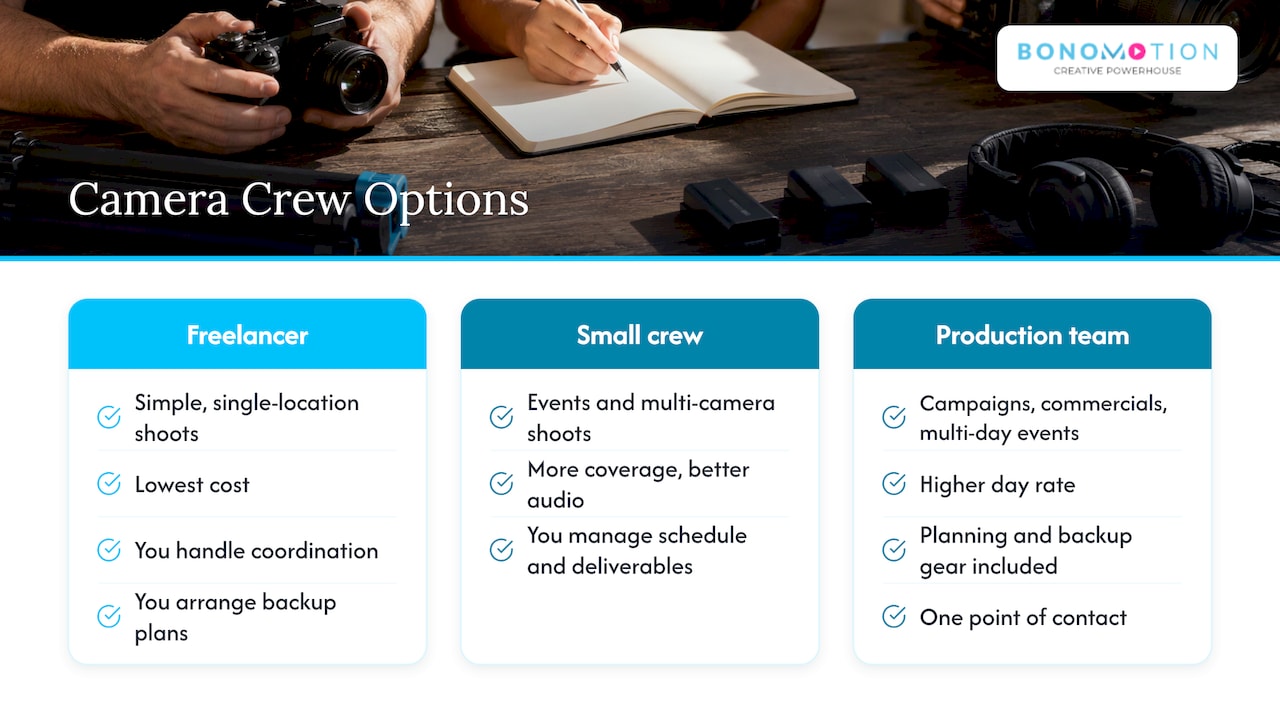
There are three common ways to staff a shoot, and each fits a different need.
A solo freelancer suits simple, single-location work: a short interview, a headshot-style testimonial, social clips. Cost is lowest, but you carry the coordination, backup plans and post-production hand-offs yourself.
A small crew booked directly suits events and multi-camera shoots. You get more coverage and better audio, but someone on your side still has to manage the schedule and deliverables.
A full production team with a producer suits campaigns, commercials, multi-day conferences and anything with brand risk. The day rate is higher, but it includes planning, backup gear, and one point of contact. That reduces the chance of a missed shot or a late delivery, which are the expensive problems on a corporate calendar.
A useful test: if a missed shot or late file would cost you more than the price difference between options, hire for reliability.
What a camera operator earns, and why it matters to you
Day rates make more sense next to what operators earn over a year. The U.S. Bureau of Labor Statistics reports a median annual wage of $74,990 for camera operators in television, video and film as of May 2025, with the lowest 10 percent earning under $38,520 and the highest 10 percent over $135,180. Freelancers do not work every day of the year. They pay for gear, insurance, software and downtime between jobs, so a day rate has to cover far more than the hours on set. A rate that looks low often means a crew that cannot sustain quality equipment or backup gear.
Our perspective on crew rates
After more than 20 years producing corporate, event, livestream and lifestyle work, we have watched the same budgeting mistake repeat: comparing day rates instead of comparing outcomes. A low number on a quote means little if it leaves out the producer, the audio plan, the backup camera or the edit.
We build every project around an experienced producer who works with your team to understand your objectives, audience and timeline. That producer scopes the crew to the job, so you pay for the roles the shoot needs and not for ones it does not. A talking-head interview and a multi-day conference need different teams, and we say so up front.
Our approach is custom proposals for event coverage, animation and photography, plus hourly or package pricing for studio, crew and equipment rentals. The goal is a quote you can read line by line, where the day rate, the gear and the post-production are all visible, so your approval is easy and your final invoice holds no surprises.
Bernard Bonomo
How to get an accurate quote fast
The more specific your brief, the tighter the number. Send these details with your request:
- Purpose and audience: Sales video, internal training, event recap, social campaign.
- Location(s): Office, venue, studio, outdoors, on the water. Name the city: Miami, Fort Lauderdale, Coral Gables, Palm Beach.
- Shoot length: Hours on site, and whether it is one day or several.
- People on camera: How many interviewees, any talent, any need for a teleprompter.
- Deliverables: Run times, aspect ratios (horizontal, vertical), captions, number of cutdowns.
- Deadline: When you need the first cut and the final.
- Budget range: Even a rough range helps a producer propose the right crew size.
If you are still working on the overall budget, our video project budget planning guide for Florida planners and our video production pricing page are good starting points.
Crew needs by project type
Different projects call for different crew shapes. Use these as starting points for conversation.
- Corporate and leadership videos: Often a producer, one or two camera operators, a sound recordist and lighting. See our corporate video production service.
- Events and conferences: Multiple cameras for stage, audience and details, plus photography if you want stills. Multi-day events need rotating crew and a clear shot list. Our event videography and photography team covers this, and our guide for South Florida planners shows how to plan coverage.
- Interviews and testimonials: A lean crew with strong sound and lighting, since the footage depends on how the person looks and sounds. See interview and testimonial video production.
- Live streaming: Camera operators plus a switcher, audio engineer and stream technician. Redundancy matters because there is no second take. Learn more about live streaming services.
- Yacht and real estate marketing: Small, specialized crews with stabilized and aerial capture, often timed around light and weather. See our yacht marketing and real estate marketing pages.
Book a crew that comes with a producer
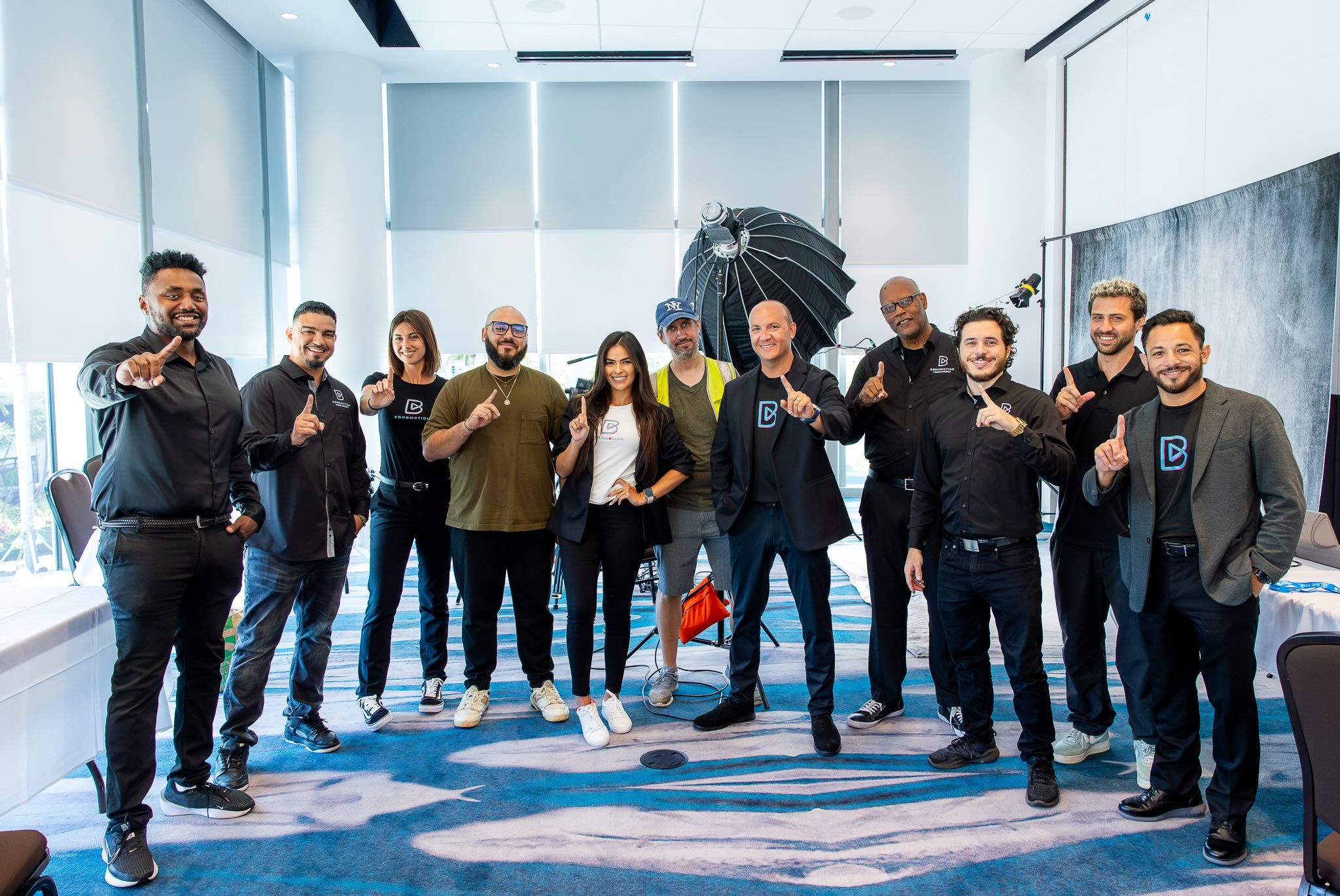
If you want a quote built around your project instead of a generic rate card, talk to us. Bonomotion has produced corporate, event, livestream and lifestyle video since 2003 for startups, growing brands and Fortune 100 companies. We serve Miami, Fort Lauderdale, Coral Gables and Palm Beach, and we travel throughout Florida and nationwide.
We also offer studio and camera and equipment rentals for teams that have their own crew and need the gear or the space. Browse our full list of services or start with our videography production services in Miami, then send your brief and we will propose the crew that fits.
FAQ
How much does a videographer charge per day?
Industry guides commonly cite $500 to $1,500 per day for a solo freelance videographer and $2,000 to $7,000 or more for an agency crew. The gap reflects crew size, equipment, producer involvement and whether editing is included. Ask what hours and gear the day covers before comparing quotes.
What is a standard video production day rate?
A production day is typically 8 to 10 hours on the clock. Work beyond that is usually billed as overtime, and a half day commonly runs 60 to 70% of the full rate. Confirm the hours in writing so you can compare quotes fairly.
What is a producer’s day rate?
Producer rates depend on experience and project complexity. Published Florida guidance runs from about $400 to $650 for emerging producers to $1,700 to $3,000 for expert producers. At Bonomotion, an experienced producer guides every project, and the cost is scoped within your custom proposal.
Are camera crew rates in Florida different from the rest of the U.S.?
Florida is generally treated as a mid-market, so rates run close to the national baseline. South Florida has steady commercial and branded production, which keeps skilled crews in demand. Booking early for busy event periods helps you secure the team you want.
What should I include when I ask for a crew quote?
Share your goal, audience, location, shoot length, number of people on camera, deliverables, deadline and budget range. With those details, a producer can propose the right crew size and give you a line-by-line estimate.