

To use a song in a business video, you need permission from two separate owners: the publisher of the composition and the label that owns the recording. Royalty-free and library tracks shortcut that process with a single license, but only within the terms written in that license. This guide explains how each route works, what drives cost, and how to clear music for corporate videos, event recaps and commercials without risking a takedown or a demand letter.
TL;DR
- A popular song in a video needs two licenses: a sync license for the composition and a master use license for the recording. Both are negotiated directly with the owners.
- Royalty-free means you pay once or subscribe, without per-use royalties. It does not mean copyright-free, and the license still limits what you can do.
- Cost depends on how the music is used, for how long, where the video will run and how prominent the track is. Fees are negotiable, not standardized.
- Get every agreement in writing and match its scope to your real distribution plan: web, paid ads, event screens, livestream.
- Crediting the artist or using a short clip does not replace permission.
Table of Contents
- Why music licensing matters for business video
- The two rights behind every song
- Royalty-free vs licensed music
- What a royalty-free license can restrict
- How to get permission to use a commercial song
- What affects music licensing costs
- Websites, social media, ads and event screens
- Myths that cause trouble
- Our perspective
- Clearing music with Bonomotion
- A quick checklist before you publish
- FAQ
Why music licensing matters for business video
Music does more emotional work in a video than almost any other element. It sets pace, signals tone and tells a viewer within seconds whether a brand feels premium, energetic or trustworthy. That is exactly why marketing teams reach for a recognizable song, and exactly why it is the most common licensing mistake we see.
A corporate video is not a personal home video. It promotes a company, so the use is commercial. Commercial use of someone else’s copyrighted music without permission exposes the business to takedowns, muted audio, removed ads or a claim from the rights holder. For a company that has just invested in a polished production, discovering that the soundtrack cannot be used is an expensive way to learn the rules.
The good news: the rules are not mysterious. Once you know who owns what, the choice between a famous track and a licensed library track becomes a practical budgeting decision.
The two rights behind every song
Every commercially released song contains two separate copyrights, and they usually have different owners.
The composition (sync license)
The composition is the melody and lyrics, the song as written. Its rights are typically held by a music publisher on behalf of the songwriters. To pair that composition with moving images, you need a synchronization license, usually called a sync license. According to the U.S. Copyright Office, there is no compulsory license for synchronizing music with audiovisual works, which means you cannot simply pay a set rate. You negotiate with the copyright owner, and they can say no.
The recording (master use license)
The master is the specific recorded performance you hear on streaming services. It is usually owned by the record label. Using that exact recording requires a master use license. As ASCAP’s checklist for using music in film explains, sync licenses generally come from publishers and master use licenses from the label that owns the recording.
Why you need both
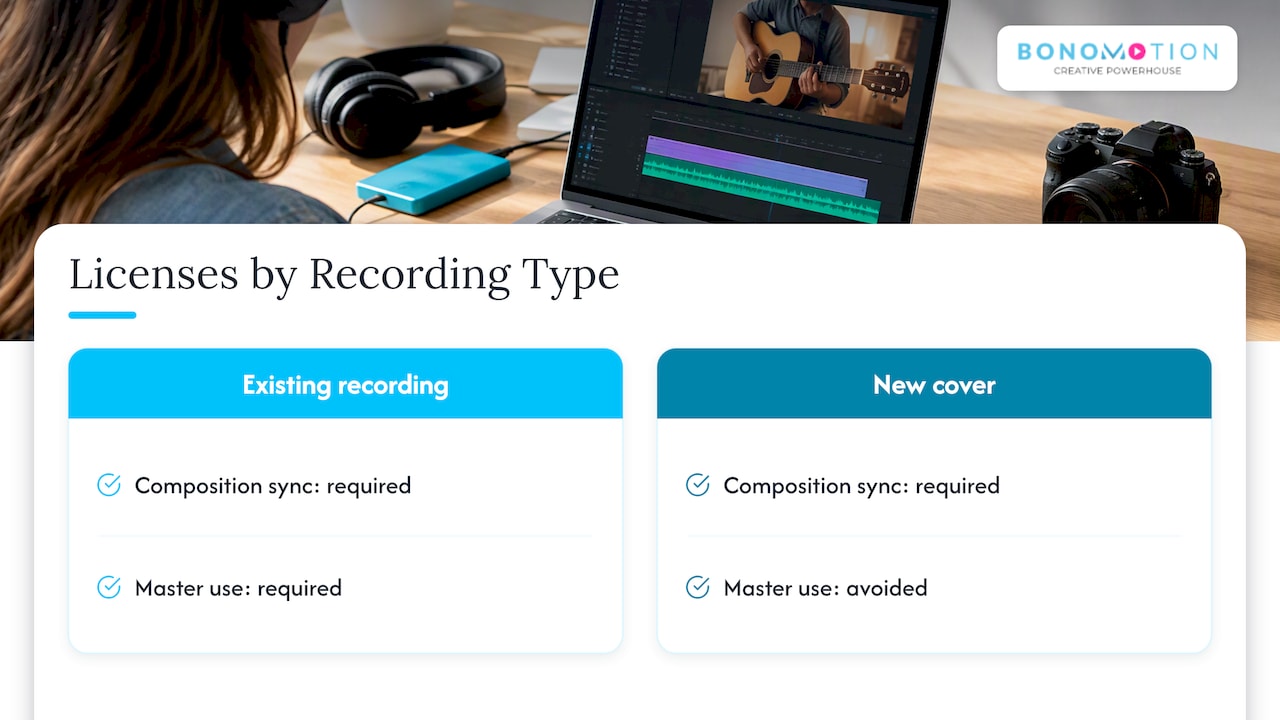
If you want a well-known track as recorded, you need both licenses, and the two owners price independently. If you hire musicians to record a new version of a famous song, you avoid the master license but still need the sync license for the composition. This is why using a hit song in a 60-second brand video can become a long, costly negotiation, and why many businesses choose another route.
Royalty-free vs licensed music
The two terms are often treated as opposites. They are not, and the confusion causes real problems.
Royalty-free describes a pricing model. You pay a one-time fee or a subscription and then use the track without paying ongoing, usage-based royalties. It says nothing about whether the music is free of copyright. The creator keeps the copyright, and you must follow the vendor’s license terms. Academic library guidance, such as Kansas State University’s guide to royalty-free and library content, makes the same point.
Licensed music in the traditional sense means a track you negotiate for individually, usually a commercial release, with a sync license and a master use license tailored to your project.
Here is how they compare for a typical business video.
| Factor | Royalty-free or library music | Individually licensed commercial track |
|---|---|---|
| Recognizability | Unknown to most viewers | Can be instantly familiar |
| Rights to clear | Usually one license from one vendor | Sync license plus master use license |
| Pricing | Fixed fee or subscription | Negotiated per use |
| Speed | Immediate | Weeks, sometimes longer, and a no is possible |
| Scope | Defined by the vendor’s terms | Defined by the agreement you negotiate |
| Best for | Corporate videos, web video, explainers, social content | Big-budget commercials where a specific song is the creative idea |
For most corporate work, royalty-free or library music is the sensible default. It gives you speed and predictable cost, and a good composer-written track can feel custom when it is matched well to the edit. We cover how to select tracks in our guide to choosing music for video production.
What a royalty-free license can restrict
The phrase royalty-free tempts people to assume they can do anything. Read the permitted uses before you download. Common limits include:
- Platform. Some licenses cover online video but not broadcast, or not in-app use.
- Audience size or number of views. Some tiers cap views, downloads or streams, and the agreement defines what is allowed.
- Redistribution. Using a track inside a template you resell, or in a product someone else will use, is often excluded.
- Exclusivity. Most library licenses are non-exclusive, so another company may use the same track. Exclusive agreements exist, and they typically mean only you can use the music for the specified uses during the term, though they can still carry restrictions.
- Term. Some licenses are perpetual for the finished video. Subscription services may tie your rights to an active account, so check what happens to videos you have already published if you cancel.
The practical habit: save a copy of the license and the receipt in the project folder next to the final video files. Six months later, when someone asks whether you can reuse the video in a trade show loop, you will have the answer in one place.
How to get permission to use a commercial song
If a particular song really is the right creative choice, the process looks like this.
- Identify what you need. Decide whether you want the original recording or a re-recording. That tells you whether you need one license or two.
- Find the owners. The online databases of performing rights organizations such as ASCAP, BMI and SESAC can help you identify the publisher of a composition, as the Copyright Alliance notes. The label is usually listed on the release.
- Describe the project. Publishers and labels will ask how the video will be used, how long the music plays, where it will run, for how long and with what budget.
- Negotiate scope and fee. Be specific about media (web, social, paid media, event screens), territory and term. Broader scope costs more.
- Get it in writing. The Copyright Alliance recommends documenting the rights, duration and payment terms in a written agreement to avoid disputes later.
- Wait for signatures before you publish. Do not edit to a song and assume approval will arrive. Edit to a placeholder only if you are prepared to replace it.
Build the timeline around this. Clearing a major song can take much longer than the edit itself, and the answer can be no.
What affects music licensing costs
There is no rate card for sync licensing. ASCAP’s checklist says fees depend on how the music is used, its duration, the number of uses and where the film or media will be shown, and that fees are often negotiable rather than standard. In practice, these are the levers.
- Prominence. A song as the featured centerpiece of a commercial costs more than the same song faintly playing in the background of an interview.
- Duration. More seconds of music generally means a higher fee.
- Media and reach. A video on your own website is a different proposition from a paid campaign running widely.
- Term and territory. A one-year, single-market license differs from a perpetual, worldwide one.
- Your budget. ASCAP advises producers to be transparent about the project’s budget when negotiating.
For a small or mid-sized company, the sum of these levers usually makes a famous song hard to justify for a standard corporate video. A well-chosen library track costs a small fraction and clears in minutes. If you are building a video budget, our guides on corporate video production costs and corporate video rates show where music fits among the other line items.
Websites, social media, ads and event screens
A single video often travels across several places, and each can raise a different question.
Your own website or app. ASCAP’s checklist notes that a public performance license is typically needed if you broadcast or stream a video on your own website or mobile app. This is separate from the sync and master rights. Library vendors often bundle this in their terms, which is another reason to read them.
Social platforms. The same checklist indicates that hosting content on third-party platforms like YouTube or Facebook generally does not require you to obtain a separate performance license, since those platforms typically have their own. That does not give you the sync or master rights. A platform can still remove or mute your video if you lack permission for the music.
Paid advertising. Promoting a video with paid media is a more demanding use than organic posting. Confirm that your license covers advertising, not just online display.
Event screens and livestreams. Conference openers, gala sizzle reels and live broadcasts bring in live audiences and real-time streams. If you are producing event content, tell your producer up front how the video will be used on site and online. Our event teams cover this when planning event videography and photography and live streaming, and venues and event planners in Miami, Fort Lauderdale and Palm Beach often have their own music policies for in-room playback.
A safe rule: license for the widest use you can reasonably foresee, not just the first post.
Myths that cause trouble
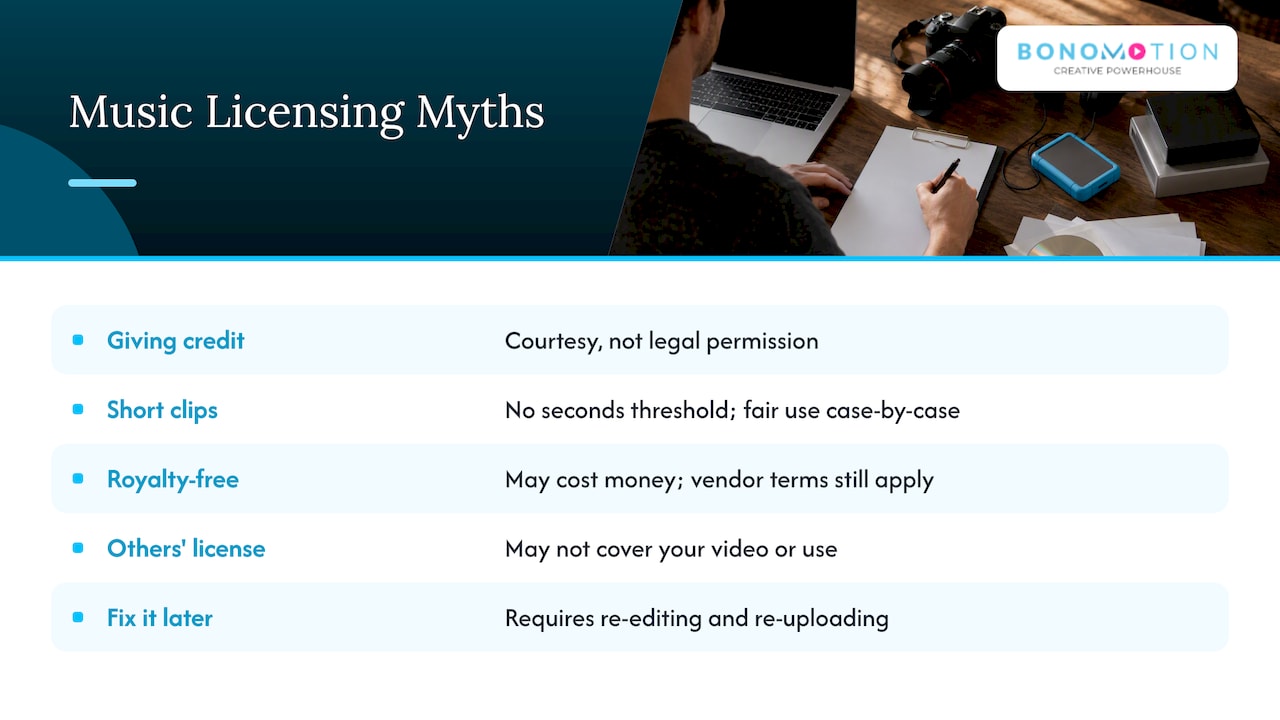
Giving credit is enough. Crediting the artist is courtesy, not permission. A license is a legal grant, and a credit line does not create one.
A short clip is safe. There is no magic number of seconds that makes copyrighted music free to use. Fair use is decided case by case, and courts weigh whether the use is transformative, among other factors. In Leadsinger v. BMG Music Publishing, the Ninth Circuit found that a commercial karaoke use of lyrics was not fair use, in part because it was non-transformative and used the lyrics in their entirety, as the U.S. Copyright Office’s fair use summary records. A business promoting its services is poorly placed to argue fair use for a background track.
Royalty-free means free. Often it costs money, and always it comes with terms.
Someone else’s license covers me. A freelancer’s or agency’s license may be tied to their account or to a different client. Ask for the license that covers your video and your intended uses.
We will fix it later. Replacing music after a video is published means re-editing, re-approving and re-uploading, and breaking embeds and links along the way. Clearing it at the start is cheaper.
Our perspective
We have produced corporate, event, livestream and lifestyle video since 2003, and music clearance is one of the quietest ways a good project goes wrong. The video is approved, the client loves the cut, and then someone realizes the soundtrack was a placeholder from a streaming playlist.
Our approach is simple. We settle the music question at the start of production, not at the end. For most corporate videos, interviews, explainers and web video, we recommend properly licensed library or composed music, selected to match the pace of the edit and documented in the project file. When a client has a strong creative reason to use a specific commercial song, we tell them honestly what that involves: two rights holders, a negotiated fee, a longer timeline and no guarantee of a yes.
In South Florida, where a single video may play on a website, at a conference in Miami, on a screen at a Palm Beach gala and in a paid campaign, scope matters as much as the song. A clear brief on where the video will live saves money and prevents surprises. Your producer should ask about it before the first edit, and ours does.
— Bernard Bonomo
Clearing music with Bonomotion
When you work with us, a dedicated producer guides the project from concept to delivery, and music selection is part of that conversation rather than an afterthought. Whether you need a brand film, a recap of a multi-day conference, a livestream or a set of customer stories, we match the soundtrack to your distribution plan so the finished video is ready to publish wherever you need it.
Start with our corporate video production service, or explore commercial video production in Miami if you are planning advertising. Tell us where the video will run, and we will build the production and the music plan around it. Contact us through bonomotion.com to request a custom proposal.
A quick checklist before you publish
- Do we know whether each track needs one license or two?
- Is every license in writing and saved with the project files?
- Does the license cover our website, social channels, paid ads and any event or livestream use?
- Does it cover the term we need, and will the video stay licensed if a subscription ends?
- Did a freelancer or vendor supply the music, and if so, is it licensed in our name or for our use?
- Have we avoided relying on credit lines, short clips or a platform’s music library for commercial use?
If any answer is uncertain, resolve it before launch. For serious or high-value campaigns, have a music attorney review the agreement, since scope and indemnity language can matter.
FAQ
Do I need a license to use a popular song in a corporate video?
Yes. Using a commercial recording in a business video requires a sync license from the publisher and a master use license from the label. There is no compulsory license for this use, so you negotiate directly and the owners can decline.
Is royalty-free music safe to use in a corporate video?
It is safe when your use fits the terms of the license you bought. Royalty-free describes the payment model, not the copyright status, so check platform limits, audience limits, exclusivity and term. Keep a copy of the license with the finished video.
How much does it cost to license music for a video?
It varies. Sync and master fees depend on how the music is used, how long it plays, where the video runs and how prominent the track is, and they are often negotiable. Library tracks usually carry a fixed fee or come with a subscription, which makes them easier to budget.
Can I use a short clip of a song if I give credit to the artist?
No. Neither a credit line nor a short duration replaces permission. Fair use is decided case by case, and commercial promotional use is a weak fit for it, so license the music or choose a track you can clear.
Do I need separate permission to post my video on social media?
You still need the underlying music rights for the video. Social platforms generally handle their own performance licensing, but that does not give you sync or master permission. Make sure your music license covers social distribution and paid promotion if you plan to advertise.