
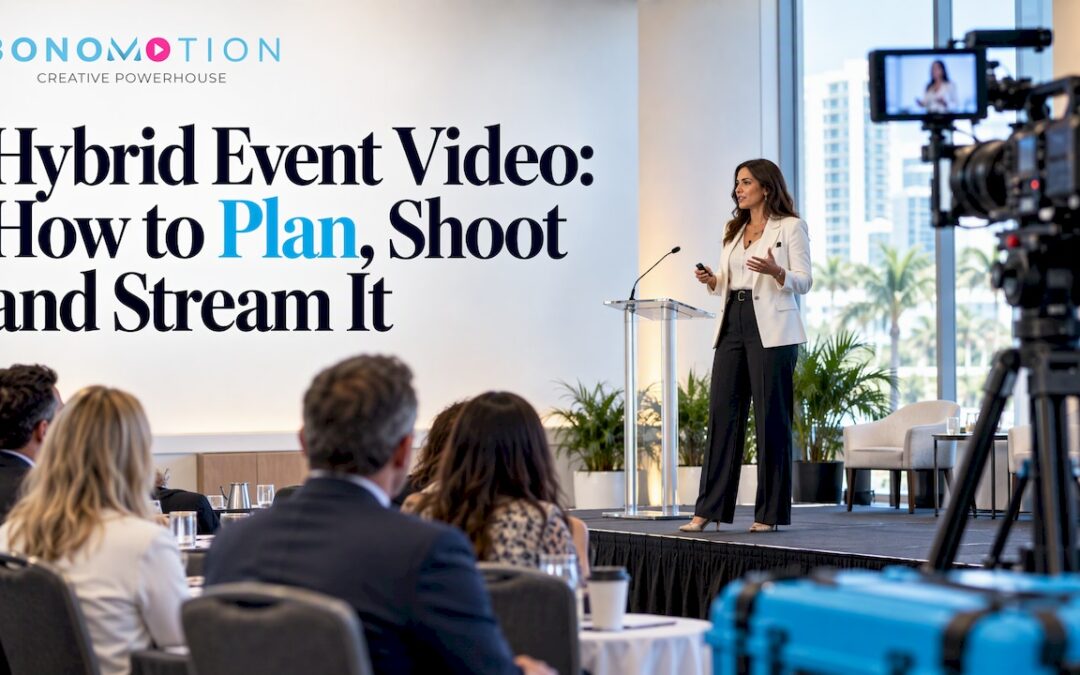
Hybrid event video is the camera, audio, switching and streaming work that lets a remote audience experience your live event as fully as the people in the room. Done well, it is a produced broadcast, not a phone on a tripod. In South Florida, where conferences, product launches and galas draw guests from across the Americas, we handle it as one production: cameras, crew and live stream planned together, guided by a dedicated producer. If you are planning one, start with our hybrid event videography services.
TL;DR
- A hybrid event gives in-person and remote attendees equal standing, so the video has to be built for the remote viewer, not just for the room.
- Plan at least two camera angles, clean audio, a backup internet path and a full rehearsal before doors open.
- Remote viewers typically see the stream with a delay, so design polls and Q&A with that gap in mind.
- Captions, a dedicated producer and a recorded edit extend the value of the event long after the day itself.
- Bonomotion produces hybrid events across Miami, Fort Lauderdale, Coral Gables and Palm Beach.
Table of Contents
- What hybrid event video actually is
- Hybrid event examples worth studying
- The hybrid event setup: equipment, people and connection
- How hybrid event production runs
- Making the video work for both audiences
- Perspective
- Hybrid event video with Bonomotion
- FAQ
What hybrid event video actually is
A hybrid event combines an in-person segment with a virtual one of equal importance, where both audiences can attend sessions, network and join polls. A virtual-only event has no venue at all, so a webcam and a platform can be enough. A hybrid event has a stage, a room and a remote audience at once, and the video is what connects them.
That changes the job in three ways:
- Two audiences, two experiences. The room sees the stage. Remote viewers see only what your cameras choose to show them, so camera work, graphics and sound carry the whole experience.
- A timing gap. On standard streaming, remote viewers hear a speaker 15 to 30 seconds after the room does. A poll can be answered in the room before the question reaches viewers at home.
- A single point of failure. If the stream drops, nobody in the building notices. That is why monitoring and backups matter.
If you want the broader planning picture, our guide on how to create successful hybrid event productions covers it, and our overview of hybrid event production services shows what a full-service build includes.
Hybrid event examples worth studying
The best examples share one trait: the remote audience was treated as a primary audience.
TikTok LIVE Fest 2024, Miami. Jack Morton’s case study reports that the event reached more than 3 million viewers and 55 million impressions, with 400 creators streaming live from the red carpet, activations and awards show. It shows how a live venue can double as a content set.
CNXN Live, West Palm Beach. This four-day corporate kickoff ran in real time across the Palm Beach Convention Center and a second site in New Hampshire, 1,465 miles apart, with 36 crew members and nine camera shots switched to the livestream as if in one room. It is an extreme case, but it shows what dependable audio and video links make possible.
A medical device conference, Miami Beach. In January 2024, a production team built a three-day live program at the Fontainebleau for nearly 1,000 sales professionals and executives, with keynotes, panels, live demos and remote broadcasts.
Most South Florida businesses are planning something smaller: a sales kickoff, a product launch, a chamber luncheon, a charity gala or a training day. The same principles scale down. Fewer cameras, a smaller crew, the same discipline.

The hybrid event setup: equipment, people and connection
The checklists published by AV bodies and universities agree on the essentials.
Cameras and stage video
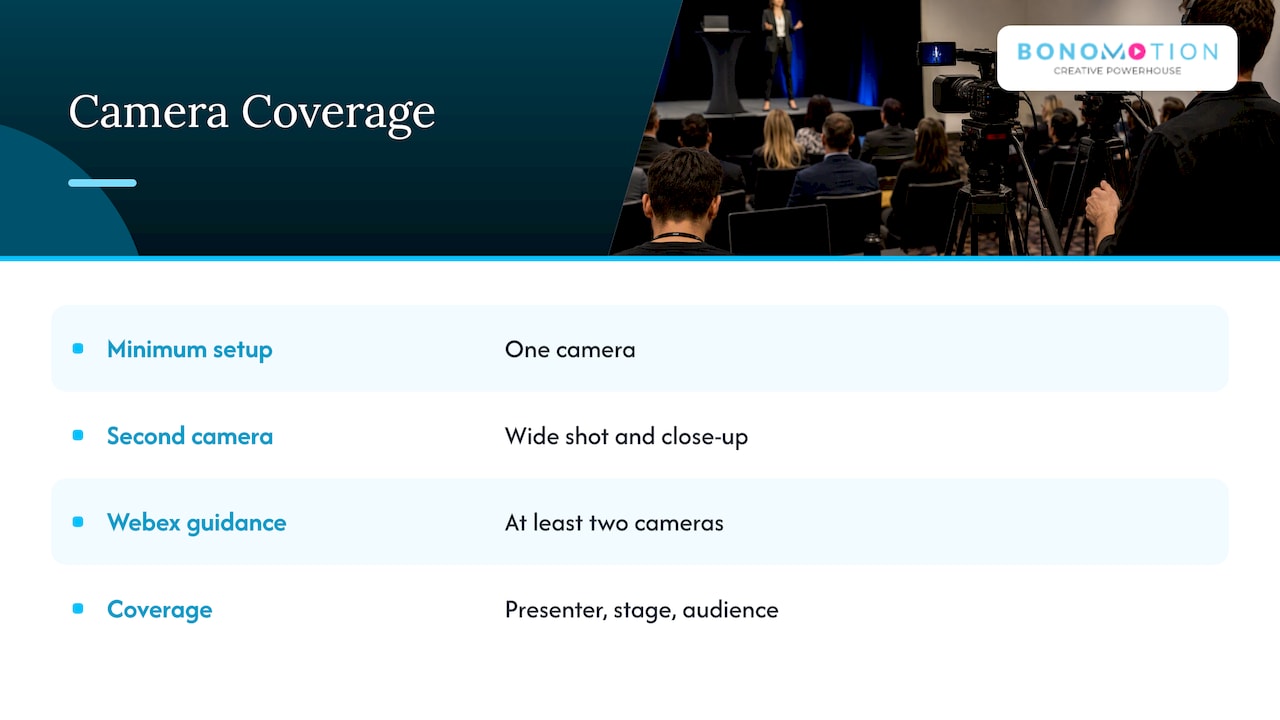
Stanford’s A/V guide says one camera is the minimum for a hybrid event, and a second adds a wide shot and close-up, which keeps remote viewers more engaged than slides and audio alone. Webex Events’ knowledge base suggests at least two cameras, covering presenter shots, a wide stage view and the audience. Our event teams shoot with this multi-angle thinking in mind, and you can see the style in our event videography reel.
Audio
Remote viewers forgive soft video faster than bad sound. Plan speaker microphones plus room microphones so audience questions are heard online. Princeton’s toolkit notes that hybrid rooms need room microphones for Q&A and AV bridges for video conferencing.
Crew
A hybrid room is not a one-person job. Princeton’s toolkit describes a minimum of four production roles: a video conferencing monitor, a video broadcast lead, an audio lead and a presenter assistant. Bonomotion assigns an experienced producer to every project, who works with your team on objectives, audience and timeline.
Internet
This is where hybrid events most often fail, and venue Wi-Fi shared with guests is the usual culprit. Published guidance converges on a few points:
- A dedicated wired connection, not guest Wi-Fi, per AVIXA’s hybrid production guide.
- Upload speed tested separately from download, with a 25 Mbps minimum and an automatic-failover backup source.
- Two separate internet providers where the venue allows, a bonded cellular backup for the encoder, and a 30-minute test stream under load 48 hours before the event.
Ask your venue about its connection options early. South Florida ballrooms, hotel conference centers and waterfront venues vary widely, and a site visit settles it.
How hybrid event production runs
AVIXA describes production in phases, and it matches how a well-run job feels.
- Pre-event preparation. Run through camera feeds, microphone quality, software compatibility, redundancy and firewall settings.
- Training. Moderators and staff learn the platform before the day.
- Rehearsal. Complete rehearsal simulations with presenters stress-test the system under load.
- Live execution. A producer watches the outgoing stream while others run the room.
- Post-event. Review participation and engagement, follow up within 24 to 48 hours, and post recordings with captions and timestamps.
Two habits prevent most on-the-day trouble. Treat the broadcast as live TV and keep a visual such as a logo slide ready in case a source drops, as Stanford advises. And give remote guests a person to contact: AVIXA recommends a helpdesk by phone, chat or email.
Common technical problems and how to handle them
- Dropped stream: a second internet path and a secondary streaming link, with a producer assigned to watch the feed.
- Echo and feedback: a clean audio mix feeding the stream, tested in rehearsal with real presenters.
- Speakers facing the wrong way: confidence monitors placed so presenters look toward the camera.
- Out-of-sync interaction: a moderator who reads remote questions aloud and allows for the stream delay.
Making the video work for both audiences
AVIXA stresses that attendees expect the same high-value experience in the front row or on a laptop. In practice:
- Write for both. Avoid in-room references such as pointing at a screen. Make slides readable on a phone.
- Share the interaction. Run Q&A, polls and chat across both audiences, and have a moderator recognize remote participants. An ACM editorial note on hybrid conferences also suggests two large screens, one for the remote audience and one for the presentation.
- Add captions. Captions help deaf and hard-of-hearing viewers, mobile users, non-native speakers and sound-off viewers, and improve comprehension and retention. In South Florida’s multilingual market, translation options can widen your reach further.
- Give remote guests a role. Ideas for building a comparable audience experience are covered in this piece on engaging your audience.
Perspective
A hybrid event is two shows sharing one stage. The room will forgive a lot, because people are there for each other. The viewer at home has only the picture and the sound, so those have to be right.
We have been producing video since 2003, and the projects that go smoothly share one thing: planning the stream as carefully as the stage. That means a producer in the conversation from the first meeting, camera angles chosen for the remote viewer, and a recording plan so the event keeps working after the day ends.
Treat the live stream and the highlight edit as one investment. The same crew that covers your keynote can capture testimonials and interviews in the hallway, and your event becomes a library of content for months.
Bernard Bonomo
Hybrid event video with Bonomotion
We cover events across Miami, Fort Lauderdale, Coral Gables and Palm Beach, and throughout Florida and nationwide. Our live streaming services and event videography and photography work together, with a dedicated producer guiding the project from concept to delivery. We also offer studio and camera and equipment rentals. Tell us your date, venue and audience, and we will scope a custom proposal.
If your event also needs speaker interviews or attendee testimonials, our interview and testimonial video production fits into the same shoot. For a wider look at live delivery, read our live event streaming guide.
FAQ
What is the difference between a virtual meeting and a hybrid meeting?
A virtual meeting is held entirely online with no shared physical room. A hybrid meeting has people in a room and people online at the same time, so it needs cameras, room microphones and a platform that links both groups. The video setup is what makes the remote group feel present.
How many cameras do I need for a hybrid event?
One camera is the minimum, and two or more give remote viewers a far better experience, with a presenter shot, a wide stage view and an audience angle. The right number depends on your venue, program and audience size. We scope it with you during planning.
How long does it take to set up hybrid event video?
On-site setup depends on the venue and the size of the program, and rehearsal with presenters should come before the event day. Early planning, ideally a venue visit, gives your producer time to arrange internet, audio and camera positions.
Can a hybrid event be recorded for later use?
Yes. Recordings can be posted with captions and timestamps, and key moments can be edited into highlight videos. Planning this before the event lets the crew capture extra footage, such as interviews.
Do you produce hybrid events outside Miami?
Yes. We are based in Miami and serve Fort Lauderdale, Coral Gables and Palm Beach, with service throughout Florida and nationwide.