

Construction project managers, architects, and real estate developers know the frustration of walking into a stakeholder meeting armed with nothing but a stack of static photos and a written progress report that nobody reads past the first page. The gap between what actually happens on a job site and what gets communicated to decision-makers is wider than most firms admit. Timelapse video closes that gap decisively, turning weeks or months of complex construction activity into a clear, compelling visual narrative that stakeholders actually engage with and that feeds directly into modern project analytics workflows.
Table of Contents
- What is construction timelapse? The basics and the benefits
- Timelapse vs. traditional site documentation: A practical comparison
- How construction timelapse powers progress analytics and 3D insights
- Best practices: Capturing high-impact construction timelapse
- Why the future of construction timelapse is about more than just the visuals
- Take your construction project to the next level with professional timelapse solutions
- Frequently asked questions
Key Takeaways
| Point | Details |
|---|---|
| Timelapse boosts transparency | Construction timelapse video gives all stakeholders a transparent, unbiased view of site progress. |
| Supports analytics & compliance | Timelapse footage can be integrated with analytics and compliance workflows for smarter project management. |
| Outperforms static documentation | Compared to manual reporting, timelapse offers a more engaging and comprehensive project record. |
| Best practices matter | Proper planning, camera placement, and reliable setups are key to successful construction timelapse results. |
What is construction timelapse? The basics and the benefits
Construction timelapse is a video production method where a camera captures images of a build site at regular intervals, typically every few minutes or hours, and those images are stitched together into a fast-moving video sequence. What takes months to build on the ground takes minutes to experience on screen. The result is a dynamic, sequential record of every major milestone, every structural shift, and every crew movement from groundbreaking to final inspection.
Job site timelapse has grown far beyond a marketing novelty. Today, it functions as a living document of project evolution that serves your entire team, not just your marketing department. Here is why forward-thinking firms are adopting it across the board:
- Clarity: Compresses complex, multi-phase activity into a digestible visual format that anyone can understand at a glance.
- Transparency: Gives owners, investors, and municipal authorities a real-time window into site conditions and progress.
- Stakeholder engagement: Video dramatically outperforms static reports in keeping non-technical stakeholders informed and confident.
- Dispute resolution: Visual records provide objective evidence when schedule or scope disagreements arise between contractors, subcontractors, or clients.
- Analytics integration: Footage can be processed to extract data on crew density, equipment utilization, and schedule adherence.
- Marketing impact: Finished timelapse becomes powerful content for social media, investor presentations, and award submissions.
The analytics dimension is especially significant. Research shows that timelapse video can support near real-time 3D reconstruction and plug into broader project analytics pipelines, transforming raw footage into actionable intelligence rather than just a visual record. This shift from passive documentation to active data collection is what separates the firms winning on complex, high-visibility projects from those still scrambling to explain delays after the fact.
Construction time lapse documentation is being adopted by general contractors, specialty subcontractors, architecture firms monitoring design fidelity, and real estate developers who need to report meaningful progress to lenders and equity partners on a regular cadence.
Timelapse vs. traditional site documentation: A practical comparison
Now that we’ve defined construction timelapse, it’s helpful to see how it measures up against the traditional documentation methods still common on many jobsites.
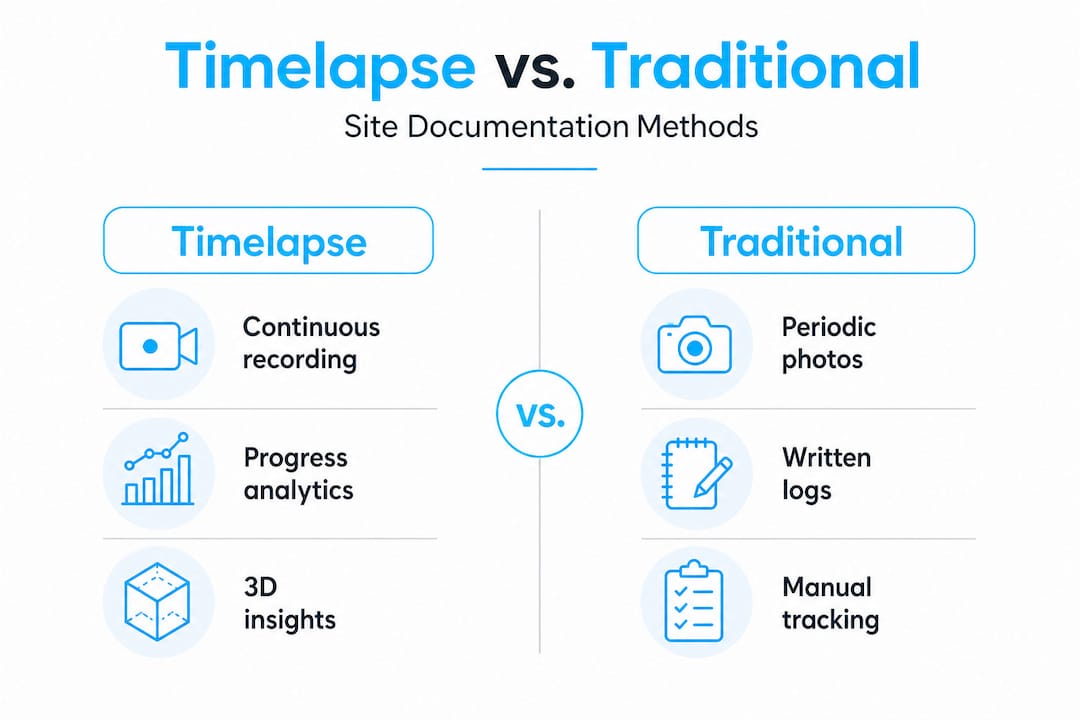
Most sites still rely on a combination of periodic photos taken by a site superintendent, written daily logs, and occasional in-person walkthroughs for key stakeholders. Each method has real limitations that compound over time, especially on projects running 18 to 36 months.
| Feature | Construction timelapse | Traditional documentation |
|---|---|---|
| Visual continuity | Complete, sequential record | Fragmented, selective snapshots |
| Stakeholder accessibility | Instant video sharing | Requires site visits or lengthy reports |
| Data integration | Analytics and 3D pipeline-ready | Manual review only |
| Dispute resolution | Objective visual timeline | Subject to interpretation |
| Production cost | Fixed setup, automated capture | Ongoing labor hours |
| Marketing utility | High: shareable, engaging content | Low: rarely usable externally |
| Schedule monitoring | Supports automated delay detection | Reactive, human-reviewed |
The drawbacks of manual methods are significant and often underestimated:
- Time consumption: A site superintendent spending two hours per week on photo documentation accumulates over 100 hours of labor annually on a two-year project.
- Coverage gaps: Manual documentation misses events that happen between visits, including incidents, unauthorized access, and schedule slippage.
- Subjectivity: Written reports reflect the perspective of the author, which creates blind spots in complex multi-contractor environments.
- Stakeholder fatigue: Lengthy PDF reports with embedded photos rarely get read in full by the investors and owners who need the information most.
“Integrating timelapse with surveillance camera-based analytics unlocks deeper oversight capabilities that traditional documentation simply cannot match, enabling teams to monitor progress, safety, and compliance from a single coordinated system.”
The magic of construction time-lapse lies in its ability to serve multiple teams simultaneously. Your project manager uses it to verify schedule adherence. Your marketing coordinator pulls clips for social content. Your legal team archives it for potential dispute documentation. One production system, multiple layers of value.
How construction timelapse powers progress analytics and 3D insights
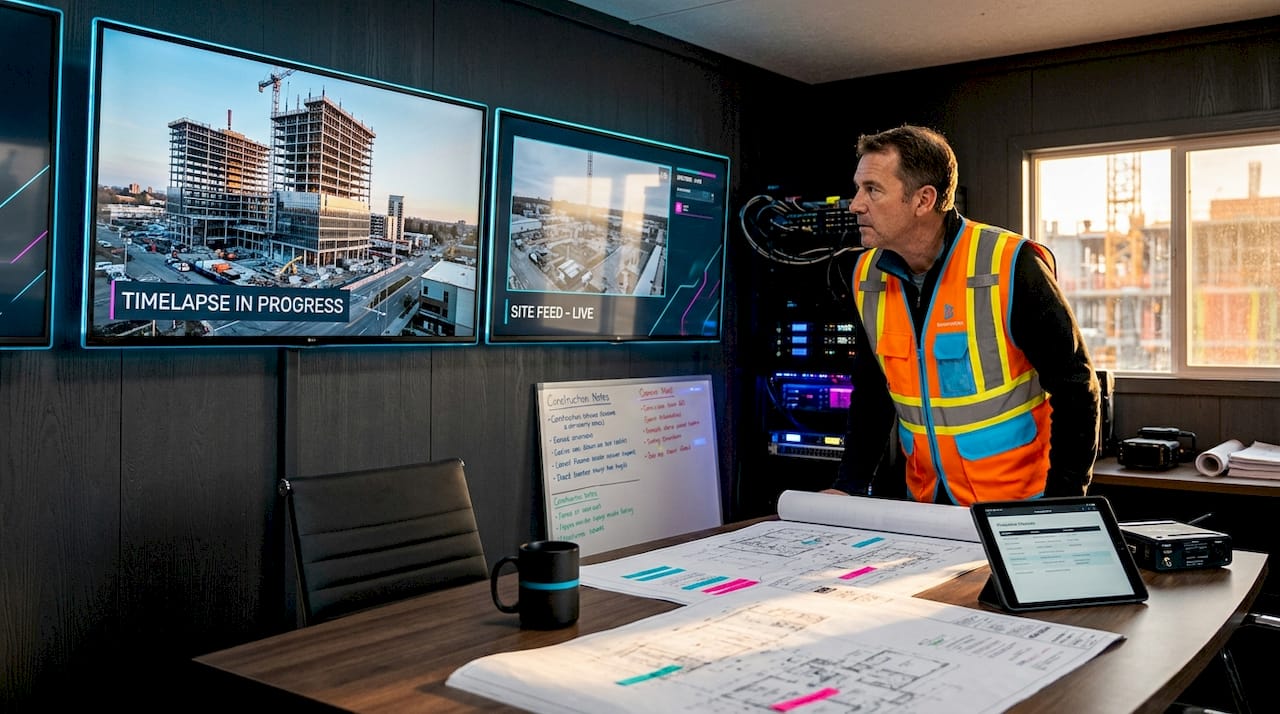
After seeing the practical differences, let’s explore how construction timelapse opens new doors for smart project analytics and even near-real-time 3D modeling.
The most sophisticated users of timelapse technology today are not just watching footage. They are feeding it into automated systems that extract measurable data about project performance. Adjacent research confirms that timelapse supports digital twin workflows, meaning your footage can anchor a continuously updated virtual model of your project that decision-makers can interrogate at any time.
Here are the types of analytics that timelapse data can realistically support on a modern construction project:
| Analytics type | What it measures | Project benefit |
|---|---|---|
| Schedule adherence | Planned vs. actual milestone completion | Early delay identification |
| Crew density analysis | Number of workers by zone and time | Labor productivity insights |
| Equipment utilization | Machine activity and idle time | Cost reduction opportunities |
| Safety monitoring | PPE compliance, restricted zone access | Reduced incident rates |
| Material flow tracking | Delivery timing and staging efficiency | Supply chain optimization |
| 3D reconstruction | Progressive digital twin updates | Real-time design fidelity checks |
Here is how a timelapse-to-analytics pipeline actually works in practice:
- Camera deployment: Weatherproof cameras are installed at strategic angles covering all critical work zones, typically on masts, building edges, or adjacent structures.
- Automated capture: Images are taken at preset intervals, from every few minutes to once per hour, depending on project activity and analytics goals.
- Cloud upload: Footage is transmitted automatically to a secure cloud platform where it is stored and indexed by date, time, and camera position.
- AI processing: Computer vision algorithms analyze the image sequence to identify workers, equipment, materials, and structural changes.
- Dashboard reporting: Processed data populates real-time dashboards that project managers and executives can access from any device.
- 3D integration: Selected frames are fed into photogrammetry software (which generates 3D models from photos) to build or update a digital twin of the structure.
Site video monitoring solutions that incorporate these analytics layers are becoming standard on major infrastructure and commercial real estate projects. If you want to understand what those tools look like in practice, reviewing site monitoring essentials will help you build a clear evaluation framework before you commit to a system.
Pro Tip: Configure your timelapse system to automatically export a daily summary clip and an annotated still image to your project management platform. This creates an effortless compliance documentation trail that satisfies many lender and municipal reporting requirements without any manual labor.
Best practices: Capturing high-impact construction timelapse
Having seen the technical possibilities, it’s crucial to embrace best practices, ensuring your timelapse project delivers maximum return and lasting impact.
Professional timelapse setups are increasingly valued on construction sites for progress visibility and marketing impact alike, which means the bar for execution quality is rising. A shaky camera on a makeshift mount with inconsistent exposure settings will not serve your analytics pipeline or your investor presentation. Here is how to set up a system that performs reliably from day one:
- Define your objectives first: Decide whether you need footage for marketing, analytics, compliance documentation, or all three. Your objective determines camera count, resolution requirements, and capture interval.
- Select the right camera system: Choose cameras rated for outdoor use with IP65 or higher weatherproofing (a standard rating for dust and water resistance), sufficient internal storage or reliable wireless upload capability, and at least 4K resolution for analytics-grade footage.
- Plan camera placement strategically: Position cameras at consistent heights and angles that capture the full footprint of the project. Avoid positions that will be obstructed as the building rises. At minimum, capture the primary facade and the most active work zone.
- Set your capture interval correctly: For most commercial construction, an image every 10 to 15 minutes during work hours provides enough density for analytics while keeping file sizes manageable. Structural and civil projects with slower activity can use 30-minute intervals.
- Establish a weatherproofing and maintenance protocol: Assign a team member to clean lenses weekly, check battery or power connections, and verify upload status. A missed week of footage cannot be recovered.
- Build your distribution plan before the project starts: Identify which stakeholders will receive weekly timelapse updates, what format they prefer, and who owns post-production responsibilities for the final project video.
Consulting AI-powered timelapse tools early in the planning process can help you automate much of the capture and processing workflow, reducing manual oversight significantly. Additionally, reviewing a guide on choosing the best monitoring camera will give you a concrete comparison of hardware options suited to various site conditions and budget constraints.
Pro Tip: The most common failure point in construction timelapse projects is camera placement that gets blocked by cranes, scaffolding, or material staging areas as the project develops. Walk the planned camera positions with your site superintendent before installation and model where obstructions are likely to appear at each major phase. Adjust camera locations or add secondary units proactively rather than discovering coverage gaps after three months of footage are compromised.
Stakeholder engagement is the final piece. A polished monthly timelapse edit shared with your investment group is worth far more than a spreadsheet. Keep clips under three minutes for regular updates, and save the full project timelapse for the completion event and marketing release.
Why the future of construction timelapse is about more than just the visuals
We’ve built a strong case for timelapse as a practical documentation and analytics tool. But we want to push further, because most firms are still underestimating its strategic role.
Here is the honest reality we see in the market: the majority of construction companies deploying timelapse treat it as a feature rather than a system. They set up a camera, collect footage, post an impressive video when the building is done, and call it a success. That approach captures maybe 20 percent of the value available.
The firms pulling ahead are the ones integrating timelapse data into every layer of project governance. Research confirms that timelapse can power analytics pipelines and enable digital twins in construction, which means the footage you capture today can become the foundation for a living, data-rich model of your project that informs decisions in real time, not just retrospectively.
Think about what that means for dispute resolution. Instead of arguing about when a subcontractor finished a particular floor or whether weather delays were as long as claimed, you have an objective visual record with timestamps that answers the question in minutes. Think about what it means for lender reporting. Automated weekly clips replace manual progress certifications and give lenders confidence without consuming your project manager’s time.
The competitive advantage is not the video itself. It is the data and trust infrastructure that the video makes possible. Firms that understand video documentation’s importance as a strategic asset rather than a marketing afterthought are the ones winning complex, multi-stakeholder projects where accountability and communication quality are differentiators.
We believe the next major leap in construction project management will belong to firms that treat the camera as a sensor, the footage as data, and the final video as one output among many rather than the end goal.
Take your construction project to the next level with professional timelapse solutions
If you’re ready to turn these insights into tangible project improvements, here’s how to partner with specialists who deliver results.
At Bonomotion, we have spent over two decades producing high-impact video for some of the most demanding clients in real estate development and corporate communications. We understand the difference between a beautiful timelapse and a timelapse system that serves your project’s documentation, analytics, and marketing needs simultaneously.

Whether you need end-to-end corporate video production support for your firm’s communications strategy or a cinematic showcase of your development with real estate timelapse videos that command attention from investors and buyers alike, our team delivers work that meets the standards of the most ambitious projects. Let’s talk about what your next build deserves.
Frequently asked questions
How do I choose the right camera for construction timelapse?
Choose a camera that offers weatherproofing rated at IP65 or higher, long battery life or reliable power connectivity, and adjustable capture intervals to ensure consistent, reliable coverage across all project phases.
Can timelapse footage be used for more than marketing?
Absolutely. Timelapse is increasingly integrated with analytics and compliance workflows, making it a core tool for real-time project management, lender reporting, and dispute documentation rather than a marketing-only asset.
How often should timelapse images be captured on a construction site?
Capture intervals depend on project pace and activity level. Most commercial construction workflows perform well with images taken every 10 to 30 minutes during active work hours, with adjustments based on specific analytics requirements.
What is the main advantage of construction timelapse over static photos?
Timelapse delivers a comprehensive dynamic view of the entire project timeline, enabling clearer progress tracking, stronger stakeholder communication, and a sequential record that static photos simply cannot replicate.
How can I ensure my timelapse project meets compliance standards?
Automated timelapse systems paired with secure cloud backup, consistent timestamp labeling, and clearly defined retention policies provide the objective, auditable documentation trail that most compliance and lender reporting requirements demand.