

Corporate video projects fail more often than most marketing managers realize, and poor production quality is rarely the reason. The real culprit is an unclear, incomplete brief. When a video agency receives vague direction, even the most talented producers are left guessing at your goals, your audience, and your message. The result is rounds of expensive revisions, missed deadlines, and a final product that doesn’t move the needle. This guide walks you through exactly how to build brief a video agency that gives your video agency everything it needs to deliver work that performs.
Table of Contents
- Understanding what a video agency needs from your brief
- How to prepare and organize your key briefing points
- Structuring your brief for clarity and impact
- Common mistakes and how to troubleshoot your briefing process
- Why clear briefing is the unsung driver of video ROI
- Take your next step with expert video partners
- Frequently asked questions
Key Takeaways
| Point | Details |
|---|---|
| Clear objectives matter | Setting clear goals ensures your video agency delivers results that match your vision. |
| Detailed briefs speed up production | Organizing all key information up front reduces delays and revisions for corporate and event videos. |
| Avoid common mistakes | Recognize and troubleshoot briefing pitfalls early for smooth video agency collaboration. |
| Structured templates win | Using checklists and templates keeps your briefing process consistent and effective. |
| Local expertise is valuable | Partnering with proven South Florida video agencies boosts your chances of event and corporate video success. |
Understanding what Brief a video agency needs
Every video agency, regardless of its size or specialty, depends on one thing before cameras ever roll: clarity. Clear goals and audience insights are the foundation of every successful video project, and your brief is the document that delivers both. Without them, the agency is essentially producing content in the dark.
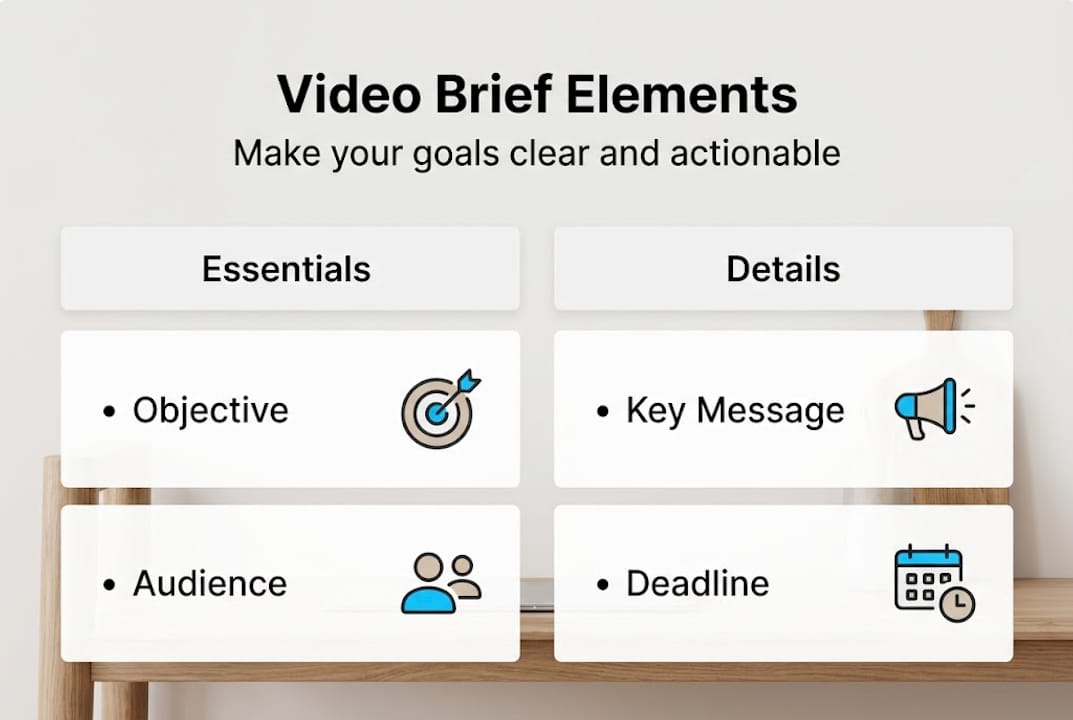
So what does a strong brief actually include? Think of it as a blueprint covering five core areas:
- Objectives: What do you want the video to accomplish? Drive event registrations, build brand awareness, support a product launch, or train employees?
- Target audience: Who is watching? Define demographics, psychographics, and viewing context (conference room, social feed, trade show screen).
- Key messages: What are the two or three things your audience must walk away knowing or feeling?
- Brand guidelines: Colors, fonts, tone of voice, logo usage, and any existing creative assets the agency should align with.
- Logistics: Shoot dates, locations, talent requirements, and any access restrictions relevant to your South Florida event or office environment.
Knowing what video production agencies do helps you understand why each of these elements matters. Agencies coordinate directors, cinematographers, editors, and post-production specialists. Every one of those people needs the brief to make decisions that serve your brand.
Here’s a quick comparison of strong versus weak briefing practices:
| Element | Weak brief | Strong brief |
|---|---|---|
| Objective | “Make it look great” | “Drive 20% more event registrations” |
| Audience | “Everyone” | “B2B decision-makers, 35-55, in South Florida” |
| Message | “Show our brand” | “Communicate speed, reliability, and local expertise” |
| Deadline | “ASAP” | “Final delivery by March 14, 2026” |
| Deliverables | “A video” | “90-second hero video plus 3 social cuts” |
Before you ask questions to ask your video agency, make sure you can answer these same questions yourself. Agencies mirror the clarity you bring.
Pro Tip: Always define deliverables and deadlines before your first agency meeting. Ambiguity about format or timeline is one of the most common sources of budget overruns and missed expectations.
How to prepare and organize your key briefing points
Knowing what to include is one thing. Assembling it in a way that’s usable is another. Detailed briefs improve production speed and reduce the number of revision cycles your team has to manage, which directly protects your budget and timeline.
Here’s a step-by-step approach to organizing your briefing materials:
- Start with the business goal. Write one sentence that describes the measurable outcome you want. “Increase event attendance by 15%” is a goal. “Showcase our company culture” is a theme, not a goal.
- Define the audience in writing. Go beyond job title. Include where they consume content, what they care about, and what objections they might have.
- List your non-negotiables. Mandatory brand elements, legal disclaimers, required talent appearances, and any footage you already have.
- Map out the logistics. Shoot location, access requirements, number of shoot days, and any South Florida venue or permitting considerations.
- Set a revision framework. Agree upfront on how many rounds of feedback are included and who has final approval authority.
- Attach reference materials. Past videos you admire, competitor examples, mood boards, or brand style guides.
Use this simple table to organize your project requirements before submitting your brief:
| Category | Your details |
|---|---|
| Project name | |
| Primary objective | |
| Target audience | |
| Key messages (max 3) | |
| Required deliverables | |
| Shoot date(s) | |
| Final delivery date | |
| Budget range | |
| Approval authority |

Agencies that specialize in video production for marketing teams will often provide their own intake forms, but having your own organized template means you walk into every conversation prepared. It also signals professionalism, which sets the tone for the entire partnership.
Review the criteria for hiring video production partners alongside your brief to make sure your expectations are realistic for the scope and timeline you’re proposing.
Pro Tip: Create a standard briefing template your team uses for every video project. Consistency reduces the time spent gathering information and ensures nothing critical gets left out.
Structuring your brief for clarity and impact
A brief can contain all the right information and still fail if it’s poorly structured. A clear structure reduces misunderstandings and keeps production moving without unnecessary back-and-forth. Think of structure as the delivery mechanism for your content.
Every strong video brief should include these segments, in this order:
- Project overview: One paragraph summarizing the context, purpose, and desired outcome.
- Audience profile: A concise description of who will watch the video and where.
- Core messages: Numbered list of two to three statements the video must communicate.
- Tone and style: Adjectives that describe the feel (e.g., energetic, authoritative, warm) plus reference videos.
- Technical requirements: Aspect ratios, file formats, platform specs, and length.
- Timeline and milestones: Key dates from kickoff through final delivery.
- Budget parameters: A realistic range so the agency can propose appropriate solutions.
Here’s the difference between a weak and a strong briefing statement:
Weak: “We want a video that tells our story and connects with people.”
Strong: “We need a 90-second brand video for LinkedIn that positions our Miami-based logistics firm as the fastest and most reliable regional partner for mid-market retailers.”
The strong version gives the agency a format, a platform, a geography, a competitive angle, and an audience. That’s actionable. The weak version leaves every creative decision open to interpretation.
“Ambiguity is the enemy of great videos.”
When you’re producing impactful corporate videos, precision in language translates directly into precision on screen. Avoid internal jargon your agency won’t recognize. Use plain, direct language that any skilled producer can act on immediately. If your company uses acronyms or proprietary terms, define them in a glossary at the end of your brief.
Understanding the company video impact your project is meant to create will also help you write more specific, outcome-focused briefing statements.
Pro Tip: Read your brief out loud before sending it. If any sentence feels vague or open to interpretation, rewrite it until it’s specific enough that only one meaning is possible.
Common mistakes and how to troubleshoot your briefing process
Even experienced marketing managers make briefing errors. Overlooking stakeholder input and making assumptions are two of the most common reasons video projects go sideways before production even begins. Catching these issues early saves time, budget, and frustration.
Here are the most frequent briefing mistakes we see:
- Vague objectives: Saying “increase brand awareness” without defining what that means or how it will be measured.
- Missing stakeholder alignment: Submitting a brief that hasn’t been reviewed by legal, executive leadership, or the event team, leading to late-stage revisions.
- Unclear approval chain: Not specifying who has final sign-off, which creates conflicting feedback during post-production.
- Underestimating logistics: Failing to account for venue access, permitting in South Florida, or talent availability.
- Ignoring platform requirements: Forgetting that a video built for a conference screen needs different specs than one cut for Instagram.
- Treating the brief as final: Submitting the document and assuming the agency will figure out the rest without a conversation.
To troubleshoot these issues, start by circulating your draft brief internally before it goes to the agency. Get written sign-off from every stakeholder who will have input on the final product. This single step eliminates the most common source of mid-project conflict.
For expert corporate video production in South Florida, agencies expect clients to come prepared. The more organized your brief, the more creative energy the agency can direct toward execution rather than clarification.
Pro Tip: Schedule a 30-minute review call with your agency immediately after submitting your brief. Walk through it section by section and invite questions. This call often surfaces assumptions that would otherwise cost days of revision later.
Why clear briefing is the unsung driver of video ROI
After two decades of producing corporate and event videos across South Florida and beyond, we’ve noticed a pattern that most clients don’t expect to hear: the quality of your brief predicts the quality of your video more reliably than your budget does.
Clients sometimes blame agencies when a video underperforms. But when we trace the issue back, it almost always leads to a brief that left too much open to interpretation. The agency made reasonable creative choices, but they weren’t your choices, because you never specified them clearly enough.
Selecting the right video partner matters enormously, but even the best agency can’t manufacture ROI from an incomplete brief. ROI is built when clear goals meet skilled execution. Your brief is where that process starts.
“The best video campaigns start with the simplest, most detailed briefs.”
The brands that consistently get the most from their video investments aren’t necessarily the ones with the biggest budgets. They’re the ones who show up to every project with a brief that’s specific, aligned, and ready to act on. That discipline is what separates a video that drives results from one that just looks good.
Take your next step with expert video partners
You now have a clear framework for briefing a video agency effectively. The next step is finding a production partner who can meet that level of preparation with equal expertise and commitment.
Bonomotion has been delivering high-impact corporate and event video productions across South Florida since 2003. Whether you need corporate video production in Hollywood, commercial video production in Miami, or full-service business corporate video solutions, our experienced producers are ready to work directly with your team. Before you reach out, review your brief one more time for clarity, specificity, and stakeholder alignment. Then let’s build something that performs.
Frequently asked questions
What should be included in a video agency brief?
A video agency brief should cover objectives, target audience, brand guidelines, messaging, logistics, deliverables, and deadlines. Clear goals and audience insights are the starting point for every successful production.
How do I organize briefing materials for a corporate video?
Use a checklist to collect all necessary details and structure them in a reusable template so the agency can interpret your needs quickly. Detailed briefs improve production speed and reduce costly revision cycles.
What are the most common briefing mistakes?
Vague objectives, missing stakeholder input, and unclear deadlines are the most frequent issues. Overlooking stakeholder input in particular tends to derail projects during post-production when it’s most expensive to fix.
How can I make sure my video agency understands my vision?
Schedule a review call after submitting your brief and ask the agency to summarize their interpretation or share an early storyboard. A clear structure in your brief makes this alignment conversation much faster.
What kind of video agencies are best for events in South Florida?
Look for agencies with documented experience in live event coverage and references from local corporate clients in your industry. Expert corporate video production teams in South Florida understand regional logistics, venues, and permitting requirements that out-of-market agencies often miss.