

Multi-camera production is defined as a filming method that uses multiple cameras simultaneously to capture a scene from different angles in a single take. Known formally in the industry as the multiple-camera setup, this technique typically deploys 3 to 8 cameras per production, coordinated through a video switcher or vision mixer that lets a director select the best angle in real time. The result is faster shooting, richer coverage, and a workflow that single-camera productions simply cannot match at scale. For content creators and video production enthusiasts, understanding how this system works is the first step toward using it well.
What is multi-camera production and how does it work?
Multi-camera production works as a coordinated system, not a collection of independent cameras. Every element, from camera placement to crew communication, must function together for the output to hold up.
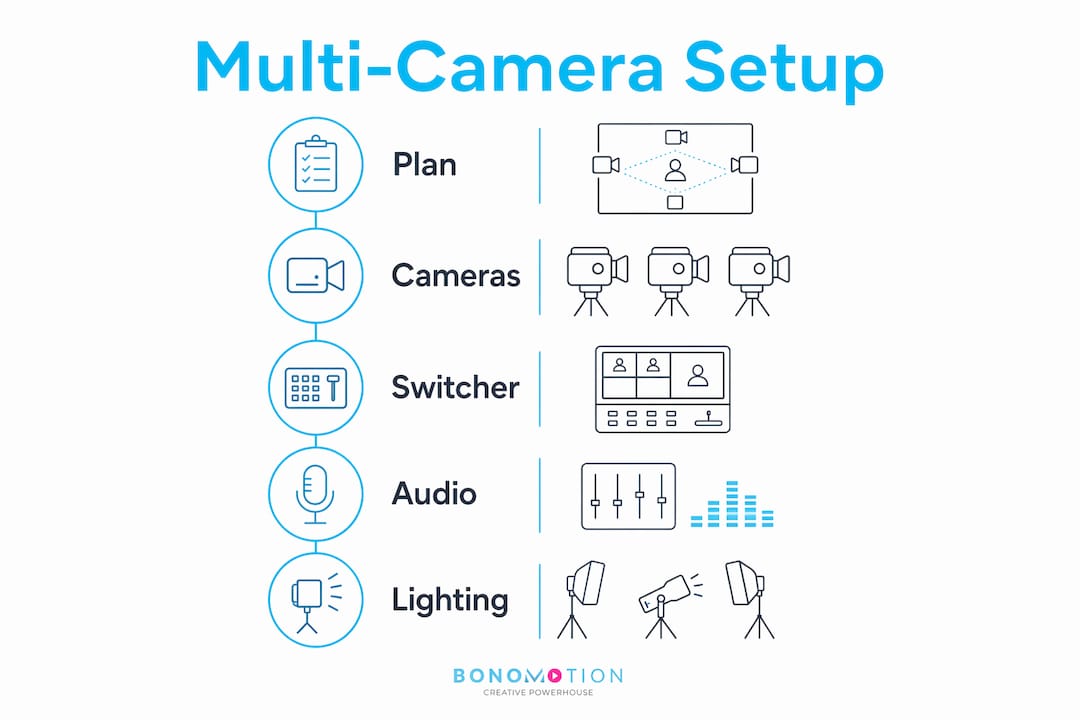
The workflow breaks down into five stages.
-
Pre-production planning. The director and producer map out every camera position before the shoot day. Primary cameras sit at eye level to establish a natural perspective, secondary cameras capture alternative angles for editorial flexibility, and overhead rigs, jib-mounted cameras, and robotic PTZ units provide dynamic creative options. Getting this right on paper saves hours on set.
-
Synchronization setup. All cameras must share the same frame rate, typically 24fps or 30fps, to prevent motion inconsistencies in the edit. Frame rate settings must be standardized across every unit before recording begins. Many professional productions also use SMPTE timecode, a broadcast-standard synchronization signal, to lock all cameras to a single clock reference.
-
Live switching. During the shoot, a technical director operates the video switcher, cutting between camera feeds in real time. This live line cut is the defining feature of the multiple-camera setup. For live broadcasts, this cut goes directly to air. For recorded productions, it serves as a rough edit that editors refine later.
-
Crew communication. The director calls shots through an intercom system, giving camera operators advance notice before each cut. Clear communication is the backbone of a successful shoot. When operators know what is coming, they can frame up cleanly and avoid jarring transitions.
-
Post-production editing. Editors import all camera feeds into non-linear editing software that supports multicam sequences. Multicam sequences enable toggling between synchronized angles) without manually aligning timelines. The tradeoff is file size. Multiple high-resolution feeds demand significant storage and processing power.
Pro Tip: Set your timecode before talent arrives on set. Fixing sync issues in post costs far more time than the two minutes it takes to verify timecode at the start of each recording session.
What are the benefits and limitations of multi-camera shoots?
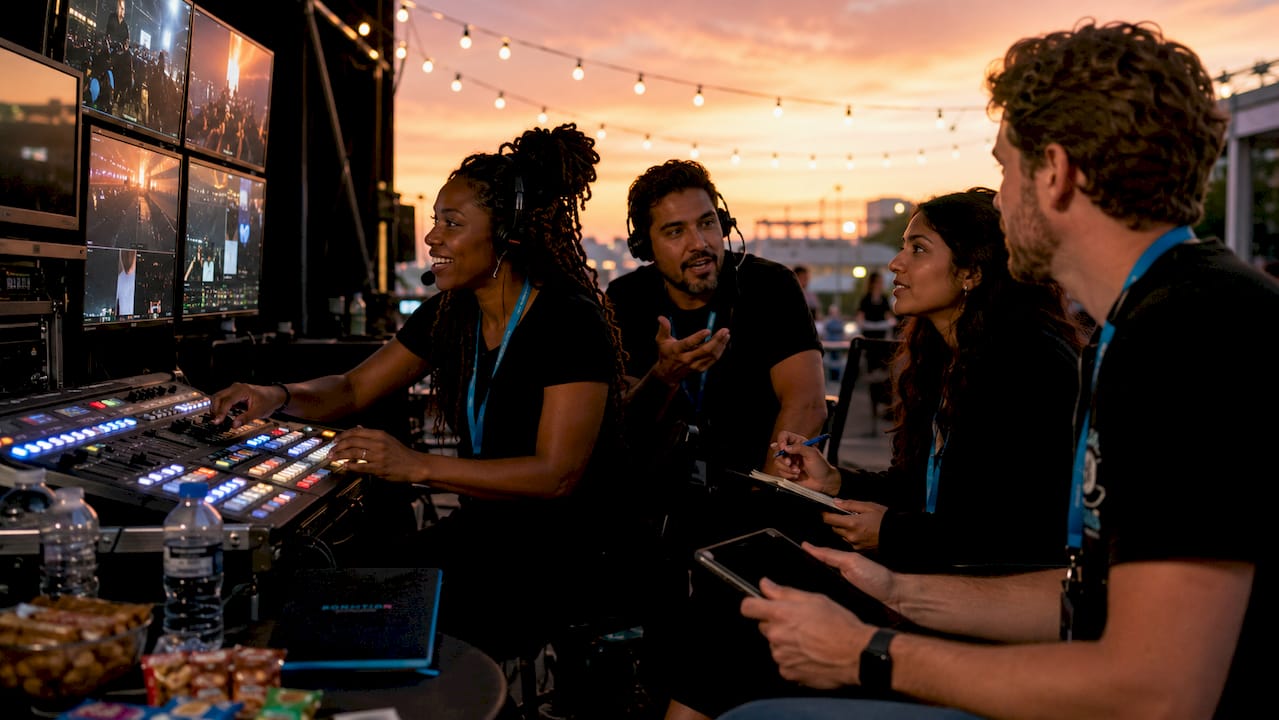
The benefits of multi-camera shoots are real and measurable. The limitations are equally real and worth planning around.
Core advantages:
- Speed. Multi-camera setups drastically reduce total production time by eliminating repeated setups between angles. Some professional productions deliver final content within hours of recording. That turnaround is impossible with a single-camera workflow.
- Continuity. Capturing all angles simultaneously means performances, lighting conditions, and set dressing match perfectly across every shot. There is no risk of a continuity error caused by reshooting a scene hours later.
- Coverage. A director always has a cutaway available. Reaction shots, wide masters, and close-ups exist simultaneously, giving editors genuine choices rather than forced cuts.
- Cost efficiency at volume. For high-volume productions like daily talk shows or multi-day corporate conferences, the reduced shoot time translates directly into lower crew and facility costs per episode or session.
Limitations to plan around:
- Lighting compromises. Lighting a set for one camera angle is straightforward. Lighting it for six is not. Multi-camera lighting must be invisible to multiple angles simultaneously, which means no camera position can catch a fixture or produce harsh shadows that look natural from one angle but distracting from another. This constraint limits the dramatic, directional lighting that single-camera films use freely.
- Reduced shot control. Each camera operator works within a shared space. Tight, cinematic compositions are harder to achieve when three other cameras are also in the frame.
- Equipment complexity. More cameras mean more cables, more monitors, more intercom channels, and more points of failure. A technical problem with one unit can affect the entire line cut.
- Storage and processing demands. Editing multi-camera footage is computationally heavy. Productions need fast storage arrays and capable editing workstations to handle multiple simultaneous high-resolution feeds.
Pro Tip: For corporate events and conferences, treat the lighting rig as a fixed infrastructure decision. Once talent is on stage and cameras are in position, adjusting lights is disruptive. Lock your lighting plot in rehearsal.
What equipment does a multi-camera setup require?
The equipment list for a multiple-camera setup is longer than most creators expect. Each component plays a specific role, and weak links in the chain show up immediately on screen.
Essential gear by category:
- Cameras. All cameras in the rig should be the same model or at least the same sensor size and color science. Mismatched cameras produce footage with different color temperatures and dynamic ranges that are difficult to match in post.
- Video switcher or vision mixer. This is the nerve center of the production. The switcher takes all camera feeds as inputs and outputs a single program feed. Choosing the right switcher depends on input count, resolution support, and whether the production is live or recorded. Bonomotion Agency’s guide on selecting a video switcher covers the key features to evaluate.
- Intercom system. A reliable intercom connects the director, technical director, and all camera operators. Clear, low-latency communication prevents missed cues and bad cuts.
- Audio synchronization tools. A dedicated audio feed routed to all cameras, or a timecode generator syncing audio and video, prevents drift across long recordings.
- Monitoring. The director and technical director need a multiviewer monitor showing all camera feeds simultaneously. Without it, live switching becomes guesswork.
| Equipment | Primary role |
|---|---|
| Matched cameras | Visual consistency across all angles |
| Video switcher | Real-time feed selection and program output |
| Intercom system | Crew coordination and shot calling |
| Timecode generator | Synchronization across all cameras and audio |
| Multiviewer monitor | Simultaneous feed monitoring for the director |
Budget-conscious productions can reduce costs by using PTZ (pan-tilt-zoom) robotic cameras for secondary angles. PTZ units require no dedicated operator, which lowers crew costs significantly on longer shoots. For guidance on selecting video equipment for live events, the considerations around switchers and camera matching apply directly.
Where is multi-camera production used across media?
The multiple-camera setup is the production standard across a wide range of formats. Each application benefits from the method in a specific way.
- Live broadcasts and sports. Live television has no room for single-camera reshoots. Sports coverage uses 8 or more cameras to capture simultaneous action across a field or court. The live switcher output goes directly to air, making the technical director’s decisions the final edit.
- Sitcoms filmed before a live audience. Sitcoms like Friends, talk shows, game shows, and variety programs rely on the multiple-camera setup as their production standard. The live audience creates energy that a single-camera shoot cannot replicate. Multiple cameras capture audience reactions, performer close-ups, and wide shots simultaneously, preserving that energy in the edit.
- Talk shows and panel discussions. A three-camera setup covering a wide shot, a host close-up, and a guest close-up gives editors everything they need. The format is efficient and repeatable, which is why daily talk shows can produce 200 or more episodes per year.
- Corporate events and conferences. Multi-day conferences with keynote speakers, panel sessions, and breakout rooms benefit enormously from multi-camera coverage. A professional event video captures every speaker angle and audience reaction without stopping the event to reposition a single camera.
- Emerging PTZ automation. Robotic PTZ cameras are changing the economics of multi-camera production. A single operator can control multiple PTZ units from a single console, reducing crew size without reducing coverage. This makes the multiple-camera setup accessible for smaller productions that previously could not afford the crew costs.
Key Takeaways
Multi-camera production is the most efficient method for capturing live or performance-based content, provided the crew plans synchronization, lighting, and communication before the shoot begins.
| Point | Details |
|---|---|
| Camera count and coordination | Productions use 3 to 8 cameras coordinated through a video switcher for real-time angle selection. |
| Synchronization is non-negotiable | Standardized frame rates and SMPTE timecode prevent audio drift and motion inconsistencies in post. |
| Lighting requires a fixed plan | Multi-camera lighting must work from all angles simultaneously; adjust it in rehearsal, not on the day. |
| Speed is the primary advantage | Some productions deliver final content within hours of recording by eliminating repeated single-camera setups. |
| PTZ cameras reduce crew costs | Robotic PTZ units let one operator control multiple secondary angles, making the format viable at smaller budgets. |
What 20 years of multi-camera shoots taught me
After two decades of producing multi-camera shoots for corporate clients, live events, and broadcast programs, the lesson that stands out most is this: the camera count matters far less than the pre-production plan.
Most production problems I have seen on set were not equipment failures. They were planning failures. A director who has not walked the set and assigned specific shot responsibilities to each camera operator will spend the shoot day reacting instead of directing. That reactive mode produces a line cut full of missed moments and awkward transitions that no editor can fully fix.
The second thing I would tell any creator moving into multi-camera work is to treat lighting as infrastructure, not decoration. Single-camera directors have the freedom to light dramatically because they control every angle. In a multi-camera environment, that freedom disappears. You are lighting a space, not a shot. The sooner you accept that constraint and design your lighting rig around it, the better your footage will look from every position.
The third lesson is about communication systems. An intercom that cuts out or has too much latency is not a minor inconvenience. It breaks the rhythm of the entire shoot. Invest in a reliable intercom before you invest in a fourth camera. Three well-coordinated cameras beat five poorly coordinated ones every time.
Multi-camera production rewards crews that think in systems. When every element, cameras, switcher, audio, lighting, and communication, functions as one integrated rig, the output reflects that discipline. When any element is treated as an afterthought, the whole production suffers.
— Bernard Bonomo
Professional multi-camera production with Bonomotion Agency
Bonomotion Agency has been producing multi-camera corporate events, live broadcasts, and conference coverage since 2003. Our productions are built on the same principles covered in this guide: matched camera systems, reliable synchronization, and experienced directors who plan every shot before the crew arrives on set. We work with startups, growing brands, and Fortune 100 companies across Florida and nationwide, operating as a direct extension of your production team.
For organizations that need corporate video production delivered on time and at broadcast quality, Bonomotion Agency brings the full multi-camera rig, the experienced crew, and the post-production workflow to make it happen. Contact us to discuss your next project.
FAQ
What is multi-camera production in simple terms?
Multi-camera production is a filming method that uses 3 to 8 cameras simultaneously to capture a scene from multiple angles in a single take, coordinated through a video switcher.
How does multi-camera production differ from single-camera?
Single-camera productions film one angle at a time and reposition between shots. Multi-camera setups capture all angles at once, which eliminates repeated setups and reduces total production time significantly.
What types of shows use multi-camera production?
Live broadcasts, sitcoms filmed before a live audience, talk shows, game shows, sports events, and corporate conferences all use the multiple-camera setup as their production standard.
What is the biggest technical challenge in multi-camera shoots?
Synchronization failures are the primary technical challenge. Mismatched frame rates and audio drift are the most common causes of problems, not artistic decisions.
Do I need expensive equipment to start multi-camera production?
Not necessarily. PTZ robotic cameras reduce crew costs by letting one operator control multiple secondary angles, making multi-camera production viable at smaller budgets without sacrificing coverage.