

Breaking through South Florida’s crowded digital marketplace requires more than polished graphics and clever copy. Video has become the dominant force in brand communication, and the gap between professional production and DIY efforts is widening fast. 93% of marketers report positive ROI from video, with 84% seeing increased sales and 88% generating more leads. For marketing managers at mid-sized and large corporations in Miami, Fort Lauderdale, and the greater South Florida region, understanding how to leverage professional video isn’t optional anymore. It’s a competitive necessity.
Table of Contents
- Why professional video delivers superior ROI
- Brand trust and credibility through high-quality production
- Process and efficiency: What goes into professional video production?
- Audience engagement and messaging power: Real-world examples
- The truth: Why most video fails and how to avoid it
- Ready to elevate your corporate marketing with professional video?
- Frequently asked questions
Key Takeaways
| Point | Details |
|---|---|
| Proven ROI impact | Investing in professional video consistently yields strong returns and increased sales. |
| Brand credibility boost | High-quality production builds trust and enhances your company’s market reputation. |
| Strategic production workflow | Through streamlined pre-production, filming, and editing, professional teams maximize efficiency. |
| Audience engagement advantage | Tailored videos, especially short-form and explainer formats, capture attention and generate leads. |
Why professional video delivers superior ROI
The numbers behind professional video’s return on investment are hard to ignore, and they’re getting more compelling every year. Marketers across industries are shifting budgets toward video precisely because it outperforms almost every other content format in measurable ways.
“Short-form video delivers the highest ROI for 48.6% of marketers, and tailoring content to specific platforms consistently outperforms generic video repurposed across channels.”
This distinction matters enormously for corporate marketing teams. Many organizations invest in a single video asset and then push it everywhere, from LinkedIn to Instagram to their website homepage. The data shows that approach underperforms. Channel-specific videos, sized and scripted to match the audience and format of each platform, generate measurably stronger engagement and conversion.
Here’s what the research tells us about video ROI in practice:
- Short-form video (under 60 seconds) delivers the highest ROI across social channels, making it the format to prioritize for awareness campaigns
- Channel-tailored content consistently outperforms repurposed long-form video, particularly on mobile-first platforms
- Video budgets are rising, yet effectiveness metrics remain strong with 82 to 93% of marketers reporting positive ROI despite increased investment
- B2B and corporate videos show strong returns when aligned with buyer journey stages, not just brand awareness
For South Florida corporations competing in sectors like finance, real estate, healthcare, and hospitality, understanding strategic event video ROI can unlock significant value from conferences, product launches, and executive presentations that would otherwise go undocumented.
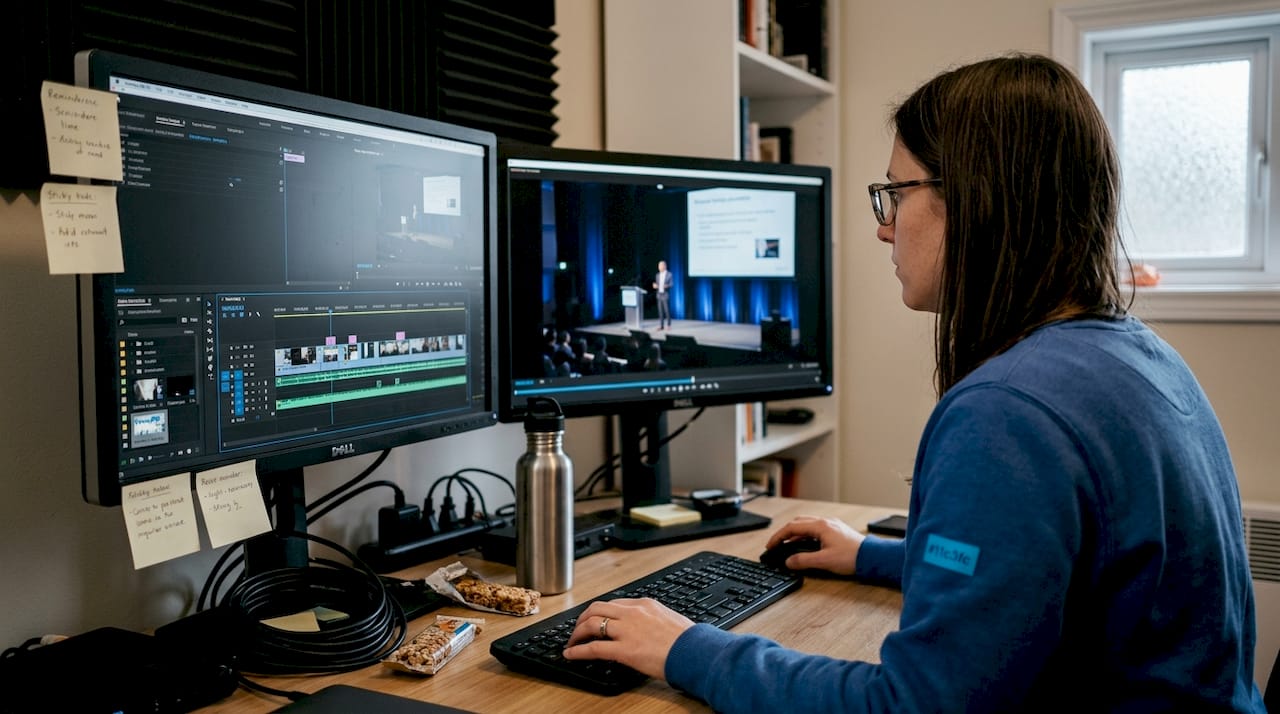
The takeaway is clear: professional video delivers returns, but only when it’s built with strategy. Generic production that ignores channel fit and audience intent will underperform regardless of budget. That’s where working with experienced producers, rather than relying on in-house generalists, makes a measurable difference. Teams that specialize in video production ROI for agencies understand this distinction deeply and build it into every project from the start.
Brand trust and credibility through high-quality production
ROI statistics tell one side of the story. The less quantified but equally powerful benefit of professional video is what it does to your brand’s perceived credibility.
When a potential client or partner watches your corporate video, they form an immediate impression. Shaky footage, inconsistent color grading, and audio that drops mid-sentence signal disorganization. Polished, well-lit, professionally edited video signals the opposite. It says your organization is serious, competent, and worth trusting with real business.
Visual storytelling builds emotional connection in ways that written content simply cannot replicate. A well-crafted executive interview, for example, lets viewers read body language, tone, and confidence. A branded lifestyle campaign shot across South Florida’s distinctive visual landscape creates regional resonance that generic stock footage can never achieve.
Pro Tip: Consistency across video assets matters as much as quality in any single production. If your brand uses specific color palettes, typography, and messaging frameworks in print, those same elements should carry through every frame of your video content. Viewers notice when they don’t.
Here’s how high-quality production strengthens brand positioning:
- Professionalism signals reliability to prospects who are evaluating multiple vendors
- Emotional storytelling creates audience attachment that drives long-term loyalty
- Consistent visual identity reinforces brand recognition across touchpoints
- Differentiation in crowded markets becomes easier when your content looks and sounds better than competitors’
The data supports this: 84% see increased sales after adopting video, which reflects the trust-to-conversion pipeline that polished production enables. Understanding how corporate video strengthens brand image is the first step toward using it strategically rather than reactively.
For South Florida corporations operating in competitive sectors, building credibility with video isn’t a luxury. It’s a baseline expectation from sophisticated buyers and partners who consume dozens of brand videos every week.
Process and efficiency: What goes into professional video production?
One reason marketing managers sometimes hesitate on professional video is uncertainty about the process. What does it actually take? How long will it disrupt the team? Understanding the production workflow removes that ambiguity.
A professional corporate video project moves through three defined stages:
- Pre-production (1 to 3 weeks): Strategy alignment, scriptwriting, storyboarding, location scouting, talent coordination, and logistics planning. This is where the planning for corporate video happens, and it’s the most critical phase for final quality.
- Production (1 to 2 days): The actual filming. With proper pre-production, shoot days are efficient and focused. Professional crews handle lighting, audio, direction, and technical execution simultaneously.
- Post-production (2 to 4 weeks): Editing, color grading, sound design, motion graphics, and final review cycles. This is where raw footage becomes a finished, brand-ready asset.
These production timelines are industry benchmarks that experienced teams consistently meet when pre-production is handled thoroughly.
| Production stage | Timeline | Key deliverables |
|---|---|---|
| Pre-production | 1 to 3 weeks | Script, storyboard, shot list, logistics |
| Production | 1 to 2 days | Raw footage, B-roll, interviews |
| Post-production | 2 to 4 weeks | Final edited video, graphics, audio mix |
The most common mistake organizations make is underinvesting in pre-production. Rushing the strategy and scripting phase to save time almost always creates problems on shoot day and in editing. An experienced producer will push back on compressed pre-production timelines, because they know where quality gets lost. Selecting the right video production partner means finding a team that protects this process rather than shortcuts it.
Audience engagement and messaging power: Real-world examples
Understanding production process is important. But seeing how video actually performs against other content formats brings the value to life.
Key statistic: 91% of marketers use video as a core marketing tool, with B2B explainer and demo videos delivering the highest category ROI of any format.
For South Florida corporations, three video formats consistently drive the strongest results:
| Video type | Primary use case | Engagement advantage |
|---|---|---|
| Explainer videos | Product or service clarification | Reduces sales cycle length |
| Event coverage | Conference and launch documentation | Extends reach beyond attendees |
| Executive interviews | Thought leadership and PR | Builds personal brand and trust |
Consider a Miami-based financial services firm that captures its annual leadership summit on video. The live event reaches 300 attendees. A professionally produced highlight reel, combined with speaker clips distributed on LinkedIn and the company website, extends that reach to thousands of prospects and stakeholders. The content also feeds quarterly newsletters, sales decks, and new employee onboarding materials. One well-produced video becomes a multi-channel asset.
For retail and hospitality brands operating in competitive South Florida markets, commercial video engagement works differently but no less effectively. Short promotional videos showcasing product quality, ambiance, or customer experience outperform static photography in driving website time-on-page and conversion rates.
The pattern across industries is consistent: tailored video content, produced to match the specific audience and channel, generates stronger measurable outcomes than repurposed or generic alternatives. Brands that invest in effective B2B video strategies see compounding returns as each asset builds audience familiarity and brand equity over time.
The truth: Why most video fails and how to avoid it
After two decades working with corporations across South Florida and nationally, we’ve seen a consistent pattern in the projects that underperform: they started with the wrong question. Most failed video campaigns begin with “What should we film?” instead of “What does our audience need to feel or understand after watching this?”
Generic scripts are the single biggest killer of corporate video ROI. A polished, beautifully lit video that says nothing specific to its target audience will be scrolled past in under three seconds. Meanwhile, a moderately budgeted video with a sharp, audience-specific message will outperform it every time.
Platform mismatch is the second most common failure. A five-minute brand documentary that works on your website will fail on Instagram. A thirty-second teaser that performs on LinkedIn may feel incomplete on YouTube. Choosing the right video partner means working with a team that thinks in channels, not just cameras.
In South Florida specifically, we’ve watched brands miss opportunities by producing videos that ignore the region’s cultural texture. Miami’s multicultural business community, Fort Lauderdale’s maritime and professional services economy, and Boca Raton’s affluent consumer base each respond to different visual languages and messaging tones. Local relevance isn’t a detail. It’s a strategic variable that separates videos that resonate from ones that simply exist.
Invest in the story first. The visuals serve the narrative, not the other way around.
Ready to elevate your corporate marketing with professional video?
If this breakdown has shown you anything, it’s that professional video is a measurable, strategic investment rather than a production expense. The ROI is documented, the process is predictable, and the brand impact is real.
At Bonomotion, we’ve been producing high-impact corporate video for South Florida businesses and national brands since 2003. Whether you need corporate video production in Hollywood, Miami commercial video production, or a full suite of business video solutions, our experienced producers are ready to work as a true extension of your marketing team. Let’s build something that actually moves your audience.
Frequently asked questions
How long does a typical corporate video production take?
A full project usually takes 1 to 3 weeks for pre-production, 1 to 2 days for filming, and 2 to 4 weeks for post-production, depending on complexity and revision cycles.
Which video types generate the highest ROI for corporations?
B2B explainer and demo videos deliver the highest ROI of any format and are now used by 91% of marketers as a core content tool.
Is professional video worth the cost for South Florida corporations?
With up to 93% of marketers reporting positive ROI, professional video consistently drives measurable sales increases and lead generation, making it one of the highest-returning marketing investments available.
How does professional video impact brand credibility?
High-quality production signals professionalism and reliability instantly, and 84% of marketers report that video directly contributes to increased sales, reflecting the trust-to-conversion pipeline that polished video enables.