

A media agency is defined as a specialized firm that plans, buys, manages, and optimizes advertising across paid media channels to connect brands with their audiences at the lowest cost and highest impact. The role of agency in media has shifted far beyond ad placement. Global advertisers spent about $1.1 trillion on advertising in 2024, spread across an increasingly fragmented set of digital, broadcast, and out-of-home channels. That scale demands a partner who does more than execute transactions. The modern media agency functions as a commercial operating partner, one that aligns media investment with measurable business outcomes and manages complexity that most internal marketing teams cannot absorb alone.
What are the core functions of a media agency today?
The function of agencies in media covers five distinct disciplines, each requiring dedicated expertise.
- Media planning and audience strategy. Agencies map audience segments, identify where those segments consume media, and build channel plans that match brand objectives to real consumer behavior.
- Media buying and rate negotiation. Agencies consolidate spend across clients to secure bulk pricing. Brands working through agencies can achieve 20–40% lower media rates compared to direct booking. That cost advantage alone often justifies the agency fee.
- Campaign scheduling and budget management. Agencies manage flight dates, pacing, and budget allocation across channels so spend is distributed efficiently throughout a campaign cycle.
- Data analysis and performance reporting. Agencies track conversion events, build attribution models, and produce reporting that connects impressions to revenue rather than stopping at reach or frequency.
- Cross-functional collaboration. High-functioning agencies maintain tight integration between research, planning, creative, and media teams. That internal feedback loop prevents off-strategy creative and keeps campaigns on schedule.
Pro Tip: Ask any agency candidate to walk you through a specific campaign where their internal research and media teams disagreed. How they resolved it tells you more about their process than any credentials deck.
The media agency responsibilities listed above are not sequential. They run in parallel, with continuous feedback between each function. A planning insight changes the buy. A buying constraint reshapes the creative brief. That interconnection is what separates a capable agency from a simple vendor.

How have media agency roles evolved in the digital era?
The shift is quantifiable. Digital media now accounts for 68.4% of global ad spend, with programmatic technology comprising 82.4% of that digital investment. Those numbers mean agencies must now operate as technology-fluent commercial partners, not just media schedulers.
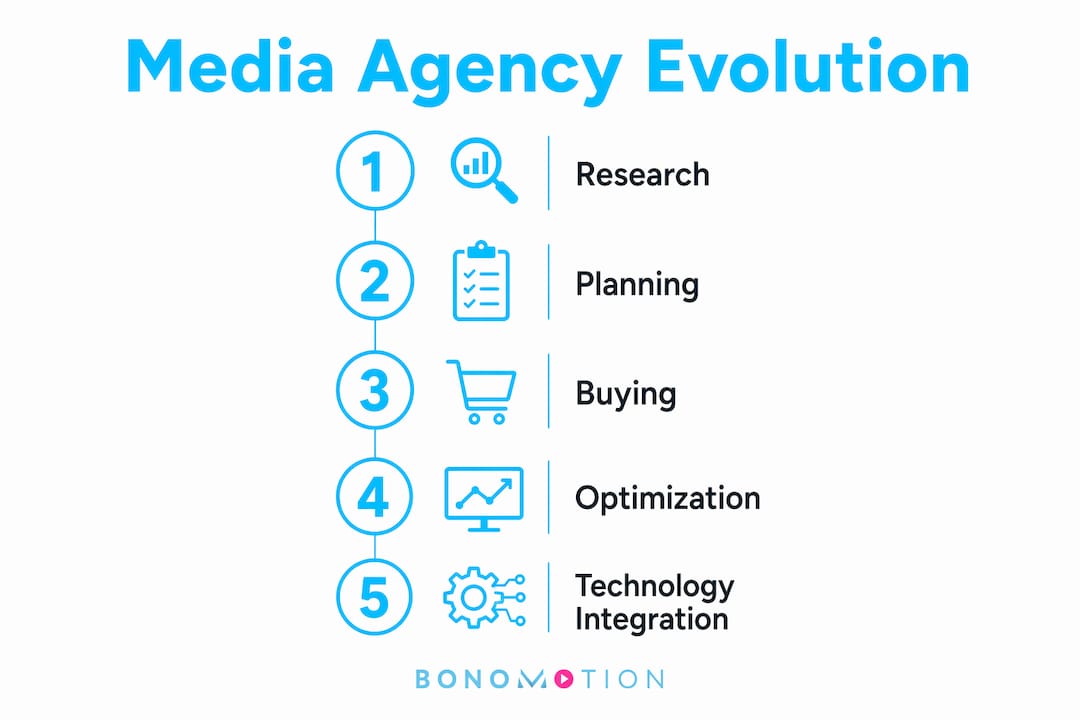
The evolution happened in three distinct phases:
- Transactional vendor phase (pre-2010). Agencies primarily negotiated rates and placed ads. Success was measured by reach, frequency, and cost per thousand impressions. The relationship was largely transactional.
- Digital integration phase (2010–2020). The explosion of search, social, and display advertising forced agencies to build new capabilities in data, attribution, and cross-channel planning. Many agencies added technology stacks and data science teams.
- Accountable partnership phase (2020 to present). The role of an agency has narrowed from offering broad service menus to focusing on specialized, accountable partnerships measured by connecting media spend directly to business growth. Vanity metrics are no longer acceptable currency.
The impact of agencies on media buying is now inseparable from their impact on technology decisions. Agencies evaluate demand-side platforms, data management platforms, and measurement tools on behalf of clients. That technology layer adds complexity and responsibility that did not exist a decade ago.
Longer client relationships have become a defining feature of this phase. Average client-agency tenure has doubled since 2016, with pitch processes now averaging $400,000 per cycle. Stability is not just comfortable. It is financially rational. A long-term partner builds deep brand knowledge that a new agency must spend months reacquiring.
Why is choosing the right media agency a strategic priority in 2026?
The wrong agency costs more than its fee. Frequent switching burns budget on pitch processes, onboarding, and lost institutional knowledge. The right agency multiplies the value of every media dollar you spend.
Evaluating agency fit requires looking at four criteria:
| Evaluation criterion | What to assess |
|---|---|
| Specialization depth | Does the agency have proven expertise in your primary channels, not just general digital capability? |
| Transparency in billing | Can they provide clear breakdowns of management fees versus third-party technology costs? |
| Strategic alignment | Do their planning frameworks connect media spend to your commercial KPIs, not just media metrics? |
| Cultural fit | Will their team operate as an extension of yours, or as a separate entity that reports in monthly? |
Agency transparency in billing is the criterion most brands underweight during selection. Opaque billing structures, where technology costs are bundled into management fees without itemization, erode trust and make performance measurement unreliable. Require upfront fee itemization before signing any contract.
Pro Tip: Request a sample invoice from any agency before signing. If they cannot show you a clear line between their management fee and third-party platform costs, that opacity will compound over time.
The importance of media agencies also shows up in their ability to scale your internal team’s capabilities without adding headcount. When your marketing operation faces channel complexity that exceeds internal bandwidth, an agency fills that gap faster and more cost-effectively than hiring. Understanding how to find the right agency partner for your specific growth stage is a decision worth treating with the same rigor as a senior hire.
How do media agencies measure and demonstrate accountable growth?
The measurement question is where most agency relationships either prove their value or expose their weaknesses.
Strong agencies connect media spend to commercial KPIs through a defined measurement framework. That framework typically includes:
- Conversion tracking and attribution modeling. Agencies implement pixel-based and server-side tracking to capture conversion events, then apply attribution models (last-click, data-driven, or multi-touch) to assign credit across channels.
- Revenue and demand metrics. The best agencies report on pipeline contribution, customer acquisition cost, and return on ad spend rather than stopping at click-through rates or impressions.
- Continuous testing protocols. Media solutions agencies integrate siloed digital channels into unified, performance-measured systems and run ongoing A/B tests on creative, audience segments, and bid strategies to improve efficiency over time.
- Programmatic supply chain audits. This is the area most brands ignore. Only about 36 cents of every dollar entering programmatic demand-side platforms reliably reaches the consumer. The remainder is absorbed by intermediary fees, fraud, and inefficient inventory. A capable agency audits the supply chain and challenges waste at every layer.
“Treating an agency merely as an ad production vendor wastes potential. The real value lies in upstream strategy and challenging opaque programmatic supply chains.”
Collaborative feedback loops between agency teams and clients are the final piece. Agencies that maintain tight research, planning, and media integration produce campaigns that stay on strategy and improve with each cycle. That requires clients to share business data openly, including sales figures, customer lifetime value, and pipeline data, so the agency can calibrate media decisions against real commercial outcomes.
How agencies influence media outcomes ultimately depends on the quality of data flowing in both directions. The brands that treat their agency as a true commercial partner, sharing real business context, consistently outperform those that keep the relationship at arm’s length.
Key Takeaways
Media agencies deliver the most value when treated as commercial partners accountable for business outcomes, not vendors accountable only for media delivery.
| Point | Details |
|---|---|
| Agencies reduce media costs | Negotiation power delivers 20–40% lower rates compared to direct booking. |
| Digital complexity demands specialization | Digital media represents 68.4% of global ad spend, requiring agencies with technology and data expertise. |
| Transparency protects your investment | Require itemized billing that separates management fees from third-party technology costs. |
| Long-term relationships outperform frequent switching | Pitch processes average $400,000 per cycle; stability builds brand knowledge that compounds over time. |
| Programmatic waste is measurable and avoidable | Only 36 cents per dollar reliably reaches consumers; strong agencies audit and reduce supply chain waste. |
What I have learned about agency partnerships after 20 years in production
The conversation about media agencies tends to focus on channel expertise and rate cards. After two decades producing corporate, commercial, and event content for brands ranging from startups to Fortune 100 companies, I have found that the most important variable is almost never the channel mix. It is the quality of the working relationship.
The agencies that consistently delivered results for our clients shared one trait: they asked hard questions before they made recommendations. They wanted to understand the business objective behind the campaign, not just the media budget available. That upstream curiosity is rare, and it is worth paying for.
The agencies that underdelivered almost always had the same problem: they operated in silos. The media team did not talk to the creative team. The reporting team delivered numbers without interpretation. The client received a dashboard instead of a diagnosis.
My honest advice is this: treat the agency selection process like a long-term hire, not a procurement exercise. Check their references specifically for how they handled a campaign that was not working. The answer tells you everything about their accountability culture. And when you find an agency that challenges your assumptions rather than just executing your brief, protect that relationship. Those partnerships are genuinely rare, and building long-term B2B client relationships of that quality takes time to develop on both sides.
The future of media agency roles is not about doing more. It is about doing fewer things with greater depth and accountability. Specialization wins. Transparency wins. Everything else is noise.
— Bernard Bonomo
How Bonomotion Agency supports your media and video strategy
When your media strategy calls for video content that performs across paid, owned, and earned channels, production quality becomes a direct factor in campaign results.

Bonomotion Agency has produced corporate, commercial, and event video for startups, growing brands, and Fortune 100 companies since 2003. Every project is led by an experienced producer who works directly with your team to align creative execution with your campaign objectives and audience. Whether you need executive messaging, branded lifestyle content, or multi-day conference coverage, we operate as an extension of your marketing operation. Explore our corporate video production services or review our full range of video production for marketing agencies to see how we support agency-led campaigns at scale.
FAQ
What is the role of agency in media buying?
A media agency negotiates, purchases, and manages advertising placements across paid channels on behalf of a brand. Agencies use consolidated buying power to secure rates 20–40% lower than brands can achieve through direct booking.
What do media agencies do beyond buying ads?
Media agencies handle audience strategy, campaign planning, performance reporting, attribution modeling, and programmatic supply chain audits. Their value lies in connecting media spend to commercial outcomes like revenue and customer acquisition cost.
How have media agency responsibilities changed with digital advertising?
Digital media now represents 68.4% of global ad spend, with programmatic technology driving 82.4% of that investment. Agencies have evolved from transactional rate negotiators into technology-fluent partners who manage complex, cross-channel media ecosystems.
Why does agency transparency in billing matter?
Opaque billing structures bundle management fees with third-party technology costs, making it impossible to assess true agency value. Requiring itemized invoices protects your budget and keeps performance measurement accurate.
How long should a client-agency relationship last?
Average client-agency tenure has doubled since 2016, and pitch processes now cost an average of $400,000 per cycle. Long-term relationships build brand knowledge that improves campaign performance over time and avoid the financial and strategic cost of frequent transitions.