

A testimonial video is a short, authentic video in which a real customer describes their experience with a product or service, delivering social proof through face, voice, and emotion that written reviews cannot replicate. Where a text review sits flat on a page, a video testimonial activates the viewer’s mirror neurons, creating the kind of emotional resonance that drives purchase decisions. Industry data shows video testimonials convert at 4x the rate of written testimonials, making them one of the highest-return content formats available to marketers today. If you are building brand credibility or shortening a sales cycle, understanding the testimonial video meaning is the right place to start.
What is a testimonial video and why does it outperform text?
A testimonial video is the video production industry’s term for a customer endorsement captured on camera, typically running between 30 seconds and four minutes depending on the platform and purpose. The format predates the internet, appearing in broadcast commercials as early as the 1950s, but digital distribution has made it accessible to companies of every size. Today, brands from early-stage SaaS startups to Fortune 100 companies use testimonial videos as a core trust-building asset across websites, social channels, and sales decks.
The performance gap between video and text testimonials comes down to neuroscience. Video activates mirror neurons in viewers, triggering an empathetic response that text simply cannot produce. When a prospect watches a real customer describe solving a painful problem, their brain processes it almost as a personal experience. That neurological shortcut collapses skepticism faster than any copywritten headline.
The data reinforces this point at every level of the funnel. Video content on landing pages can increase conversions by up to 80%, and testimonial videos specifically lift add-to-cart rates by 15 to 34%. Those numbers represent real revenue, not vanity metrics. For B2B marketers running long sales cycles, a two-minute customer story placed on a product page can do the work of three follow-up emails.
“The most persuasive voice in your marketing is not yours. It belongs to the customer who already believes in what you do.”
Three factors explain why video outperforms text in authenticity perception:
- Microexpressions and tone of voice communicate sincerity in ways that punctuation and capitalization cannot.
- Visual context, such as a customer speaking from their own office or workspace, grounds the story in reality.
- Unscripted pauses and natural phrasing signal genuine experience rather than coached messaging.
What does effective testimonial video production involve?
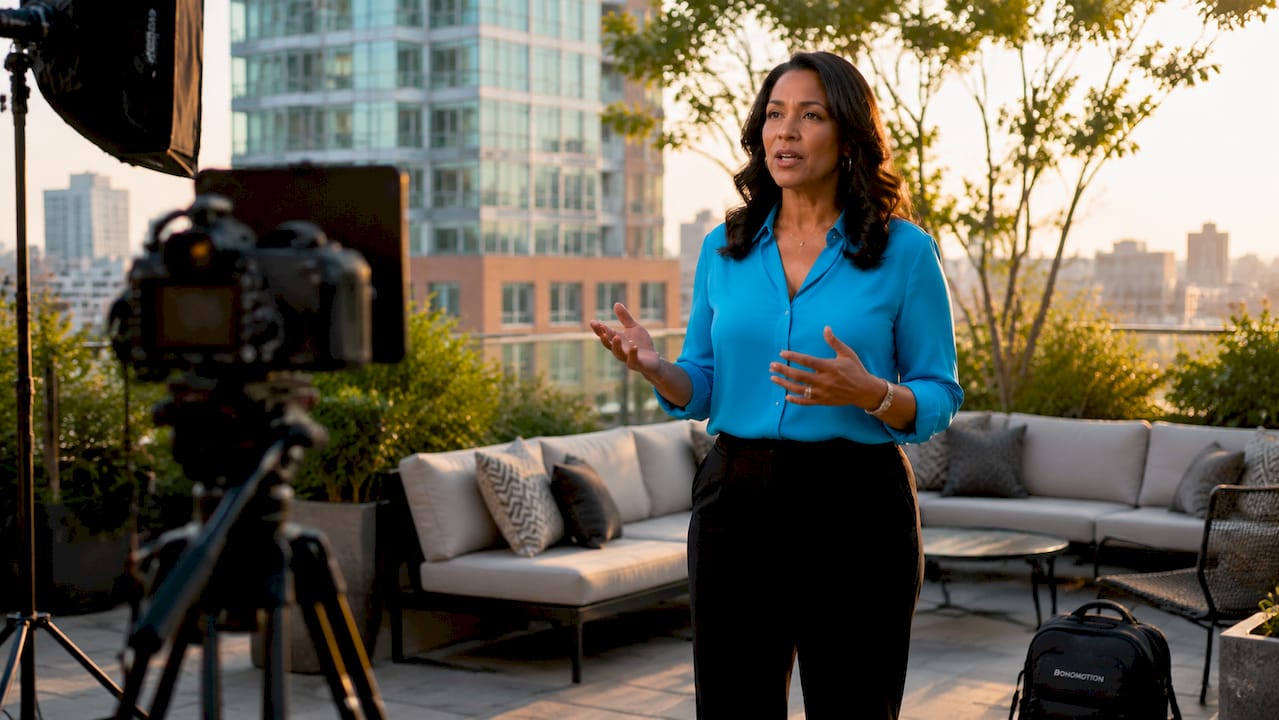
Effective testimonial filming prioritizes authenticity above production complexity, and audio quality above camera resolution. Modern production best practices rank audio clarity and natural lighting above expensive gear, because viewers will forgive a slightly soft image before they forgive muffled or echo-heavy sound. A customer recorded on a quality USB microphone in a quiet room will outperform a beautifully lit subject recorded on a smartphone in an open office.
Here is the production hierarchy that Bonomotion applies to every testimonial project:
- Audio first. Use a dedicated microphone, whether a lavalier, a USB condenser, or a broadcast-quality boom. Eliminate background noise before pressing record.
- Lighting second. Natural window light or a simple two-point LED setup creates a professional look without a full studio. Avoid overhead fluorescent lighting, which flattens faces and reads as amateur.
- Camera third. A modern mirrorless camera, a high-end webcam like the Logitech Brio, or even a recent iPhone on a tripod delivers sufficient resolution for web and social use.
- Background and framing. A clean, uncluttered background keeps attention on the speaker. Frame the subject with their eyes in the upper third of the frame.
- Guided prompts, not scripts. Give customers a narrative structure rather than written lines. The Problem → Solution → Outcome framework consistently produces usable, emotionally engaging footage.
Pro Tip: Never ask a customer to read from a script. Scripted testimonials undermine credibility because viewers detect the artificiality within seconds. Instead, send three to five open-ended questions 24 hours before recording so the customer can think through their story naturally.
Remote recording has changed what is testimonial filming at scale. Browser-based tools allow customers to record from any location without scheduling a crew visit. Remote video tools increase response rates by 5 to 10 times compared to traditional on-site scheduling, which means you collect more testimonials in less time. The tradeoff is reduced control over environment, which is why clear technical instructions and a pre-recording checklist are non-negotiable.
Optimal video length depends on where the content will live. Platform-specific length guidelines recommend 30 to 60 seconds for social media, 60 to 90 seconds for landing pages, and 2 to 4 minutes for in-depth case studies. Matching length to context prevents drop-off and keeps the message tight.
One of the most common production failures is letting customers supply their own B-roll footage. Amateur B-roll introduces inconsistent quality that undercuts the polished interview footage, and the visual mismatch signals low production investment to the viewer. Either shoot B-roll professionally or omit it entirely in favor of clean graphics and lower-third text.
How to use testimonial videos to build brand credibility
Placement strategy determines whether a testimonial video converts or gets ignored. The highest-performing placements share one characteristic: they appear at the exact moment a prospect is evaluating risk. That moment occurs on product pages, pricing pages, and checkout flows, not on the homepage hero banner where brand awareness is still forming.
A practical placement framework for most B2B and B2C brands looks like this:
- Homepage: One short testimonial video (60 to 90 seconds) near the primary call-to-action, featuring a recognizable customer name or company logo.
- Product and service pages: A testimonial directly addressing the specific use case or pain point that page targets. A SaaS company selling project management software should show a testimonial from an operations director, not a generic “great product” clip.
- Pricing page: A customer who specifically mentions ROI or cost savings. This placement addresses the highest-friction objection in the funnel.
- Email sequences: A 30-second clip embedded in a mid-funnel nurture email outperforms text-only messages in click-through rate.
- Sales decks and proposals: A two-minute case study video from a comparable client removes more objections than three pages of written proof.
The winning testimonial video strategy matches the customer profile in the video to the prospect watching it. A CFO evaluating enterprise software responds to a testimonial from another CFO at a comparable company. Demographic and role alignment is the single most underutilized lever in testimonial video deployment.
Measuring effectiveness requires tracking beyond view count. Monitor conversion rate changes on pages where testimonials are added, track time-on-page as a proxy for engagement, and A/B test different testimonial subjects against each other. The goal is to identify which customer stories move the needle for which audience segments, then produce more of what works.
Comparing testimonial video formats and styles
Different formats serve different goals, and choosing the wrong one wastes both budget and audience attention.
| Format | Best use case | Key advantage | Key limitation |
|---|---|---|---|
| Short social clip (30 to 60 sec) | Paid social, organic reach | High shareability, low production cost | Limited depth, no room for nuance |
| Landing page testimonial (60 to 90 sec) | Conversion optimization | Directly addresses buyer objections | Requires strong editing to stay tight |
| In-depth case study (2 to 4 min) | B2B sales, enterprise deals | Full narrative arc, high credibility | Higher production cost, lower organic reach |
| User-generated content (UGC) | Community building, social proof at scale | Authentic, low cost, high volume | Inconsistent quality, limited brand control |
| On-camera interview | Corporate marketing, PR, events | Professional look, brand-controlled | Requires crew or professional setup |
Scripted versus unscripted is the most consequential format decision. Scripted testimonials feel controlled and polished, but even slight authenticity imperfections in unscripted content boost viewer trust. The practical answer is guided and unscripted: give the customer a clear narrative structure and let them speak in their own words. This approach delivers the emotional authenticity of UGC with the narrative coherence of a produced piece.
Polished productions benefit from branded lower-thirds, subtle music beds, and color grading that matches the brand’s visual identity. These elements signal professionalism without overshadowing the customer’s voice. The production quality hierarchy always keeps the customer’s story at the center; design and graphics serve the narrative, not the other way around.
Key takeaways
Testimonial videos outperform every other social proof format because they combine neurological engagement, authentic voice, and strategic placement to convert skeptical prospects into confident buyers.
| Point | Details |
|---|---|
| Video converts at 4x text | Video testimonials drive significantly higher conversion rates than written reviews across all funnel stages. |
| Audio quality is the top priority | Clear sound matters more than camera resolution; invest in a quality microphone before upgrading your camera. |
| Guided prompts beat scripts | Use a Problem → Solution → Outcome structure to get authentic, usable footage without scripting the customer. |
| Placement drives performance | Position testimonials on product, pricing, and checkout pages where purchase risk is highest. |
| Match customer to prospect | Align the testimonial subject’s role and industry with the specific audience segment viewing that page. |
Why authenticity is the only metric that matters in testimonial video
I have been producing corporate and testimonial video content for over two decades, and the single biggest mistake I see marketers make is optimizing for production value before optimizing for truth. A Fortune 500 company once came to us with a testimonial script that had been through seven rounds of legal review. The resulting video looked expensive and said absolutely nothing a real customer would ever say. It performed exactly as you would expect: near zero engagement, no measurable conversion lift.
The testimonial videos that consistently outperform are the ones where the customer forgets the camera is on. That happens when you build trust before you press record. It means briefing the customer on the narrative arc without handing them lines. It means choosing a location where they feel comfortable, not where the lighting is perfect. It means letting a moment of genuine emotion stay in the edit rather than cutting to the next polished soundbite.
The future of this format is moving toward AI-assisted editing tools and remote workflows, and both trends are net positives for authenticity. Remote recording removes the intimidation of a full crew. AI editing tools like Descript and Adobe Premiere Pro’s AI features reduce the time between raw footage and finished product, which means more iterations and more chances to find the real story. What will not change is the fundamental requirement: a real person, speaking honestly, about a real result. No technology replaces that.
My advice to any marketer building a testimonial video program is to start with your three most vocal customers and record them with minimal setup. Watch what happens to your conversion metrics. Then invest in production quality once you know which stories move your audience. The sequence matters. Production quality amplifies a great story; it cannot create one.
— Bernard
Produce testimonial videos that actually convert
At Bonomotion, we have spent over 20 years helping brands from Miami startups to Fortune 100 companies capture customer stories that drive real business results. Our corporate video production team manages every element of the testimonial process, from pre-interview coaching and location scouting to professional audio, lighting, and post-production editing. We also offer commercial video production services for brands that need testimonial content built for paid media and broadcast. Whether you need a single polished testimonial or a full library of customer stories, our producers work directly with your team to deliver content that performs. Contact Bonomotion to discuss your next testimonial video project.
FAQ
What is the difference between a testimonial video and a case study video?
A testimonial video is a short customer endorsement focused on emotional impact and social proof, typically 30 to 90 seconds. A case study video is a longer, structured narrative (2 to 4 minutes) that details the specific problem, solution, and measurable outcome in depth.
How long should a testimonial video be?
Optimal length depends on placement: 30 to 60 seconds for social media, 60 to 90 seconds for landing pages, and 2 to 4 minutes for in-depth case studies, according to current production best practices.
Do testimonial videos need to be professionally produced?
Audio clarity and natural lighting matter more than expensive camera gear. A customer recorded with a quality microphone in a quiet, well-lit space will outperform a visually polished video with poor sound.
What is the best way to prompt a customer for a testimonial video?
Use the Problem → Solution → Outcome framework. Send three to five open-ended questions before recording so the customer can organize their thoughts, and avoid providing a script, which viewers detect as inauthentic.
Where should testimonial videos be placed on a website?
The highest-converting placements are product pages, pricing pages, and checkout flows, where prospects are actively evaluating risk. Homepage placement works for brand awareness but produces lower direct conversion impact.