

Branded content is defined as media funded by a brand where the brand’s identity is woven into the story rather than positioned as the primary subject. Unlike a 30-second TV spot or a banner ad, branded content earns attention by delivering genuine entertainment or educational value first. Think of Red Bull’s documentary series, Patagonia’s environmental films, or a podcast series sponsored by a financial services firm where money psychology drives every episode. The brand facilitates the story; the story does the selling. Platforms like Instagram have formalized this with dedicated branded content tools that let creators tag sponsors and extend organic reach through paid partnerships.
What is branded content, and what makes it different?
Branded content is entertainment or utility-driven content that prioritizes brand affinity and trust over direct conversion. The brand funds the content and integrates its identity into the narrative, but the story itself must stand on its own merit. If the content would not hold an audience’s attention without the brand logo attached, it is not branded content. It is an advertisement wearing a costume.

The industry also uses the term “brand journalism” to describe a specific subset of branded content where brands produce editorial-quality reporting or storytelling. Brand journalism follows journalistic standards, covers topics relevant to the brand’s world, and builds credibility through informational depth rather than product promotion. Red Bull Media House and Michelin’s travel guides are two of the most cited examples in the field.
The core distinction matters because it changes how you plan, produce, and measure everything. Branded content is not a shortcut to sales. It is a long-term investment in mental availability, the degree to which your brand comes to mind when a buyer enters a relevant purchase situation.
Key characteristics that define branded content
Branded content shares four defining attributes that separate it from adjacent marketing formats:
- Brand integration is subtle. The brand appears as a facilitator or sponsor of value, not the hero of the story. A fitness brand producing a documentary about elite athletes integrates its identity through association, not product demos.
- Audience value comes first. The content must entertain, educate, or inspire independently of any commercial message. Audiences choose to consume it; it does not interrupt them.
- It builds affinity, not immediate conversions. The goal is long-term brand favorability, not a click-through to a product page.
- It is non-interruptive by design. Branded content lives where audiences already spend time, from YouTube channels to podcast feeds, and competes on quality rather than placement frequency.
Pro Tip: Before greenlighting any branded content project, ask one question: would a person share this if the brand name were removed? If the answer is no, the content is too product-focused to qualify as genuine branded content.
How does branded content differ from other marketing formats?
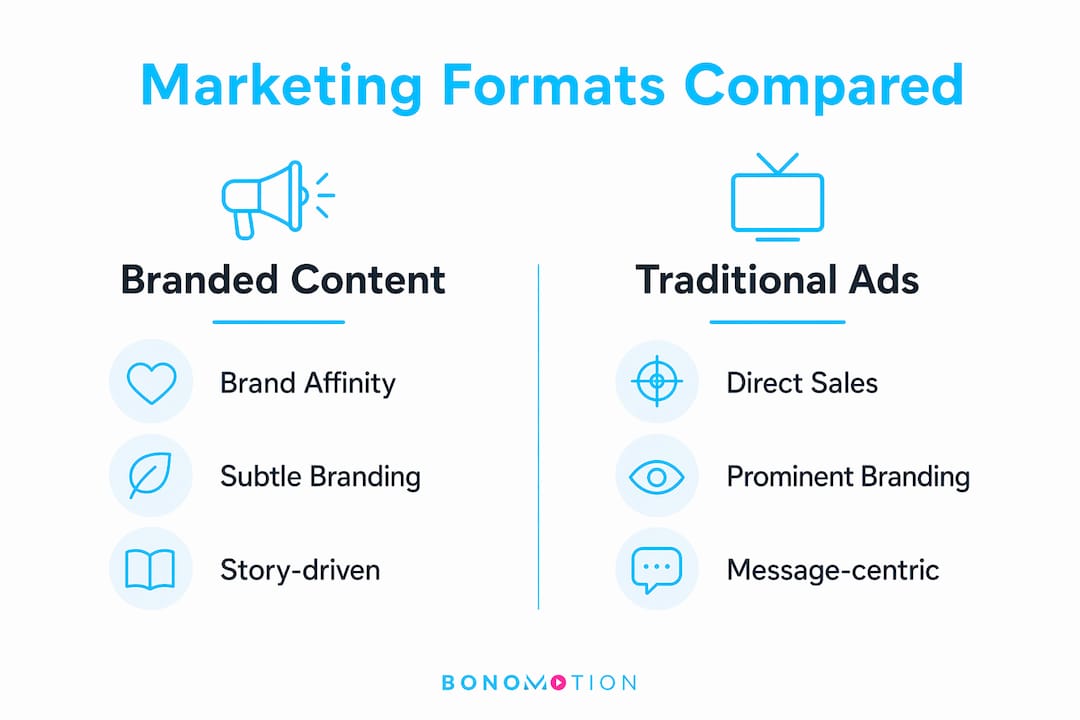
The confusion between branded content, content marketing, product placement, and traditional advertising is real and persistent. Each format has a distinct goal, a different relationship with the brand, and a different creator profile.
| Format | Primary goal | Brand presence | Typical creator |
|---|---|---|---|
| Branded content | Brand affinity and trust | Subtle, integrated into story | External creator or media partner |
| Content marketing | Demand generation and SEO | Moderate, brand is publisher | In-house marketing team |
| Product placement | Awareness within existing media | Incidental, background or prop | Production company or network |
| Traditional advertising | Direct response or awareness | Central, explicit | Ad agency |
Content marketing, as practiced by brands like HubSpot or Moz, is owned-channel publishing designed to generate search traffic and qualified leads. The brand is the publisher and the subject. Branded content, by contrast, often lives on third-party channels and keeps the brand in a supporting role. Product placement drops a logo or product into existing content without shaping the narrative. Traditional advertising makes the brand the explicit subject and pays for placement rather than earning attention.
The practical implication for marketing professionals is this: branded content requires a media mindset, not a marketing mindset. You are producing content that must compete with everything else in a person’s feed, inbox, or podcast queue. That is a fundamentally different creative brief than writing a product description or designing a display ad.
What formats and trends define branded content in 2026?
Common branded content formats include articles, videos, podcasts, documentaries, interactive tools, research reports, and experiential events. In 2026, the most effective campaigns combine several of these formats around a single narrative core.
The dominant formats this year break down as follows:
- Social video series. Short-form and mid-form series on YouTube, Instagram, and TikTok remain the highest-volume format. Brands like Nike and Glossier have built entire content studios around episodic social storytelling.
- Podcasts. Audio remains one of the most intimate branded content formats because listeners choose to spend 20 to 60 minutes with a single piece of content. A brand-funded podcast on a topic adjacent to its product category builds deep audience relationships over time.
- Documentaries and long-form video. Feature-length and short documentary formats carry the highest production value and the strongest brand recall. Nielsen analysis of 100-plus branded video pieces shows branded content generates an average of 86% brand recall among viewers, compared to 65% for traditional pre-roll advertising. That 21-point gap is the business case for investing in quality production.
- Interactive tools and research reports. B2B brands increasingly fund original research or build interactive calculators that provide genuine utility. Salesforce’s annual “State of Marketing” report is a textbook example of branded content that earns media coverage, backlinks, and industry authority simultaneously.
- Experiential events. Live events, from branded conferences to sponsored cultural moments, create content that lives well beyond the event itself when captured and distributed across channels.
Creator partnerships amplify every format. Micro- and nano-influencers are preferred partners by 70% of brands for authentic engagement in branded content campaigns. Their audiences are smaller but more trusting, which aligns with the affinity-first goal of the format. Instagram’s branded content ad tools let brands extend a creator’s organic post to larger audiences through paid promotion, combining authenticity with reach.
Pro Tip: Plan your branded content as a modular seed asset from day one. A 20-minute documentary becomes a 90-second social cut, a five-part email series, three podcast episodes, and a dozen social graphics. One production budget, ten distribution touchpoints.
How do you create and measure branded content effectively?
Effective branded content starts with audience passion mapping, not product features. Identify the topics, questions, and cultural moments your audience genuinely cares about, then find the intersection with your brand’s credibility. A cybersecurity firm producing a true-crime style podcast about corporate data breaches is operating in that intersection. The audience gets compelling storytelling; the brand earns authority in its category.
The creation steps that drive real ROI follow a clear sequence:
- Define the audience passion point. Research what your audience consumes for pleasure, not just for work. The content must compete in that space.
- Build a modular master asset. Create one high-quality seed piece, whether a documentary, a long-form article, or a podcast series, designed from the start to be repurposed across formats and channels.
- Distribute across creator and publisher channels. Owned platforms alone rarely reach new audiences. Partner with creators, media publishers, and platforms where your audience already spends time.
- Keep the brand in a supporting role. Successful branded content avoids overt sales pitches. When the brand becomes the central character instead of the facilitator of value, audience engagement declines.
- Measure brand lift, not clicks. Branded content success is measured through brand lift studies that compare exposed and control groups on metrics like brand awareness, favorability, and purchase intent. Direct-response click rates are the wrong scorecard for this format.
Distribution deserves as much budget as production. A documentary that lives only on your brand’s YouTube channel with 4,000 subscribers will not move brand awareness metrics. Seeding content through creator partnerships, editorial placements, and paid amplification on platforms like Instagram and YouTube is what converts a quality production into measurable brand lift.
Pro Tip: Commission a brand lift study before your campaign launches, not after. Establishing a baseline on awareness and favorability gives you a clean before-and-after comparison. Without a baseline, you are measuring noise.
Key takeaways
Branded content earns audience attention by delivering genuine value first, with brand identity integrated into the story rather than placed at the center of it.
| Point | Details |
|---|---|
| Definition clarity | Branded content integrates brand identity into story-driven media without making the brand the primary subject. |
| Brand recall advantage | Branded video content generates 86% brand recall versus 65% for traditional pre-roll, making production investment defensible. |
| Format variety matters | Effective campaigns combine documentaries, podcasts, social series, and reports around a single modular narrative core. |
| Measure brand lift | Track awareness, favorability, and purchase intent through brand lift studies, not click-through rates. |
| Creator partnerships scale reach | Micro- and nano-influencers deliver authentic engagement; Instagram branded content ads extend that reach through paid promotion. |
Why the “invitation” model is the only one worth building
Brands that still treat content as a vehicle for sales messaging are fighting the wrong battle. The shift from interruption-led advertising to invitation-led experiences is not a trend. It is a structural change in how audiences allocate attention. People have more tools than ever to skip, block, and ignore commercial messages. The only content that survives that filter is content worth choosing.
What I have seen consistently, working across corporate productions and brand campaigns, is that the brands with the strongest branded content programs treat their content operation like a media company. They have editorial calendars, audience personas, and distribution strategies that exist independently of their product launch cycles. The content serves the audience first; the brand benefits as a consequence.
The most common mistake I see is brands producing what I call “expensive brochures.” High production value, polished visuals, and a story that is ultimately about how great the product is. That is not branded content. It is a TV commercial with a longer runtime. Audiences recognize it immediately and disengage.
Cross-platform narrative cohesion is the other underrated discipline. The best campaigns tell one story across multiple formats, so a viewer who encounters the brand on Instagram, then finds the podcast, then reads the research report feels like they are going deeper into a world rather than being retargeted with variations of the same ad. That depth is what builds the kind of brand affinity that survives a competitor’s price promotion.
The opportunity in 2026 is significant for brands willing to commit to the format properly. Attention is scarce, trust is scarcer, and content that genuinely earns both is rarer than most marketing teams admit.
— Bernard
Bonomotion’s approach to branded video production
Branded content lives or dies on production quality and narrative clarity. A strong concept executed with weak production signals to audiences that the brand does not take the story seriously.
At Bonomotion, we have spent over 20 years helping brands from startups to Fortune 100 companies produce corporate and commercial video content that earns attention rather than buying it. Every project is guided by an experienced producer who works directly with your team to align the content with your audience, your brand voice, and your distribution plan. We build modular production workflows so a single shoot generates assets across social, web, and broadcast formats. If you are ready to produce branded video that builds real brand equity, our team is ready to help you get it right from the first frame.
FAQ
What is branded content in simple terms?
Branded content is media funded by a brand that entertains or educates an audience while integrating the brand’s identity into the story. The brand supports the content rather than being its main subject.
How does branded content differ from advertising?
Traditional advertising places the brand at the center of the message and pays for placement. Branded content earns audience attention by delivering value first, with the brand integrated subtly into a story the audience chooses to consume.
What are the most common types of branded video content?
The most common types of branded video content include social video series, short and feature-length documentaries, brand-funded podcasts with video components, and experiential event films. Each format prioritizes storytelling over product promotion.
How is branded content success measured?
Branded content effectiveness is measured through brand lift studies that track changes in brand awareness, favorability, and purchase intent between audiences exposed to the content and control groups that were not. Click-through rates are not a reliable metric for this format.
What is brand journalism, and how does it relate to branded content?
Brand journalism is a subset of branded content where brands produce editorial-quality reporting or storytelling on topics relevant to their industry. Michelin’s travel guides and Red Bull Media House are two of the most recognized examples of brand journalism executed at scale.