

Creative video is often reduced to a conversation about production quality, motion graphics, or cinematography. That framing sells it short. For marketing managers and business professionals in South Florida, creative video is a strategic asset that drives measurable outcomes, from increased brand recall to direct revenue impact. The real question is not whether your video looks polished. It is whether your video is built to connect, convert, and perform against your actual business goals. This article breaks down what creative video truly means, the formats that matter most, and how to put them to work.
Table of Contents
- Defining creative video: More than just visuals
- Core types of creative video for business
- What makes a video ‘creative’? Strategy meets performance
- Applying creative video: Real-world strategies
- The real reason creative video works (and why most brands miss it)
- Ready to elevate your brand with creative video?
- Frequently asked questions
Key Takeaways
| Point | Details |
|---|---|
| Creative video defined | It’s a strategic blend of visuals, narrative, and business goals—not just flashy content. |
| Types for business | Brand storytelling, performance marketing, and event videos each deliver different outcomes for companies. |
| Metrics matter | Beyond views, measure watch time, CTR, and conversions to gauge true creative video impact. |
| Real-world action | Start with clear goals, experiment with formats, and tailor creative videos to your unique audience. |
Defining creative video: More than just visuals
Most people assume creative video is simply content that looks impressive. Cinematic footage, sharp color grading, dynamic editing. These elements matter, but they are not the definition. Creative video, in a business context, is content designed with both visual impact and brand-specific storytelling working together. The goal is not to win a film award. The goal is to move your audience.
Where traditional corporate video often prioritizes information delivery, creative video prioritizes connection. It is crafted to trigger emotion, reinforce brand values, or spark a specific action, whether that is clicking a link, attending an event, or choosing your service over a competitor’s. The distinction is strategic intent layered into every creative decision.

Consider the difference between a standard explainer video and a brand storytelling piece. An explainer video tells viewers what a product does. A creative brand video makes viewers feel something about the brand behind the product. That emotional layer is what drives retention and loyalty.
Here is a practical comparison across common types of video production:
- Generic corporate video: Focuses on features, specifications, company milestones. Informational but rarely emotionally engaging.
- Explainer video: Walks audiences through a process or product. Useful but often formulaic.
- Creative brand video: Leads with story, emotion, and brand identity. Designed to resonate and be remembered.
- Performance creative video: Built for specific platforms with hooks, pacing, and calls-to-action calibrated to drive measurable results.
“The distinction between brand storytelling and performance video comes down to intent: brand storytelling videos focus on emotional connection, values, and mission, typically running 90 seconds to 3 minutes, while performance videos emphasize CTAs, hooks, and metrics like CTR and ROAS.”
Understanding that distinction puts you ahead of most businesses, who treat all video the same way regardless of context or campaign goal.
Core types of creative video for business
Once you recognize creative video as a strategic discipline, the next step is understanding which formats serve which business objectives. There is no one-size-fits-all approach. The format you choose should match your goal, your audience, and your channel.
The most effective creative video formats for marketing, corporate events, and brand storytelling fall into four primary categories. Brand storytelling and performance video formats anchor both ends of the creative spectrum, with product videos and event recaps filling critical roles in between.
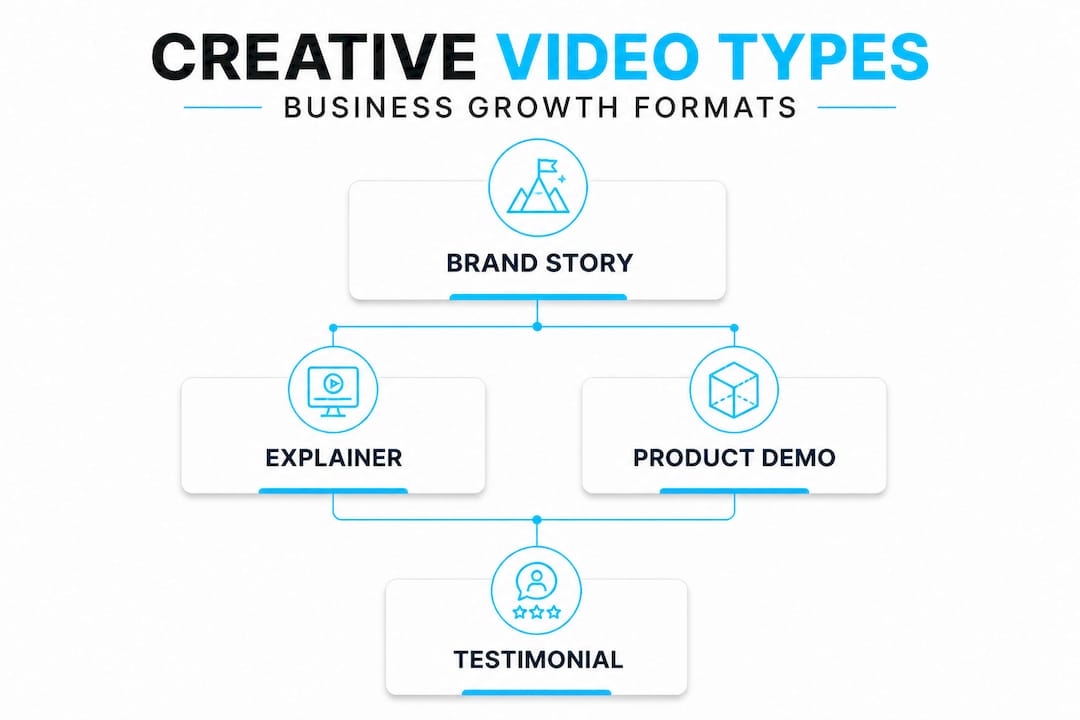
| Format | Length | Primary objective | Key metric(s) | Example use case |
|---|---|---|---|---|
| Brand storytelling | 90 sec to 3 min | Emotional connection, brand recall | View-through rate, brand lift | Company culture video for recruitment |
| Performance marketing video | 15 to 60 sec | Clicks, conversions, direct response | CTR, ROAS, conversion rate | Paid social ad for a product launch |
| Product video | 60 sec to 2 min | Education, purchase intent | Watch time, conversion rate | E-commerce feature demonstration |
| Event recap video | 2 to 4 min | Engagement, community, authority | Social shares, replay views | Post-conference highlight reel |
How does each format align with your specific goals? Here is a numbered breakdown:
- Brand storytelling videos build the emotional foundation your audience needs to trust your brand over time. They are not designed to convert immediately. They plant the flag and establish identity.
- Performance marketing videos are built for direct response. Every second is optimized: the hook lands in the first three seconds, the message is tight, and the call-to-action is unmistakable. These videos live on paid social channels and are measured against hard metrics.
- Product videos educate buyers at the decision stage. They answer the “is this right for me?” question and reduce purchase hesitation, making them essential for businesses with complex or premium offerings.
- Event recap videos serve a dual purpose. They reward attendees with shareable content and give non-attendees a reason to engage with your brand and attend the next event. For South Florida companies running conferences, trade shows, or brand activations, event recaps are an underutilized asset.
Pro Tip: Before selecting a video format, write down the one action you want your audience to take after watching. That single answer should drive your format choice, your script, and your distribution strategy.
The most effective campaigns we see at Bonomotion combine formats strategically. A brand storytelling video generates awareness, a product video nurtures intent, and a performance creative video closes the loop at the conversion stage. Exploring professional video production options with this full-funnel mindset produces significantly better results than ordering individual videos in isolation.
If you are unsure where to start, video production for your brand begins with understanding which stage of the buyer’s journey you are targeting and working backward from there.
What makes a video ‘creative’? Strategy meets performance
This is where the conversation gets more precise. “Creative” is not a synonym for “artistic.” In a business context, creativity earns its place only when it connects to performance. The most effective creative video combines storytelling craft with the discipline of performance marketing.
The industry distinguishes between two modes: brand creative and performance creative. Brand creative prioritizes long-term equity. Performance creative is engineered for short-term, measurable action. Understanding brand vs performance marketing is foundational for any marketing manager building a video strategy, because conflating the two leads to content that does neither job well.
Performance creative, specifically, merges creativity with KPIs, testing hooks for “thumbstop” (the moment a user stops scrolling), and measuring beyond views to metrics like watch time, conversions, and customer acquisition cost reduction. These are the metrics that connect creative decisions to business outcomes.
Here is a data-driven look at what those metrics reveal:
| Metric | What it measures | Why it matters for creative video |
|---|---|---|
| CTR (click-through rate) | How many viewers take the prompted action | Validates whether your hook and CTA are working |
| ROAS (return on ad spend) | Revenue generated per dollar spent | Ties creative investment directly to revenue |
| Watch time / completion rate | How long viewers stay engaged | Signals whether your story holds attention |
| Conversion rate | Actions taken after viewing (sign-ups, purchases) | Measures real business impact, not just awareness |
| CAC reduction | Lower cost to acquire each new customer | Shows cumulative efficiency of creative refinement |
The creative elements that drive these results are not random. They are deliberate choices made during pre-production:
- Visual hooks: The first three seconds must stop the scroll. A bold image, an unexpected scenario, or a direct question creates the pause that earns the rest of the view.
- Narrative structure: Even a 30-second ad has a story arc. Problem, solution, proof. Deviation from that structure loses viewers.
- Strategic CTAs: The call-to-action must feel earned, not appended. When the creative has built the right context, the CTA converts naturally.
- Brand consistency: Every visual and tonal decision must reinforce your brand identity. Inconsistency confuses audiences and erodes trust.
The data is clear: businesses that track video engagement and conversions rather than just views consistently make smarter creative decisions in subsequent campaigns. Views are a vanity metric. Watch time and conversion rate tell you whether your creative is actually working.
Applying creative video: Real-world strategies
Knowing the theory is one thing. Putting it into practice requires a structured approach, especially for marketing managers balancing multiple campaigns, stakeholders, and budgets.
Here is a step-by-step implementation framework:
- Define a single, clear campaign objective. Are you building brand awareness, generating leads, or driving event attendance? Each goal requires a different format and a different set of success metrics.
- Identify your audience with precision. For South Florida businesses, this means accounting for multicultural audiences, multilingual markets, and the distinct dynamics of industries like hospitality, real estate, technology, and finance that dominate the regional economy.
- Select your format based on objective and channel. A LinkedIn audience for a B2B services firm responds differently than an Instagram audience for a luxury product brand. Match the format to where your audience is most receptive.
- Develop the creative brief before entering production. The brief should include your brand voice, key messages, emotional tone, visual references, and the specific action you want viewers to take. Skipping this step is the most common and costly mistake we see.
- Produce with distribution in mind. Content optimized for vertical mobile viewing performs differently than widescreen broadcast formats. Make this decision before, not after, production.
- Launch with a test-and-learn mindset. Rather than committing your entire budget to one creative execution, test hooks and creative iterations for thumbstop performance, then scale what works.
- Track post-campaign metrics and iterate. Measure against your defined KPIs. What your audience responds to in Miami’s Brickell corridor may differ from what resonates in Fort Lauderdale or West Palm Beach. Local context shapes creative performance.
Pro Tip: The biggest performance gains come not from a completely new concept but from iterating on a single winning creative element. Change only the hook, or only the CTA, between test versions. This isolates what actually drives results.
For businesses working with video for marketing agencies, establishing this iterative process at the start of a client engagement sets up every subsequent campaign for better performance. It also creates a library of learnings that compound over time. Understanding the principles in a YouTube brand account guide can also help you structure your video library for maximum discoverability and long-term audience building.
The real reason creative video works (and why most brands miss it)
Here is what two decades in video production have taught us: the brands that win with creative video are not the ones with the biggest production budgets or the most visually stunning content. They are the ones who treat video as a living business asset and commit to constant refinement.
Most businesses approach creative video as a one-time project. They invest in production, publish the result, and move on. That approach produces diminishing returns because audience attention is not static. Creative fatigue is real. A video that performed well in Q1 will lose effectiveness by Q3 if it is the only asset in your rotation. Audiences tune out familiar content fast, and algorithms reward freshness.
The businesses that sustain results use what we call hybrid creative, a model that combines brand-building storytelling with performance-oriented testing. They do not treat brand creative and performance creative as separate budgets. They treat them as two phases of the same continuous strategy.
“Creative video that drives sustained business results is not about one brilliant campaign. It is about building a system for driving brand engagement through consistent production, measurement, and creative iteration.”
The uncomfortable truth is that many brands prioritize concept over consistency. They want the viral moment, the award-winning spot, the production that impresses stakeholders internally. Those goals are not wrong, but they distract from the discipline of building video content that compounds in value over time.
Think of your video library the way you think about a content calendar. Each piece serves a function in the larger ecosystem. Some build equity. Some drive action. Together, they create a network effect where each video reinforces the others, building cumulative brand authority and audience trust.
Ready to elevate your brand with creative video?
At Bonomotion, we have spent over 20 years helping South Florida businesses turn video strategy into measurable business results.
Whether you need a polished corporate production in Hollywood, Florida, or a high-energy promotional campaign for a Miami brand launch, our team works as an extension of yours from day one. Our producers bring both creative vision and performance discipline to every project, so your content looks great and delivers against your KPIs. Explore our corporate video production experts to see how we approach complex, multi-day productions. For brands ready to scale, our business video solutions connect strategy with execution across every format. You can also review our full range of commercial video production services to find the right fit for your next campaign. Let’s build something that performs.
Frequently asked questions
What is the difference between creative video and standard video content?
Creative video blends storytelling, brand identity, and measurable business impact, while standard video often focuses primarily on information or visuals. Brand storytelling videos are designed to drive emotional connection and specific outcomes, not just deliver a message.
Which metrics should I track to measure creative video success?
Monitor watch time, conversion rates, CTR, and ROAS rather than focusing on view counts alone. Performance creative frameworks prioritize metrics that connect directly to business outcomes, including customer acquisition cost reduction.
How long should a creative video be for best business impact?
Most effective creative business videos run between 90 seconds and 3 minutes, balancing storytelling depth with audience retention. Performance-focused videos for paid social channels are typically shorter, running 15 to 60 seconds with tight hooks and clear CTAs.
Do creative videos only work for big brands?
No. Small and mid-sized businesses consistently achieve strong results with creative video, particularly in local markets like South Florida where authentic storytelling and community connection resonate strongly with regional audiences. The strategy scales to any budget when the creative brief is disciplined and the objectives are clear.
Recommended
- Best Corporate Video Production For Small Business In MIami, FL
- Effective Video Ads For Small Business Growth | Bonomotion
- How To Create Effective Business Video Content (Best Guide)
- Creative Video Production Business Card Designs | Bonomotion
- Unlock YouTube Success: A Creator’s Guide to Brand Accounts