
A branding video is defined as a short-form or long-form production that communicates a company’s identity, values, and story through visual and emotional storytelling rather than direct product promotion. Producing branding videos step by step, with a structured process, is the difference between a video that builds lasting audience trust and one that burns budget without results. Bonomotion’s standard production cycle for motion-heavy branding content runs 10 days, covering brief, storyboarding, animation, revisions, and final quality assurance. Skipping any phase compounds errors downstream. This guide walks content creators and business owners through every stage, from concept to distribution, using the same professional framework that Bonomotion Agency applies across corporate, lifestyle, and event productions.
Key Takeaways
- Start with a creative brief: define your message, audience, and CTA before any production begins.
- Storyboard before filming: map shots and transitions in advance to prevent costly on-set gaps.
- Apply the 3-Second Branding Rule: place your brand identity within the first three seconds of every short-form video.
- Color grade for consistency: align hue, saturation, and contrast with your brand guidelines across every scene.
- Distribute with platform-specific versions: produce tailored cuts for each channel during post-production, not as an afterthought.
What do you need before creating branding videos?
The most critical mistake in branding video production is starting without a detailed creative brief. Without one, messaging fragments, scope creep sets in, and budgets evaporate before a single frame is captured.

The North Star creative brief
A creative brief is the single document that defines your video’s core message, target audience persona, call to action, tone, and distribution channels. Every decision made during production should trace back to this document. Teams that skip it spend more time in revision cycles than in actual production. Think of it as your North Star: it keeps every stakeholder aligned and every creative choice accountable.
Equipment and software basics
You do not need a Hollywood budget to produce a credible branding video. The essentials fall into three categories.
- Camera: A mirrorless or DSLR camera capable of 4K recording, or a high-end smartphone with manual controls, handles most brand shoots effectively.
- Audio: A directional shotgun microphone or a lavalier mic eliminates the ambient noise that makes amateur video instantly recognizable.
- Lighting: A three-point lighting setup (key light, fill light, backlight) creates professional depth on any budget.
- Editing software: Professional-grade tools like Adobe Premiere Pro or DaVinci Resolve handle color grading, audio mixing, and export formatting.
- Brand identity guidelines: Your color palette, typography, logo usage rules, and tone of voice must be documented before production begins.
| Tool category | Function |
|---|---|
| Creative brief | Aligns message, audience, and CTA across the team |
| Camera and lens | Captures footage at the resolution and depth your brand requires |
| Audio equipment | Records clean dialogue and ambient sound for post-production |
| Lighting kit | Controls mood, depth, and visual consistency across scenes |
| Editing software | Assembles, colors, and exports the final video for each platform |
| Brand guidelines | Ensures visual and tonal consistency throughout the production |
How to plan and script your branding video effectively
A well-written script is the backbone of any effective brand video. The script should focus on a single core message. Trying to communicate three brand values, two product features, and a call to action in 90 seconds produces a video that communicates nothing clearly.
Writing for the edit
Write your script with the visuals in mind from the first line. Each sentence should suggest a corresponding shot. If your script says “our team works across industries,” your shot list should already include footage of that team in action. This practice, known as writing for the edit, cuts post-production time significantly because the editor is not guessing what the director intended.
Avoid corporate jargon in your script. Phrases like “synergistic solutions” and “end-to-end ecosystems” create distance between your brand and your audience. Effective branding videos build emotional connection and trust by sounding like a real person speaking directly to another real person.
Storyboarding your shots
Storyboarding with simple sketches is an essential step to visualize video flow, camera angles, and transitions before filming begins. Storyboards do not require artistic skill. Stick figures and labeled boxes work perfectly well. The goal is visual sequencing, not illustration. A rough storyboard reveals pacing problems, missing shots, and transition gaps before you spend a day on set. Bonomotion Agency uses storyboards on every project, from 30-second social ads to multi-day conference productions, because the planning phase always costs less than the fix phase.
Pro Tip: Write your script out loud before finalizing it. If you stumble over a sentence when speaking it, your on-camera talent will too. Read every line as if you are explaining it to a friend, not presenting to a board.
- Draft a script focused on one core message only
- Write each line with a corresponding visual in mind
- Create a rough storyboard to map shots and transitions
- Read the script aloud to test natural flow and pacing
- Share the storyboard with stakeholders before the shoot date
Step-by-step guide to filming your branding video
Production day is where preparation pays off or where its absence becomes expensive. A structured shoot follows a clear call sheet, assigns roles, and moves through setups in a logical order to protect time and budget.

Setting up for a professional shoot
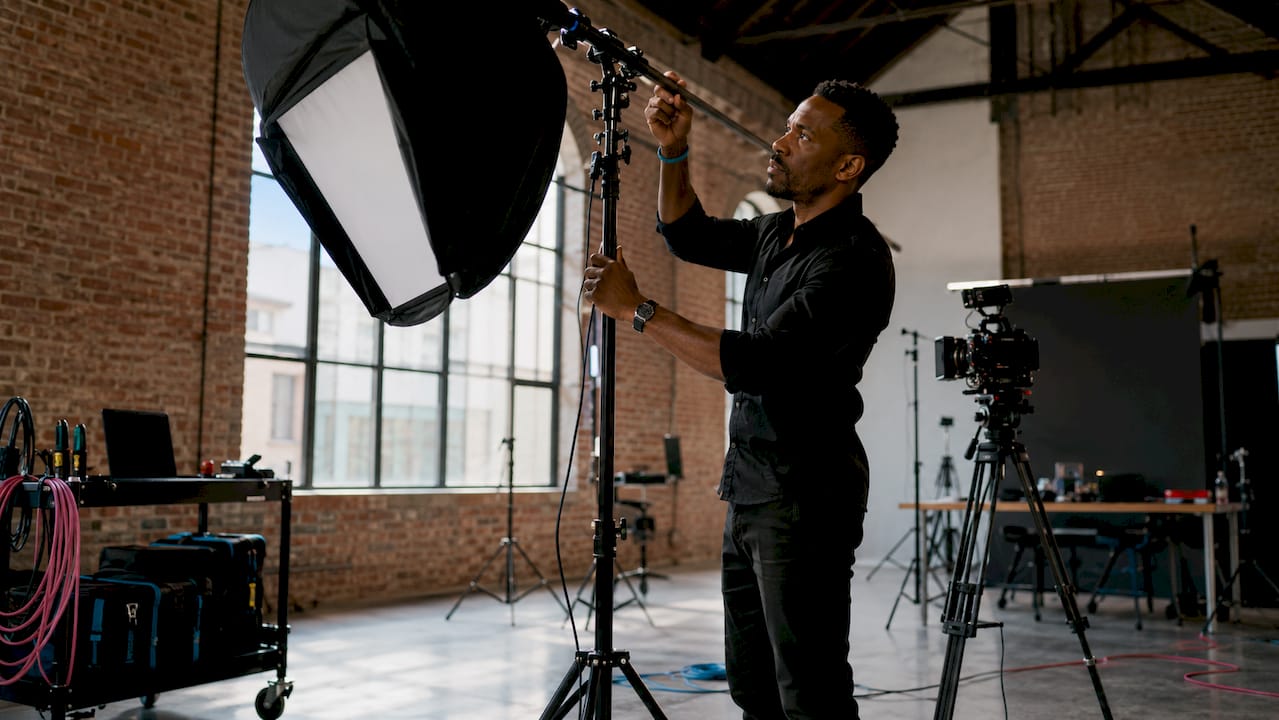
Lighting is the fastest way to separate professional-looking footage from amateur content. Position your key light at a 45-degree angle to your subject, use a fill light on the opposite side to soften shadows, and place a backlight behind the subject to create separation from the background. For audio, always monitor through headphones during recording. What sounds acceptable in a room often reveals hum, echo, or wind noise only in playback.
Camera settings matter as much as the camera itself. Shoot at a frame rate of 24fps for a cinematic look or 30fps for a corporate, documentary feel. Keep your shutter speed at double your frame rate (1/50 for 24fps) to produce natural motion blur. Use a wide aperture (f/1.8 to f/2.8) to create background separation and draw focus to your subject.
Pro Tip: Capture at least three takes of every scripted line and two versions of every B-roll shot. Editors who have options build better videos. Editors who have one take build compromises.
- Build your shot list from the storyboard before arriving on set
- Set up and test audio before talent arrives on location
- Use a three-point lighting setup as your baseline for every interior scene
- Direct talent toward natural delivery rather than memorized performance
- Capture wide, medium, and close-up versions of key shots for editing flexibility
Directing for authenticity is a skill that separates good brand videos from great ones. Ask your on-camera subjects to pause, breathe, and then speak rather than launching immediately into their lines. Natural pauses read as confidence on screen. Rushed delivery reads as anxiety, regardless of what the words say.
How to edit and polish your branding video to maximize impact
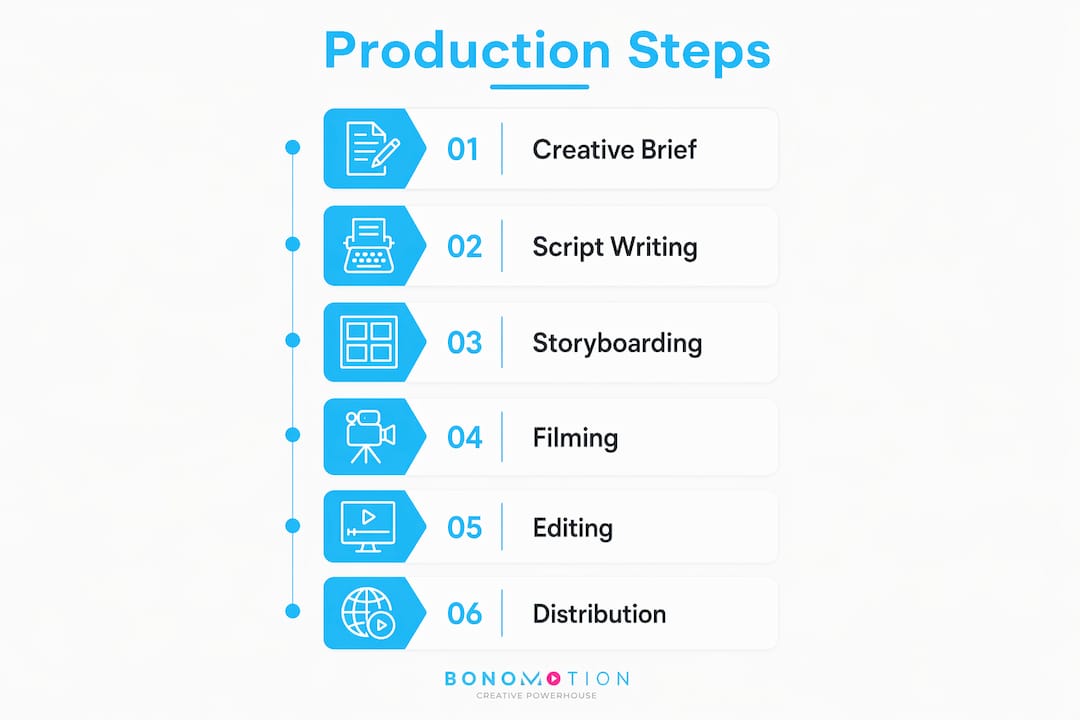
Post-production is where raw footage becomes a brand asset. The editing process follows a clear sequence: assembly cut, rough cut, fine cut, color grade, audio mix, motion graphics, and final export. Skipping steps or working out of order creates rework.
Organizing and trimming footage
Start by logging and organizing all footage before touching the timeline. Label clips by scene, shot type, and take number. This discipline saves hours during the assembly phase. Build your assembly cut by placing the best takes in sequence, then trim aggressively. Every second that does not serve the core message weakens the video.
Color grading for brand consistency
Color grading adjusts hue, saturation, and contrast to align every scene with your brand’s visual identity. A brand that uses warm, earthy tones in its visual guidelines should not deliver a video with cool, clinical color treatment. Apply a consistent look using a LUT (lookup table) as a starting point, then adjust scene by scene for exposure and white balance. This step is what makes a series of videos feel like they belong to the same brand rather than different productions.
Motion graphics and captions
Consistent motion design across videos reinforces brand identity and improves viewer recognition. Professional studios develop formal motion systems defining easing curves, transition types, and typographic animation to ensure visual consistency. Your logo animation, lower-third titles, and end card should follow the same rules every time. Captions are no longer optional. A significant portion of social video is watched without sound, making accurate subtitles a functional requirement rather than an accessibility add-on.
| Editing task | Benefit |
|---|---|
| Assembly and rough cut | Establishes narrative structure and removes unusable footage |
| Color grading | Aligns visual tone with brand identity across all scenes |
| Audio mixing and sound design | Produces clean, balanced audio that supports rather than distracts |
| Motion graphics and lower thirds | Reinforces brand identity and guides viewer attention |
| Caption and subtitle integration | Captures viewers watching without sound on social platforms |
| Platform-specific export | Delivers the correct resolution, aspect ratio, and file format per channel |
How do you distribute and measure branding video success?
Distribution without a plan wastes the production investment. A multi-platform distribution strategy treats each channel as a distinct audience with distinct expectations, not as a copy-paste destination.
Distribution must be platform-specific, adapting video length, style, and format for TikTok, Instagram Reels, and YouTube Shorts. A 3-minute brand film works on YouTube and your website. That same film needs a 30-second cut for Instagram and a 15-second vertical version for TikTok. Producing platform-specific versions during post-production, while the project files are still open, costs a fraction of what it costs to revisit the project weeks later.
The 3-Second Branding Rule requires your brand identity to appear within the first three seconds of any short-form video. Viewers who do not recognize the brand in the opening seconds scroll past before the message lands. This rule applies to logo placement, color treatment, and audio branding equally.
Key performance indicators to track include:
- View-through rate: The percentage of viewers who watch past the 30-second mark, indicating genuine content interest
- Brand recall lift: Measured through post-view surveys, this shows whether viewers remember your brand after watching
- Click-through rate: Tracks how many viewers take the intended action after the video ends
- Social shares and saves: Signal that the content resonated enough for viewers to want to return to it or share it with their network
- Website traffic from video referrals: Connects video performance directly to business outcomes
Schedule content releases to extend engagement. Releasing a hero video, a behind-the-scenes cut, and a testimonial clip across three consecutive weeks generates more sustained attention than releasing all three on the same day. For deeper context on how professional services branding connects video strategy to client trust, the principles apply directly to this distribution approach.
What I’ve learned after 20 years of brand video production
The creative brief is not a formality. It is the most valuable hour you will spend on any video project. I have watched brands with six-figure production budgets arrive on set without a clear answer to the question “what is the one thing we want the viewer to feel?” The result is always the same: a polished video that says nothing memorable. The brief forces that answer before the cameras roll.
The second lesson is about motion design systems. Brands that treat their logo animation, transition style, and typographic movement as fixed assets, not one-off decisions, build recognition faster than brands that redesign their video look with every new campaign. Building a motion design system is a one-time investment that pays back on every subsequent production.
Scope creep is the silent budget killer. Structured review checkpoints at the storyboard stage, after the rough cut, and before final delivery prevent the late-stage revision requests that double post-production time. Every stakeholder who sees the video for the first time at the final delivery stage is a process failure, not a creative one.
On AI tools: they accelerate blocking and timing in animation workflows, but they do not replace the human judgment required to make a brand feel specific rather than generic. Use them for efficiency. Keep the creative decisions human.
— Bernard Bonomo
Bonomotion Agency’s approach to brand video production
Bonomotion Agency has guided brands through corporate video production since 2003, working with startups, growing companies, and Fortune 100 clients across Florida and nationwide. Every project begins with a producer-led brief session designed to define objectives, audience, and timeline before a single camera is scheduled. Most of that work begins in Bonomotion’s Miami production studio, where lighting, sound, and backdrop are fully controlled before a single frame is shot.
Whether you need a flagship brand film, a social media content series, or executive messaging videos, Bonomotion Agency operates as a direct extension of your team. Our producers manage the full process from concept through distribution-ready delivery, so you get a polished final product without the production learning curve. Connect with our team through our video production services page to discuss your next branding project.
FAQ
What is a branding video?
A branding video is a production that communicates a company’s identity, values, and story through visual and emotional storytelling rather than direct product promotion. Its goal is to build audience trust and recognition over time.
How long does it take to produce a branding video?
Professional motion-heavy branding content follows a standard 10-day production cycle covering brief, storyboarding, animation passes, revisions, and final quality assurance. Live-action productions vary based on shoot complexity and revision rounds.
What should a branding video script focus on?
A branding video script should focus on a single core message. Scripts that try to communicate multiple brand values and product features simultaneously produce videos that fail to communicate any of them clearly.
How do you measure branding video success?
Track view-through rate, brand recall lift, click-through rate, social shares, and website traffic from video referrals. Each metric connects video performance to a specific business objective rather than vanity counts alone.
What is the 3-Second Branding Rule?
The 3-Second Branding Rule requires your brand identity to appear within the first three seconds of any short-form video. Viewers who do not recognize the brand immediately scroll past before the message lands.
Does Bonomotion produce branding videos in-house, or on location?
Bonomotion operates a dedicated production studio in Miami for controlled branding shoots (lighting, sound, backdrop control) and also shoots on location across South Florida when the brand story calls for a real environment.