

Video has quietly moved from a “nice-to-have” marketing asset to one of the most powerful drivers of business outcomes across every major industry. Yet many marketing teams still treat it as an afterthought, approving modest budgets for one-off clips with no clear connection to broader company goals. That gap between potential and execution is exactly where revenue gets left on the table. With 91% of businesses now using video as a core marketing tool and 82% reporting positive ROI, the conversation has shifted from “should we invest in video?” to “how do we make it work harder for us?”
Table of Contents
- Why video is now central to business strategy
- Where video works: Platforms, formats, and B2B dynamics
- Measuring success: How video drives ROI, trust, and growth
- Beyond the basics: Strategy nuance, common pitfalls, and actionable next steps
- A fresh perspective: What most marketers miss about video in business
- Elevate your business with expert video solutions
- Frequently asked questions
Key Takeaways
| Point | Details |
|---|---|
| Video drives measurable growth | Businesses using video see faster revenue increases, better brand awareness, and improved customer understanding. |
| Choose platforms wisely | YouTube is key for broad reach, while LinkedIn excels for B2B engagement and lead generation. |
| Focus on trust and authenticity | Authentic video content paired with influencer support builds the greatest trust with target audiences. |
| Track the metrics that matter | Success depends on measuring engagement, leads, and business impact, not just vanity metrics like views. |
| Integrate, don’t isolate | Video delivers best results when integrated with your broader marketing strategy and business systems. |
Why video is now central to business strategy
The notion that video is optional faded years ago. Today, it functions as the connective tissue between brand awareness and actual purchase decisions. Executives who still view video as a separate line item rather than a core strategic investment are working with a significantly narrowed competitive view.
The importance of video in business reveals itself across multiple performance categories. Buyers trust what they can see and hear. A well-produced product explainer or executive interview delivers context, tone, and credibility that a text paragraph simply cannot replicate. This is why 93% of marketers consider video important to their overall strategy and why that number keeps climbing year after year.
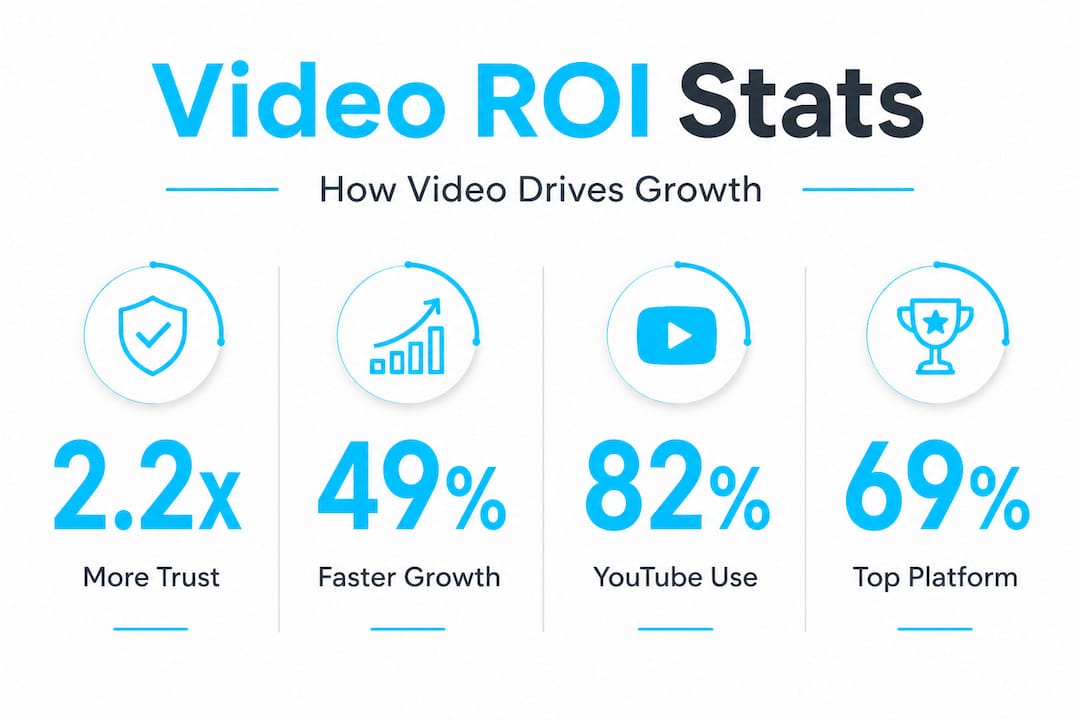
The revenue case is equally compelling. Businesses using video experience 49% faster revenue growth, and 93% report increased brand awareness along with better customer understanding of their products. Those are not incremental improvements. They represent structural advantages that compound over time as your video library grows and your audience deepens its familiarity with your brand.
Here is what drives those outcomes most consistently:
- Revenue acceleration: Video shortens the consideration phase because buyers can evaluate your offer visually and emotionally before speaking to sales.
- Brand recall: Moving image and audio together create stronger memory imprints than text alone, which means your brand stays top-of-mind longer.
- Customer education: Complex products, services, and processes become approachable when shown rather than described. This reduces friction in both the sales cycle and post-purchase onboarding.
- Trust building: Seeing real people, real environments, and genuine communication signals authenticity in ways that static assets cannot.
“Video doesn’t just support your marketing strategy. It is the strategy for brands serious about scaling audience trust and revenue in the current landscape.”
The professional videography impact on business goes beyond aesthetics. It shapes how seriously the market takes your organization. Mid-sized and large companies that treat video as a scalable system rather than a one-time tactic gain a durable edge. This is especially true in regulated or service-heavy industries, like legal, where video marketing for legal practices builds credibility in a space where trust is the primary currency.
Where video works: Platforms, formats, and B2B dynamics
Knowing that video matters is only the starting point. The next layer of strategy is knowing where to deploy it, in what format, and for which audience. Not every platform serves every business goal equally well.
YouTube is the most used platform at 82% adoption, and it ranks as the most effective at 69%. For LinkedIn, the story is different but equally important. It holds the top position for B2B content sharing, making it the primary arena for reaching decision-makers, procurement teams, and executive buyers. The practical implication is that your platform strategy should mirror your audience map, not just your comfort zone.
Here is a quick comparison of how major platforms serve different business objectives:
| Platform | Primary audience | Best content type | Business goal |
|---|---|---|---|
| YouTube | Broad consumer and professional | Long-form explainers, case studies | SEO, education, brand authority |
| B2B decision-makers | Short interviews, thought leadership | Lead gen, trust, partnership | |
| Consumer, lifestyle, mid-funnel | Short-form, behind-the-scenes | Brand awareness, engagement | |
| Mixed consumer and SMB | Live video, event coverage | Community, retargeting | |
| Website | Active buyers in research mode | Product demos, testimonials | Conversion, credibility |
Format matters as much as platform. Short-form video (under 90 seconds) maximizes reach and works well for awareness campaigns. Long-form video powers SEO and is the better vehicle for deep education, webinars, and thought leadership content that generates qualified leads. A mature video program uses both strategically.
For B2B video marketing strategies, the most effective formats include executive interviews, client testimonials, product walkthroughs, and live webinars. These are formats that answer real buyer questions at the right stage of the decision process. Authenticity is also a growing factor. Buyers today are adept at recognizing performative content. When a CEO speaks directly to camera in a candid, conversational format, it often outperforms a scripted production with expensive lighting and teleprompters.
Influencer partnerships add another credibility layer. When a respected voice in your industry references your brand in video content, the trust transfer is immediate. This is why a growing share of B2B organizations are building influencer programs as part of how they leverage video in B2B environments.
Pro Tip: Use your video portfolio as a standalone trust asset. A well-organized portfolio page with case study videos and client work samples functions like a credibility signal that continues working long after initial outreach.
Measuring success: How video drives ROI, trust, and growth
Producing great video is only half the job. The other half is building a measurement system that connects content performance to actual business outcomes. Too many organizations track vanity metrics, celebrate high view counts, and miss the deeper signals that actually inform strategy.
The metrics that reveal true video success are engagement rates, total views, and leads or clicks generated. According to 2026 video marketing data, marketers track ROI primarily through engagement (63%), views (67%), and leads or clicks (52%). Understanding which format serves which goal is equally important. Short-form video is optimized for reach and top-of-funnel awareness. Long-form video earns its keep through SEO performance and lead generation deeper in the funnel.
Here is a practical measurement framework for a structured video campaign:
- Define your business objective first. Before the first shot is framed, know whether you are targeting awareness, lead volume, conversion, or retention. The objective determines every downstream metric.
- Set platform-specific benchmarks. A LinkedIn video and a YouTube video perform differently by design. Compare each against its own platform average, not a generic industry number.
- Track watch time, not just views. A view that lasts three seconds tells you almost nothing. Watch time percentage reveals whether your content holds attention, which is the real signal of quality and relevance.
- Connect video touchpoints to CRM data. If your analytics platform allows it, trace how video viewers move through your funnel. Did viewers of a product demo convert at higher rates than non-viewers?
- Measure trust indicators over time. Brand lift surveys, Net Promoter Score (NPS) changes, and direct sales feedback all reflect whether your video program is shifting buyer perception.
The trust dimension deserves its own focus. B2B organizations with mature video strategies are 2.2 times more likely to be trusted by their buyers. That is not a soft metric. Trust accelerates sales cycles, reduces negotiation friction, and increases lifetime customer value. Organizations that pair video with strategic influencer partnerships amplify this effect significantly.
Pro Tip: For corporate video ROI, always set a pre-production measurement plan so your team knows what success looks like before production begins. Retroactively defining success nearly always leads to cherry-picked data.
Understanding how to maximize event video ROI follows the same discipline. Event footage that gets repurposed into LinkedIn clips, internal training materials, and website testimonials generates compounding value from a single shoot investment.
Beyond the basics: Strategy nuance, common pitfalls, and actionable next steps
At this stage, most marketing teams understand the value of video in concept. The harder challenge is avoiding the common execution mistakes that consistently undercut return on investment.
The most widespread mistake is treating video as a standalone tactic rather than part of an integrated system. Video without supporting text content loses discoverability. Search engines, including AI-powered ones, rely on written metadata, transcripts, and surrounding copy to understand what your video covers. As one analysis notes, going all-in on video at the expense of text-based content weakens your SEO footprint and limits how AI systems surface your brand to new audiences. The fix is to pair every major video with a blog post, social captions, and a transcript.
Authenticity is the second major lever that organizations consistently underutilize. Raw, human content frequently outperforms polished production on social platforms. When your team shares an unscripted moment from a client project or a candid walkthrough of a new product feature, it reads as genuine. That genuine quality earns attention in a feed full of heavily produced ads. Human-driven content builds more trust than AI-generated or overly curated visuals, especially in relationship-driven industries.
For large organizations, creating effective B2B video at scale requires internal systems, not just creative talent. A structured workflow that includes content calendars, approval chains, asset libraries, and defined distribution channels prevents the bottlenecks that stall most enterprise video programs. Without these systems, even well-funded video efforts stall at the production stage and never reach their intended audience consistently.
“The brands winning with video right now are not necessarily the ones with the biggest budgets. They are the ones with the clearest processes and the most honest communication.”
Practical action steps for marketing leaders who want to move forward:
- Pick your primary platform based on where your buyers actually spend time, not where your team is most comfortable.
- Define your format mix with at least one short-form and one long-form content type in rotation.
- Set clear success metrics tied to business outcomes before any production begins.
- Build an authenticity habit. Schedule one raw, human-centered video per month alongside your polished productions and track how it performs.
- Use HubSpot’s platform data to benchmark your performance against industry norms and adjust your platform allocation accordingly.
A fresh perspective: What most marketers miss about video in business
After more than two decades of producing video for startups, growing brands, and Fortune 100 companies, we have watched the same pattern repeat itself. Organizations invest in video with genuine intent, chase a viral moment or a production that looks impressive in a pitch deck, and then wonder why the results feel disconnected from real business growth.
The root problem is almost always strategic misalignment, not production quality. Video that is produced without a clear connection to your company’s broader goals, buyer journey, and content ecosystem will underperform regardless of how visually strong it is. A beautifully shot brand film that has no distribution plan, no call to action, and no integration with your sales team’s outreach is an expensive wall decoration.
What actually drives durable results is consistency, relatability, and feedback loops. A monthly cadence of focused, relevant video content builds more cumulative trust than a single marquee production. Buyers who see your brand show up regularly with useful, honest content begin to feel a relationship before they ever speak with a salesperson. That head start is measurable in shorter deal cycles and higher close rates.
We have also seen that the best-performing brands actively use viewer feedback to refine their video approach. Comments, watch time drop-off data, and direct sales team input all reveal what resonates. Treating video as a learning system rather than a one-way broadcast changes everything about how teams prioritize content.
Organizations that want to grow through video should honestly evaluate whether they are using it to serve their audience or to impress their internal stakeholders. Those are very different motivations and they produce very different results. Video for small business growth operates on the same principle as enterprise video: clarity, consistency, and genuine connection outperform budget and polish every single time.
Elevate your business with expert video solutions
Translating video strategy into measurable business results requires more than good equipment. It requires a production partner who understands your objectives, audience, and timeline as clearly as you do.
At Bonomotion, we have guided organizations through exactly this process for over 20 years, from corporate video solutions that align with broader marketing systems to fully realized campaign productions for Fortune 100 brands. Every project is led by an experienced producer who works directly with your team to make sure the final product drives real outcomes, not just impressive footage. When you are ready to build a video program that compounds in value, our corporate video production experts are ready to help you execute it with precision.
Frequently asked questions
What are the measurable business benefits of using video?
Video directly accelerates revenue and brand performance. Businesses using video experience 49% faster revenue growth and 93% report stronger brand awareness and product understanding among their audiences.
Which platforms are best for business video content?
It depends on your audience type. YouTube leads overall at 82% usage and 69% effectiveness, while LinkedIn is the top platform for B2B sharing and reaching professional decision-makers.
How do you measure the ROI of video marketing?
Focus on the metrics tied to real outcomes rather than surface-level numbers. Marketers track ROI most through engagement (63%), total views (67%), and lead or click generation (52%), with format choice aligned to funnel stage.
Is professional video production necessary, or can companies succeed with DIY content?
Both have a role in a mature strategy. Raw, authentic content frequently outperforms polished production on social platforms, but professional production adds credibility and trust at key stages like case studies, executive messaging, and sales enablement.
How can video content be scaled in large organizations?
Scale comes from systems, not just resources. Structured workflows with defined approval processes and asset management allow large businesses to produce and distribute video consistently without constant bottlenecks.
Recommended
- Best Corporate Video Production For Small Business In MIami, FL
- How To Use Streaming Video For Business Growth | Bonomotion
- Quality Video Services For Your Company In Miami Florida
- Best Digital Marketing Video Production: Boosting Engagement
- Corporate Video Production Services: What Oahu Events Need – Creative Media Production LLC