
Camera rental insurance, typically written as inland marine coverage, protects rented gear against accidental damage, theft, and in-transit loss during your rental period. You should buy it whenever a rental house requires proof of coverage, when the gear you are renting carries high replacement value, or when you are shooting on location away from controlled studio conditions. The sections below cover exactly what policies include, how certificates of insurance work, what coverage costs, and how to file a claim without friction.
TL;DR:
- Insurance coverage should match or exceed the full replacement value of rental gear to prevent out-of-pocket costs during a claim.
- Annual policies generally start around $218 and become more cost-effective than multiple short-term rentals if you rent gear more than three times a year.
- Rental houses require a COI with specific wording, including the correct dates, entity names, and loss payee details, for gear release.
- Photographing gear condition at pickup and return, along with timely police reports for theft, reduces claim delays or denials.
- Exclusions typically include theft from unattended vehicles, misuse, and high-risk activities unless specifically endorsed in the policy.
Table of Contents
- What Camera Rental Insurance Actually Covers
- Short-Term Project Policies vs. Annual Coverage
- What Rental Houses Require Before They Hand Over Gear
- Buying Coverage Fast and Preparing Your Documents
- Filing Claims and Avoiding Rental Reimbursement Pitfalls
- A Producer’s Checklist Before You Pick Up Gear
- Weighing the Cost Against the Risk
- Let Our Team Handle the Logistics for You
- FAQ
- Sources for Policy Terms, COI Standards, and Pricing
What Camera Rental Insurance Actually Covers
Camera rental insurance falls under inland marine coverage, the policy form insurers use for mobile professional equipment that travels between locations, sits with a bailee, or moves in transit. Unlike a standard property policy tied to a fixed address, inland marine coverage follows the gear wherever the shoot takes you.
Most policies protect against a consistent set of perils:
- Accidental damage: drops, crushes, and on-set mishaps during normal use
- Theft: break-ins, snatch-and-grab incidents, and stolen bags
- In-transit loss: gear lost or damaged while being shipped or driven to a location
- Water and weather damage: rain, humidity, and exposure during outdoor shoots
Coverage limits come in two shapes. Scheduled coverage lists each item individually with its own value, which matters for a flagship cinema camera body or a specialty lens. Blanket or aggregate limits cover a group of items up to a combined cap, which works for smaller accessories like batteries, cards, and cages. Most policies exclude theft from an unattended vehicle, misuse outside the stated purpose, and certain extreme activities like underwater or aerial use unless specifically endorsed. Reading the exclusions list before you sign is the single most useful five minutes you will spend on a rental.
Short-Term Project Policies vs. Annual Coverage
Renters generally choose between two structures. Short-term, project-based policies are priced for specific dates and cover a single shoot or rental window, which makes sense if you rent gear only a few times a year. Annual policies provide continuous protection across every rental during the year and come in value tiers based on the total equipment you need covered.
Annual equipment coverage can start around $218 per year for entry-level tiers, a figure that makes continuous coverage attractive once you rent more than a couple of times annually. Short-term quotes, by contrast, are priced per project and scale with your rental dates and declared equipment value.
A few pricing drivers shape your quote either way:
- Declared replacement value of the equipment you are insuring
- Deductible amount, with $250 being a common standard
- Use-case factors like travel, outdoor exposure, or high-risk locations
If you rent more than two or three times a year, running the math on an annual policy against your combined short-term costs usually tips the decision toward annual coverage.
What Rental Houses Require Before They Hand Over Gear
Rental houses almost always ask for a Certificate of Insurance, or COI, before releasing equipment. A COI is a document your insurer issues that prove your policy exists and meets the rental house’s stated requirements. Two terms on that certificate matter most: additional insured, which names the rental house as a party protected under your policy, and loss payee, which directs any claim payout toward replacing their equipment rather than paying you directly.
Before you show up for pickup, check these items against your rental agreement:
- Policy limits match or exceed the full replacement value of the equipment list
- Replacement-cost language is included, not actual cash value, which depreciates gear
- Effective dates cover the full rental window, including early pickup or late return
- Named entities on the COI match the rental house’s legal name and address exactly
- Loss payee and additional insured wording matches what the rental house specifically requested
Rental houses will refuse to release gear over a mismatched date, a misspelled entity name, or missing loss payee language, even when your coverage itself is adequate. The COI is a paperwork gate, and small wording errors are the most common reason renters get turned away at the counter.
Buying Coverage Fast and Preparing Your Documents
Getting same-day coverage is mostly a matter of having your information organized before you request a quote. Brokers and online forms generally ask for the same set of details.
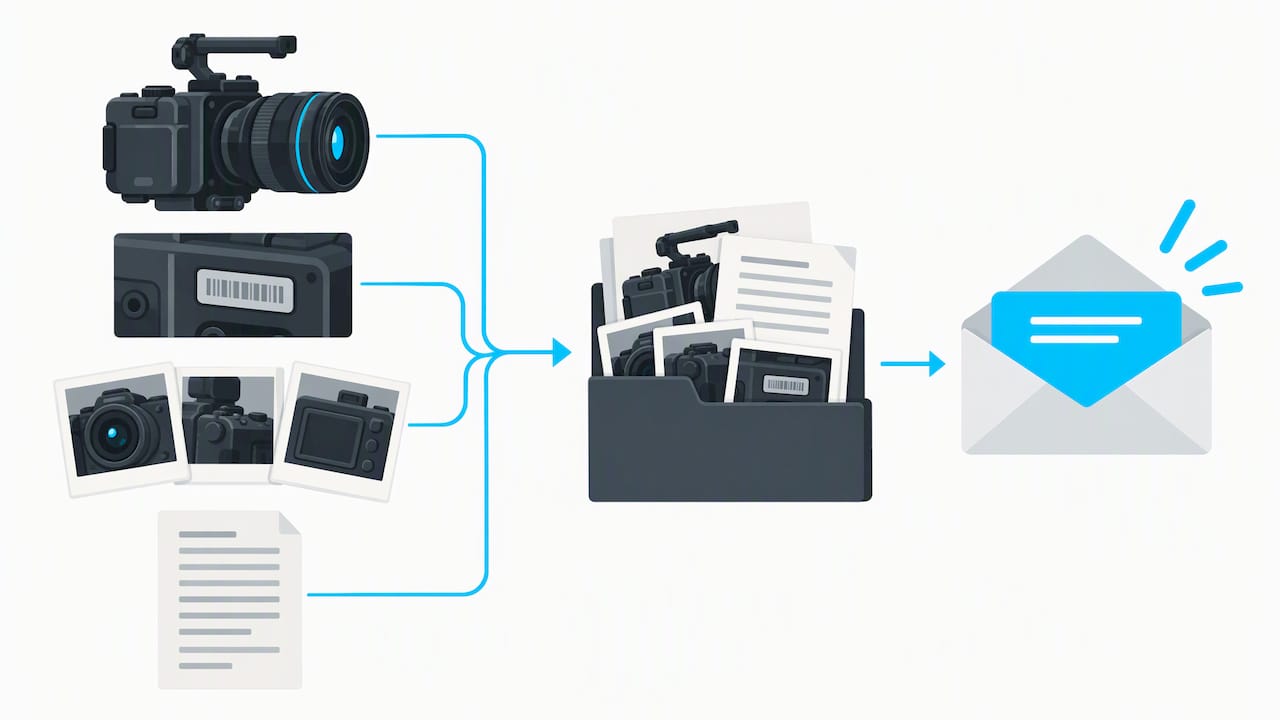
- Build your equipment list with replacement values, serial numbers, and the exact rental dates
- List the rental house’s name and address exactly as it appears on their agreement
- Decide scheduled vs. blanket coverage based on whether any single item exceeds your per-item limit
- Calculate replacement cost including local sales tax, since underestimating this figure can leave you covering the gap yourself
- Add rental reimbursement coverage if a claim would leave you without gear mid-project
- Request your COI with the exact additional insured and loss payee wording the rental house specified
Pro Tip: Email your equipment schedule and rental house requirements to your broker together in one message. Brokers who receive everything at once typically turn around a same-day COI faster than those fielding details piecemeal.
Filing Claims and Avoiding Rental Reimbursement Pitfalls
A clean claim starts with evidence you gather before anything goes wrong. Photograph every item at pickup and return, file a police report immediately for theft, and keep your pickup and drop-off notes in writing.
- Take timestamped condition photos at checkout and check-in on every rental
- File a police report the same day for any theft or break-in
- Keep your COI dates and rental agreement dates aligned from the start
- Disclose travel plans to your insurer before, not after, you leave your home market
Rental reimbursement, sometimes called continuing rental fees, pays for a replacement rental while your claim processes, which keeps a production moving instead of stalled. This coverage commonly carries a waiting period, often around 72 hours, before payments begin. The most common reason claims get delayed or denied is missing baseline condition photos, since insurers need proof of the gear’s state before the incident to validate the loss.
Pro Tip: Store your condition photos and serial numbers in the same folder as your rental agreement so you can produce everything in one email if a claim comes up.
A Producer’s Checklist Before You Pick Up Gear
Years of coordinating equipment logistics across productions have taught us that most rental problems trace back to paperwork, not the gear itself. Before any pickup, we confirm COI wording, scheduled values, effective dates, and loss payee details against the rental agreement line by line.
- Confirm COI additional insured and loss payee wording matches the rental house exactly
- Verify scheduled item values cover full replacement cost, not depreciated value
- Pack a contingency: rental reimbursement coverage, a spare body or lens, and backup memory cards
- Plan your transport route and timing so gear is never left unattended in a vehicle
Working with a provider that handles COI coordination internally removes a layer of back-and-forth that otherwise falls on you the day before a shoot.
Weighing the Cost Against the Risk
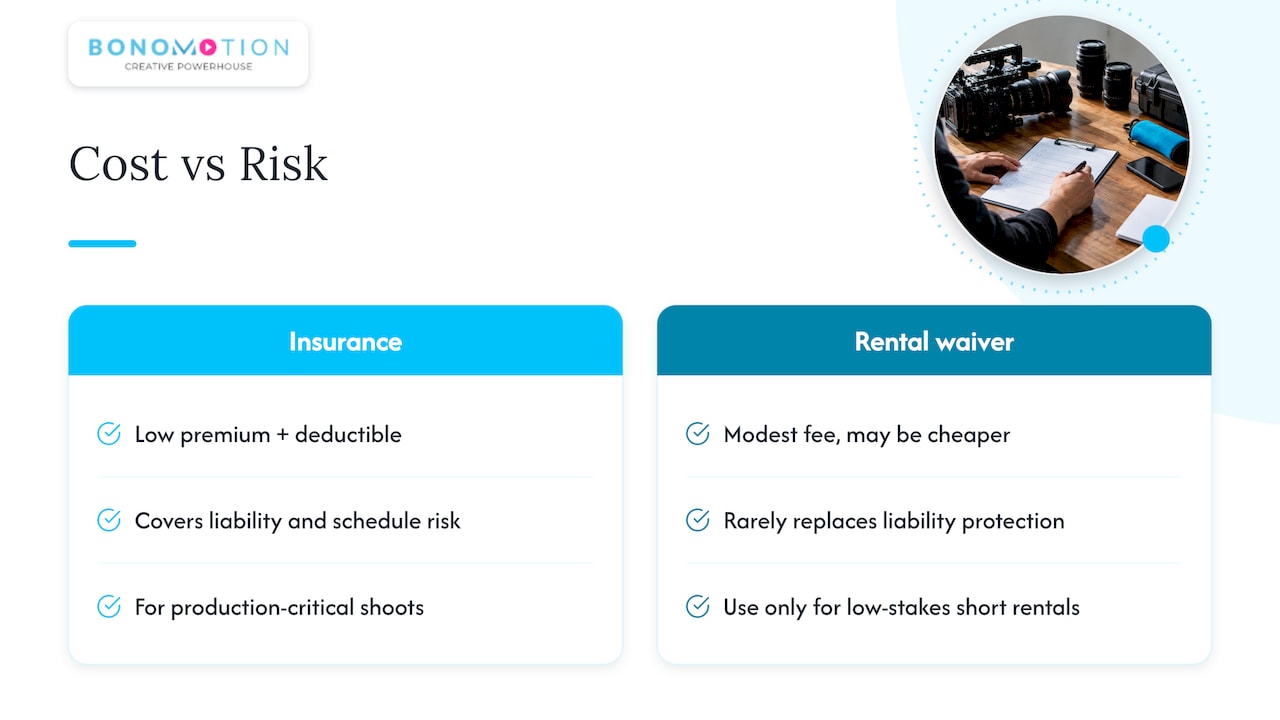
A deductible and a modest premium cost far less than a stalled shoot with no backup camera. We treat insurance as cheap relative to the schedule risk.
A rental-house waiver can work for low-stakes, short rentals, but it rarely replaces real liability protection for anything production-critical.
— Bernard Bonomo
Let Our Team Handle the Logistics for You
Coordinating insurance paperwork on top of a shoot schedule pulls focus from the work that actually matters: the footage. Our STUDIO & RENTALS services include camera and equipment rentals alongside production teams who coordinate COIs, scheduled values, and pickup logistics as part of the job, not an extra line item you manage yourself.
- Rent studio space and equipment with COI coordination handled for you
- Book a full production team for corporate video production without juggling separate vendors
- Add event videography and photography coverage for a single shoot or a multi-day production
Reach out through our services overview to get a quote and lock in dates before your next shoot.
FAQ
Is it worth getting camera insurance?
For high-value gear, remote shoots, or any rental-house requirement, yes: a modest premium and deductible cost far less than replacing a damaged or stolen camera body out of pocket. It becomes less necessary only for low-value, short, low-risk rentals where a rental house’s own waiver might suffice.
How much does camera insurance cost?
Annual equipment coverage can start at a modest annual cost for entry-level tiers, while short-term policies are priced per project based on your declared equipment value and rental dates. Your deductible, often $250, and the gear’s total replacement value both shift the final quote.
What is not covered by camera insurance?
Common exclusions include theft from an unattended vehicle, damage from misuse outside the equipment’s intended purpose, and certain high-risk activities like underwater or aerial use unless specifically added to the policy. Always check the exclusions list against your actual shoot plan before you sign.
Can I get insurance for my camera equipment?
Yes, short-duration policies are widely available and can be tailored to a single rental period, covering cameras, lenses, lighting, and accessories. You can choose scheduled coverage for high-value individual items or blanket coverage for a group of smaller accessories.
Sources for Policy Terms, COI Standards, and Pricing
- Camera equipment insurance
- Film equipment insurance for productions