
The best recruitment videos do one job: they let a candidate see the work, the people and the place before they apply. Pick the format that answers the question your best candidates ask first, shoot it with real employees, and cut it into short versions for every channel you recruit on. Below are 12 formats that work for South Florida employers, from a 15-second job ad to a full employer brand film, plus how to structure, shoot and publish them.
We produce corporate, interview and event video from Miami, and hiring content is one of the most practical uses of a single production day. This guide is written for marketing leads, HR teams and business owners who need candidates, not just views.
TL;DR
- Show the real job: the work area, the schedule, the team and the next step to apply. Specifics beat slogans.
- Use real employees speaking in their own words, not a script read by people who do not work for you.
- Shoot once, cut many: one interview day can yield a hero film, role-specific clips and vertical social ads.
- Build accessibility in from the start: captions, transcripts and a consistent review rubric.
- Match the format to the hiring goal: volume hiring, specialist roles, leadership, interns or relocations each need a different video.
Table of Contents
- What a recruitment video needs to do
- 12 recruitment video ideas worth producing
- Match the idea to the hiring goal
- How to structure a recruitment video
- Make it accessible and fair
- Ideas that fit South Florida employers
- Plan one shoot, get many videos
- Where to publish and how to measure
- Common mistakes to avoid
- Our perspective: hire on honesty, not polish
- Build your recruitment video with Bonomotion
- FAQ
What a recruitment video needs to do
A recruitment video is not a brand commercial with a job link at the end. A commercial persuades a customer to buy. A recruitment video helps a stranger decide whether they could spend forty hours a week with your team. That changes everything about how you plan it.
The strongest videos do three things:
- They answer a decision. Is the commute realistic? Is the team friendly? Will I be trained? What does a Tuesday look like?
- They let candidates screen themselves out. A video that is honest about pace, schedule and expectations reduces mismatched applications and saves your hiring managers time.
- They give a clear next step. Apply here, visit an open house, book a call with the recruiter.
Generic culture montages with stock music rarely do any of this. Candidates have seen hundreds of them. What they have not seen is your actual dock, your actual kitchen, your actual office on Brickell, and the person who will be their supervisor talking plainly about it.
12 recruitment video ideas worth producing
1. The day-in-the-life video
Follow one employee from arrival to wrap-up. Keep it grounded: the first task, the team huddle, the lunch spot, a problem solved, the end of the shift. This is the single most useful format for roles that candidates find hard to picture, such as project coordinator, nurse liaison, account executive or yacht crew.
Tip: pick someone who has been there long enough to be honest and recently enough to remember being new.
2. The meet-the-team video
Short individual introductions, each person saying what they do, what surprised them about the company and what they like about the work. Ten to fifteen seconds each can be edited together into one film or released as a series. It works well for professional services firms, agencies and clinics where candidates care about who they will sit next to.
3. The hiring manager direct address
The person who will actually manage the new hire explains the role: what success looks like in 90 days, the skills that matter most, the pay range if you are able to share it, and how interviews work. It feels human, and it is cheap to repeat for each open role once you have a template.
4. The single-role spotlight
A 60 to 90 second video about one position: responsibilities, the team, tools or equipment used, and the next step. This is the format that reduces unqualified applicants fastest because it speaks to one job, not the company in general.
5. The 15-second job ad
For volume hiring in hospitality, retail, logistics and healthcare support, shorter is better. A reliable skeleton is: role, pay and location in the first two seconds; a quick look at the real work area with one sentence from an employee about why they joined; then a low-friction call to action. Shot vertically, it fits social feeds and mobile job boards.
6. The employee testimonial series
Sit employees down for a short, structured interview and let them tell their own story: how they joined, what they have learned, how they have grown. Our interview and testimonial video production is built for exactly this: lighting, sound and a producer who knows which questions bring out specific, believable answers.
7. The leadership message
A founder or executive explains where the company is going and what kind of person will thrive there. This matters most for senior and specialist hires, who want to know if they believe in the direction before they commit. Keep it under two minutes, and keep it about the future of the work, not the history of the founder.
8. The office, site or facility tour
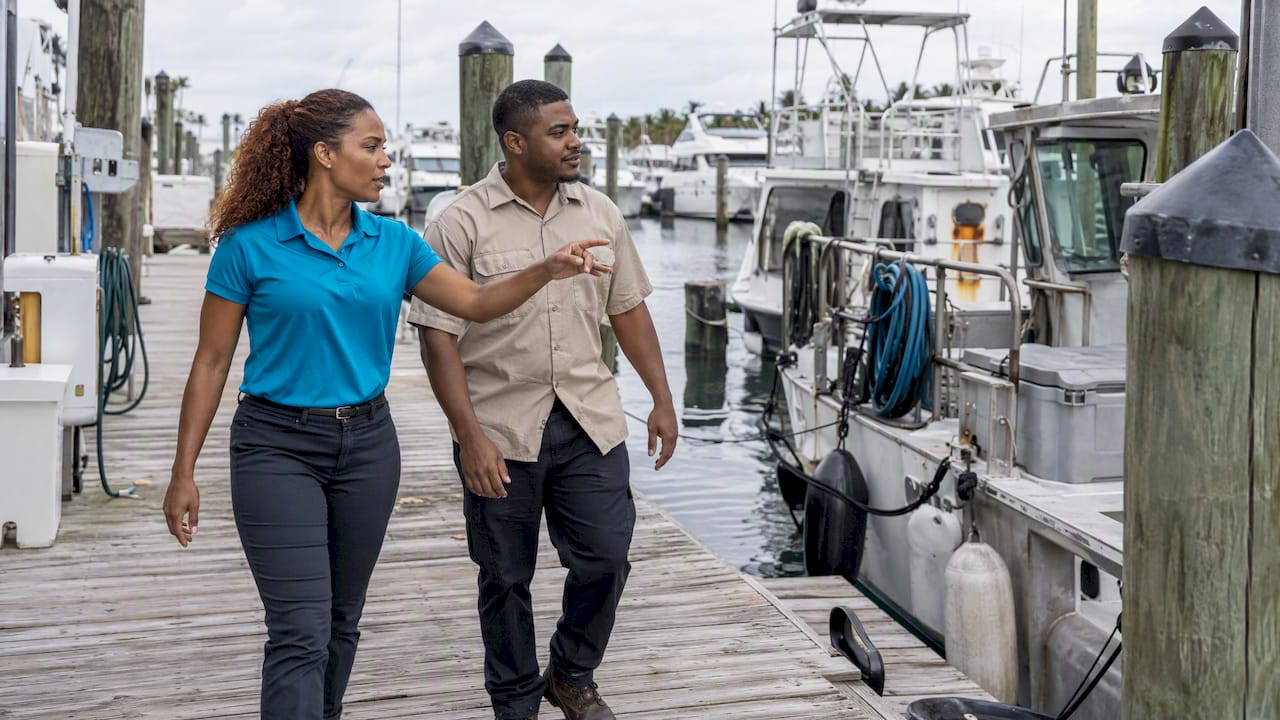
For employers with a distinctive space, a walkthrough does a lot of work. A marina operation, a Coral Gables law office, a warehouse near the airport, a hospital wing, a showroom: each has details candidates cannot get from a job description. Walk through it with an employee, not a narrator.
9. The perks and benefits explainer
Benefits are often buried in a PDF. An animated explainer or a simple on-camera walkthrough can show health coverage, schedule flexibility, tuition support, parental leave or career paths in a few minutes. Animation is especially useful when the subject is abstract. Our explainer video production team handles whiteboard and motion graphic styles for this kind of content.
10. The career path story
Show one person across three roles: the intern who became a team lead, the coordinator who now runs a department. Candidates considering a long-term move want evidence of growth, and nothing says it more convincingly than a real person who did it.
11. The live recruiting event or Q&A
Host a live open house or an employee Q&A and stream it. Candidates ask questions in real time, and the recording becomes a reusable asset afterward. This pairs well with job fairs and university visits. See how our live streaming services can support a multi-camera, professionally switched broadcast.
12. The community and culture film
This is the traditional employer brand piece: volunteer days, company events, celebrations, client work. Used on its own, it can feel generic. Used as the top layer over the specific videos above, it gives candidates the emotional context. Event footage from company gatherings, captured through event videography and photography, can be repurposed here instead of shooting new material.
Match the idea to the hiring goal
Not every opening needs every video. Use this as a starting point.
| Hiring goal | Best-fit formats | Typical length |
|---|---|---|
| High-volume hourly roles | 15-second job ad, hiring manager direct address | 12 to 30 seconds |
| Specialist or technical roles | Single-role spotlight, day in the life | 60 to 90 seconds |
| Senior and leadership hires | Leadership message, career path story | 90 seconds to 2 minutes |
| Early-career and interns | Meet the team, testimonial series | 30 to 90 seconds each |
| Out-of-state relocations | Facility tour, community and culture film | 2 to 3 minutes |
| Employer brand awareness | Culture film, perks explainer | 2 to 4 minutes |
The lengths are working guidelines, not rules. A story that earns attention can run longer. A video that has not made its point in the first few seconds should be cut.
How to structure a recruitment video
Whatever the format, a clear order helps. This five-part sequence works for a one-minute video and scales up or down.
- Hook. Open with the role, the place or a striking line from an employee. Do not open with a logo animation.
- Context. Who you are and what this team does, in a sentence or two.
- Experience. Real footage of the work, real voices, real details: the schedule, the tools, the people.
- Proof point. One concrete fact a candidate can check: pay range, training program, promotion history, the length of time employees stay.
- Call to action. One step, easy to complete on a phone.
Write the call to action as part of the video, not as an afterthought. Put the same link in the description, on the career page and in the caption.
Keep it specific
Videos that include verifiable details, such as the actual pay range, the rotation schedule or the equipment employees use, tend to attract better-matched applicants than videos that talk only about culture. If you cannot share salary, say what you can: the training, the shifts, the team size, the growth path.
Make it accessible and fair
Recruitment content is part of your hiring process, so the same fairness expectations apply to it. This is where a short conversation with your HR lead or employment counsel pays for itself.
- Caption every video. Burned-in or toggled captions help deaf and hard-of-hearing candidates, and also help the many people who watch with the sound off.
- Offer a transcript or equivalent. If a candidate cannot access a video, they should have another way to get the same information.
- Describe visual content. If key information appears only on screen, say it aloud as well, so candidates with low vision are not left out.
- Keep disability-related questions out. Do not ask about health or disability in video prompts, and if you use video submissions or recorded interviews, do not ask these questions before a conditional offer. Confirm your process with counsel, since the details depend on your situation. The U.S. Equal Employment Opportunity Commission publishes guidance on this on its own site.
- Use one rubric. If candidates record video responses, decide which skills you are assessing before you start, and have several reviewers score every submission against the same criteria tied to the job requirements.
- Show a range of employees. Cast real people from across the team, not a narrow slice chosen for looks.
Building this in during production is much cheaper than retrofitting captions and transcripts after launch.
Ideas that fit South Florida employers
South Florida has hiring conditions that national guides skip.
- Bilingual versions. Spanish is widely spoken across Miami-Dade and Broward. A bilingual employee speaking in their preferred language reads as more authentic than dubbing. Plan for Spanish and English cuts from the first interview day, with captions in both.
- Hospitality and marine. Hotels, restaurants, marinas and charter operations hire seasonally and in volume. Short vertical job ads that show the real work area, the shift and the pay do more than a polished brand film. For marine employers, footage shot on the water can double as marketing content.
- Real estate and professional services. Brokerages and firms in Coral Gables, Brickell and Palm Beach compete for experienced agents and associates. Hiring manager videos and career path stories speak directly to people weighing a move.
- Healthcare and education. Candidates want to see the unit, the equipment and the team ratio. A facility tour with a clinician is more persuasive than any benefits brochure.
- Relocation. Many candidates consider moving to Florida. A short film about the neighborhood, commute and team life helps them picture it.
Plan one shoot, get many videos
The best return comes from treating hiring video as a library, not a one-off.
A well-planned shoot day can include:
- Six to ten short employee interviews, recorded with consistent lighting and clean audio
- B-roll of work areas, tools, team interactions and the building or site
- A hiring manager address for each priority role
- A leadership message
- Vertical pickups for social ads, framed for phones
From that footage, an editor can produce a hero brand film, role-specific clips, a series of 15-second ads and still images for job boards. Our corporate video production process begins with this kind of planning: a producer works with your team to define the audience, the roles and the delivery formats before anyone picks up a camera.
Planning checklist
- List your top three to five roles to fill in the next twelve months.
- For each, write down the three questions a good candidate asks first.
- Choose the format that answers those questions most directly.
- Pick employees who are honest, comfortable and representative of the role.
- Decide where each cut will live: career page, job boards, social ads, onboarding, events.
- Write outline questions, not scripts, so answers stay natural.
- Plan captions, transcripts and a second language from day one.
- Set a date to refresh the content when roles, pay or people change.
Phone footage or a professional crew?
For a 15-second job ad about a single shift, a phone and a supervisor who knows the work can be enough. For interview-based films, leadership messages, facility tours and anything you want to reuse for years, professional audio, lighting and editing matter. Poor sound is the quickest way to lose a viewer. If you need a controlled setting for interviews, a production studio and equipment rental can give you a quiet, consistently lit space without building one in your office.
Where to publish and how to measure
Publishing is half the work. Put the right cut in the right place.
- Career page: the hero film, the team videos and role spotlights, each near the relevant job listing.
- Job boards and listings: short role-specific clips where the platform allows video.
- Social feeds: vertical 15 to 30 second ads and employee clips.
- Email and recruiter outreach: a thumbnail link to the hiring manager video in the first message.
- Events and job fairs: the culture film on a screen at your booth, or a livestream of your open house.
- Onboarding: reuse the same footage to welcome new hires, so the promise made in recruiting matches the first week.
Track what matters to hiring, not only views: applications per posting, the share of applicants who meet the requirements, time to fill, interview-to-offer ratio and early retention. Compare roles with video against comparable roles without it, and ask every new hire which content they watched before applying.
Common mistakes to avoid
- Scripted testimonials. Candidates can tell when employees are reading lines.
- Only showing the headquarters. If most hires work at a site, a store or on the water, show that place.
- No pay, schedule or location information. Even a range or a shift pattern builds trust.
- Videos that never date themselves. Update footage when leaders, benefits or workspaces change.
- Skipping captions. It excludes candidates and hurts completion rates on mobile.
- Too long, too soon. Lead with a short version, and link to the longer film for people who want more.
Our perspective: hire on honesty, not polish
We have been producing video for businesses since 2003, and the most common mistake we see in recruitment content is the pursuit of polish over truth. Companies want to look impressive, so they hire a crew, script every line and cut a beautiful two-minute film that could belong to any company in the country.
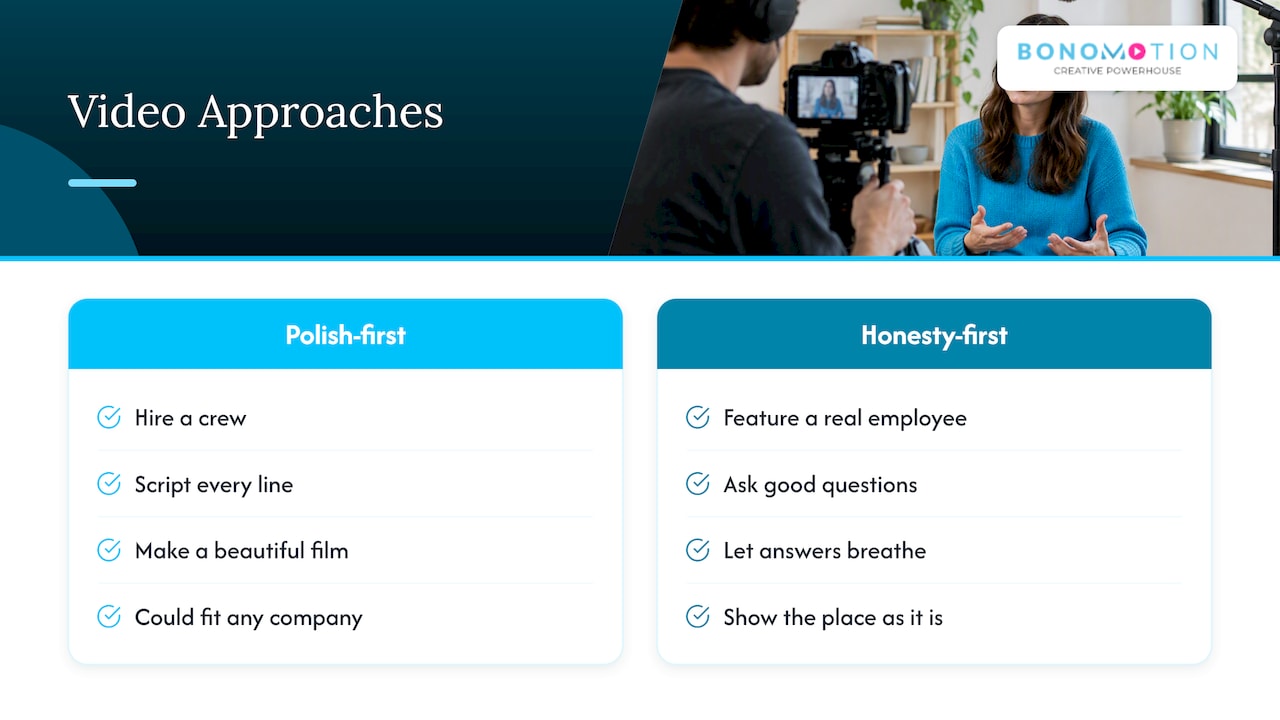
The videos that work are different. They are specific. They put a real employee in front of the camera, ask good questions and let the answers breathe. They show the place as it is. When we plan a hiring shoot, we start with the candidate: who are they, what do they worry about, what would convince them? Then a producer builds the day around those answers, so your team gets footage that serves recruiting, onboarding, internal communication and brand at once.
Production quality still matters, because clear sound and steady, well-lit images signal that you take people seriously. But quality should serve honesty, not replace it.
— Bernard Bonomo
Build your recruitment video with Bonomotion
If you are hiring in Miami, Fort Lauderdale, Coral Gables, Palm Beach or anywhere in Florida, we can plan, shoot and edit a full set of recruitment videos in one coordinated production. Every project is guided by an experienced producer who works with your team on objectives, audience and timeline, from employee interviews and leadership messages to events and livestreams.
Ready to turn your next hiring push into a video library? Explore our video production services or contact us through bonomotion.com to start a custom proposal.
FAQ
How long should a recruitment video be?
It depends on the job and where the video runs. For volume hiring and social ads, 15 to 30 seconds is usually enough. For a single role spotlight, aim for 60 to 90 seconds, and for an employer brand film, two to three minutes is plenty. Always lead with a short cut and link to the longer one.
What should I include in a recruitment video?
Show the role, the real work environment, the people candidates will work with and a clear next step. Add at least one concrete detail a candidate can check, such as the schedule, pay range, training or growth path. Captions are part of the basics.
Do I need actors or a script?
No, and you will usually get better results without them. Real employees answering well-prepared questions sound more credible than a script. A producer can prepare the questions, guide the interview and edit the best answers into a tight story.
Can one shoot cover several open roles?
Yes. A single production day can capture interviews, workplace footage and hiring manager messages for several roles, which an editor then cuts into role-specific videos, short social ads and a longer brand film. This is usually more efficient than commissioning a separate video for each opening.