

Must-have event video shots are the defined set of essential footage types that, when captured together, tell a complete and emotionally resonant story of any event. Without a deliberate shot list, even well-funded productions return from the field with gaps that no amount of editing can fix. Professional videographers working with tools like the Sony FX3, Rode Wireless GO II, and Zoom H5 treat these shots not as a wish list but as a non-negotiable filming checklist. For event planners, understanding which shots matter most is the difference between a forgettable recap and a video that clients rewatch for years.
1. Must-have event video shots: the top 10 every organizer needs
The industry term for this category is coverage shots, and they form the structural backbone of any event highlight reel or recap video. Here are the ten you cannot afford to miss.
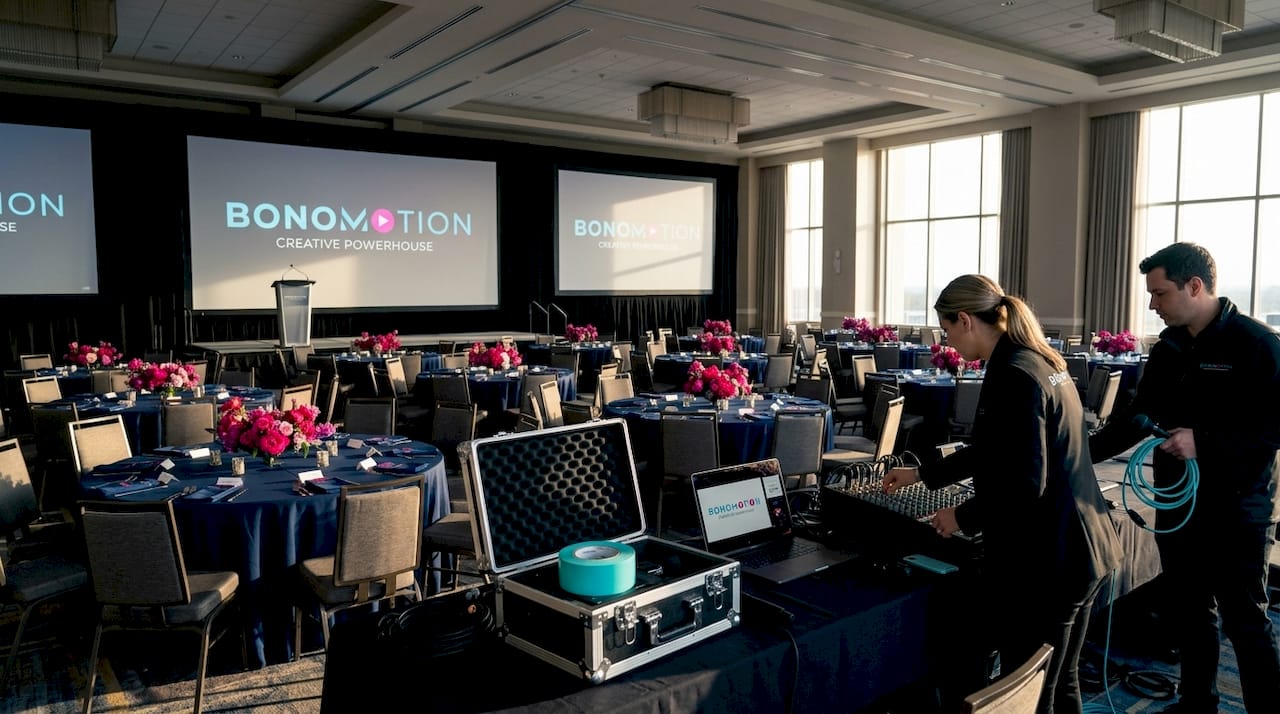
1. Venue establishing wide shot
The opening wide shot orients the viewer and sets the visual tone before a single speaker takes the stage. Capture it from an elevated angle or a corner position that shows the full scale of the space, the lighting design, and the crowd density. Drone footage works exceptionally well here for outdoor venues or large conference centers.
2. Keynote speaker or main presenter
Lock a static camera on the speaker from a medium distance as your safety shot, then use a second operator for dynamic close-ups and reaction cutaways. This two-camera approach is standard professional practice and protects you if one angle gets blocked.
3. Crowd and audience reactions
Reaction shots are the emotional proof that your event landed. A speaker landing a joke, an audience member nodding in agreement, or a room erupting in applause tells the viewer more than any scripted testimonial. Capture these during natural pauses using a long lens from the side of the room to stay unobtrusive.
4. Toasts and speeches
Speeches are the footage that clients rewatch more than any other moment, whether the event is a corporate gala or a product launch. Use wireless lav mics clipped to the speaker and pull a direct board feed from the audio system simultaneously. Never rely on a single audio source for this shot.
5. First dance or main performance
Start recording before the performer steps into position and do not stop until they fully exit the space. Mix a gimbal operator moving through the crowd, a static wide camera, and a handheld operator for tight close-ups. This three-angle approach gives your editor the material to build a cinematic sequence.
6. Candid guest interactions
Authentic candid moments captured during transitions, cocktail hours, or networking breaks consistently produce the most memorable footage in the final cut. These shots humanize the event and make the highlight reel feel lived-in rather than staged. A compact camera or mirrorless body with a 35mm prime lens keeps the operator nimble and less intrusive.
7. Detail and decor shots
Branded signage, table centerpieces, sponsor banners, custom lighting rigs, and food presentations are all detail shots that reinforce the event’s identity. These clips serve double duty: they fill editorial gaps in the edit and satisfy sponsors who want proof of placement.
8. Transitions and venue movement
Footage of guests moving between sessions, entering a ballroom, or walking through a registration area creates natural pacing breaks in the final video. These transitional clips are easy to overlook on the day but invaluable in post-production for controlling the video’s rhythm.
9. Send-off or closing moment
The closing moment, whether a confetti drop, a final bow, or a group photo, signals resolution to the viewer. Capture it from at least two angles and hold the shot longer than feels comfortable. Editors consistently wish they had more of the ending.
10. Aerial or drone footage
Drone shots provide a sense of scale and spectacle that no ground-level camera can replicate. A single 60-second drone clip of the venue exterior or a crowd overhead shot adds production value that elevates the entire piece.
Pro Tip: Build a shot list that mirrors this sequence and share it with your videographer at least one week before the event. Attach it to the run-of-show document so timing is aligned from the start.
2. How to prioritize and structure a shot list
A prioritized shot list coordinated with the event timeline and stakeholder input is the single most reliable way to prevent missing critical moments. The process works best when the event planner and lead videographer build it together, not separately.
Follow this sequence to build yours:
- Identify non-negotiable moments. List every moment that, if missed, would make the video unusable. For a corporate conference, that is the CEO keynote and the award presentation. For a gala, it is the live auction and the closing toast.
- Map shots to the run-of-show. Assign each shot a time window and a location. A shot list without timing is just a wish list.
- Add backup and filler shots. Venue details, crowd atmosphere, and sponsor signage fill editorial gaps and give the editor flexibility. Planning backup shots like these aids post-production storytelling significantly.
- Assign camera operators to specific shots. If you have two operators, clarify who owns the safety camera and who handles dynamic coverage. Ambiguity on the day costs you shots.
- Build in contingency windows. Leave 10-minute buffers around high-priority moments to account for schedule slippage, which is nearly universal at live events.
Pro Tip: Create a shared Google Doc or Notion page with the shot list, run-of-show, and venue floor plan in one place. Give your videographer edit access so they can flag conflicts before the event day.
3. Equipment and technical considerations for quality coverage
The right gear does not guarantee great footage, but the wrong gear guarantees problems. Here is what professional event videographers rely on for essential event video captures.
- Cameras: A minimum of two cameras is standard. The Sony FX3 or Sony A7S III handles low-light environments exceptionally well, which matters for ballrooms and evening receptions. Set manual exposure before the event begins and lock it. Auto-exposure hunting in a dimly lit room is one of the most common technical failures in event video.
- Audio: Audio quality is the critical differentiator in event videography. A direct board feed from the DJ or AV team’s mixer, combined with a Rode Wireless GO II on the speaker, gives you two independent audio sources. The Zoom H5 as a standalone recorder provides a third safety layer for high-stakes speeches.
- Stabilization: Use a monopod for the static safety camera, a gimbal for fluid movement shots, and handheld for intimate close-ups. Each stabilization method produces a distinct visual texture that adds variety to the edit.
- Lighting: Avoid adding artificial lighting unless the venue is genuinely too dark to expose correctly. Intrusive lighting rigs change the atmosphere of the event and make guests self-conscious. Cameras with strong ISO performance, like the Sony FX3, handle ambient light better than adding a video light.
| Equipment | Primary use | Why it matters |
|---|---|---|
| Sony FX3 / Sony A7S III | Main and safety camera | Superior low-light performance for indoor events |
| Rode Wireless GO II | Speaker lav mic | Wireless freedom, reliable signal, compact clip-on design |
| Zoom H5 | Standalone audio recorder | Backup audio capture independent of camera |
| DJI RS 3 Gimbal | Dynamic movement shots | Smooth cinematic motion without a dolly or track |
| Monopod | Static safety camera | Stable framing without the footprint of a tripod |
Arriving 90 minutes early to test audio levels, confirm camera positions, and walk the venue with the run-of-show in hand eliminates the majority of technical problems before they happen.
4. How shot variety and pacing improve viewer engagement
The Three-Shot Rule, a foundational filmmaking principle, states that moving from wide to medium to tight shot progression keeps viewers attentive and improves video pacing. Applied to event videography, this means you never stay at one focal distance for more than 30 to 45 seconds.
“Varying shot distances builds emotional engagement by guiding the viewer’s focus from the context to intimate details.” — Adorama Filmmaking Guide
A wide shot of the ballroom establishes scale. A medium shot of the speaker at the podium focuses attention. A tight shot of a guest’s expression during a moving speech delivers the emotional payoff. This progression is not just a stylistic preference; it is how editors control the viewer’s emotional state throughout the video.
Sound design follows the same logic. Wide shots pair naturally with ambient room audio. Close-ups of speakers demand clean, isolated audio from a lav mic. When the audio intimacy matches the visual intimacy, the viewer feels pulled into the moment rather than observing it from a distance.
Pro Tip: In the edit, use tight reaction shots as cutaways to mask jump cuts between wide shots. This technique keeps the pacing tight without requiring continuous coverage of every second.
Event recap videos that follow a clear narrative flow, moving from establishing shots to highlights to closing moments, consistently outperform those that present footage in chronological order without editorial shaping.
5. Customizing your shot list by event type and scale
Not every event demands the same coverage priorities. The crucial shots for events shift significantly depending on whether you are producing a corporate conference, a product launch, a gala, or a multi-day festival.
- Corporate conferences and summits: Prioritize keynote speakers, panel discussions, and branded signage. Capture C-suite executives in candid conversation during breaks, as these clips perform well in internal communications and social media. Sponsor logo placement shots are non-negotiable deliverables for most corporate clients.
- Galas and award ceremonies: The award presentation moment, the winner’s reaction, and the acceptance speech form the emotional core of the video. Aerial drone footage of the venue exterior adds prestige to the opening sequence.
- Product launches and brand activations: Focus on the reveal moment, attendee first reactions, and close-up detail shots of the product itself. These clips feed directly into marketing campaigns and paid social content.
- Festivals and social events: Candid interaction shots and crowd energy footage carry more weight here than scripted moments. Capture the atmosphere in wide shots that show density and energy, then cut to tight shots of individual faces expressing genuine enjoyment.
- Intimate events under 100 guests: Scale back to one primary camera operator and one audio setup, but do not reduce the shot variety. A single skilled operator with a Sony FX3 and a Rode Wireless GO II can cover all ten must-have shot types effectively at a smaller scale.
For any event type, aerial footage and night send-off shots, such as sparkler exits or fireworks, add a cinematic closing moment that clients consistently highlight as a favorite in the final video.
Key takeaways
The most effective event videos are built on a deliberate shot list that combines wide establishing shots, intimate close-ups, and candid moments captured with professional-grade audio from the first minute to the last.
| Point | Details |
|---|---|
| Shot list is non-negotiable | Build and share a prioritized shot list with your videographer at least one week before the event. |
| Audio quality defines the video | Use a board feed plus wireless lav mics; never rely on a single audio source for speeches. |
| Two cameras are the minimum | A static safety camera and a dynamic handheld operator together prevent missed moments. |
| Shot variety drives engagement | Apply the Three-Shot Rule: wide, medium, and tight shots in sequence to control viewer emotion. |
| Customize by event type | Corporate events prioritize speakers and branding; social events prioritize candid energy and crowd shots. |
What I’ve learned after years of filming live events
After producing event videos across corporate conferences, galas, and multi-day festivals, the pattern that stands out most clearly is this: clients almost never rewatch the polished wide shots. They rewatch the moments they did not know were being filmed. A guest laughing unexpectedly during a speech. An executive’s expression the moment their company’s name is announced as an award winner. A couple sharing a quiet look before the first dance begins.
The technical framework, the Three-Shot Rule, the two-camera setup, the board feed audio, all of it exists to create the conditions where those unscripted moments can be captured reliably. But the trap many videographers fall into is treating the shot list as the goal rather than the floor. The shot list gets you coverage. Presence and anticipation get you the moments that matter.
The most overlooked shot in event videography is the quiet moment just before the program begins. The room is full, the energy is building, and nobody is performing yet. That 30-second clip of genuine anticipation, captured from a wide angle with ambient audio, is often the strongest opening shot in the entire edit.
Invest in audio before you invest in a second camera. A stunning 4K image with muddy audio will be rejected by every client. A clean, well-exposed 1080p shot with crystal-clear speech audio will be used in every deliverable. That priority order is not intuitive, but it is correct.
— Bernard
Capture every moment with Bonomotion’s event video expertise
Bonomotion has been producing high-impact event coverage videos for corporate clients, growing brands, and Fortune 100 companies since 2003. Every project is guided by an experienced producer who works directly with your team to build a custom shot list aligned to your event objectives, timeline, and deliverable format. From multi-day conferences in Miami to national brand activations, Bonomotion operates as a true extension of your organization, not just a vendor showing up on the day. If you want polished, story-driven event video that captures every critical moment, contact Bonomotion’s corporate video production team to discuss your next event.
FAQ
What are the most important shots for any event video?
The ten most important shots are the venue establishing wide shot, keynote speaker, crowd reactions, toasts and speeches, main performance, candid guest interactions, detail and decor shots, transitional movement, the closing moment, and aerial footage. Speeches and candid reactions are the footage clients rewatch most.
How many cameras do you need for event videography?
A minimum of two cameras is standard professional practice: one static safety camera and one handheld operator for dynamic coverage. This setup protects against blocked angles and gives editors multiple perspectives for every key moment.
How do you capture good audio at a live event?
The most reliable method combines a direct board feed from the venue’s audio system with a wireless lav mic, such as the Rode Wireless GO II, clipped to the speaker. A standalone recorder like the Zoom H5 adds a third safety layer for high-stakes speeches.
When should you start filming at an event?
Arrive 90 minutes before the event begins to test audio, set camera positions, and walk the venue. Begin recording establishing shots and detail footage before guests arrive, as these clips are often the strongest material for the video’s opening sequence.
How do you create a shot list for an event?
Identify non-negotiable moments first, then map each shot to the run-of-show timeline and assign it to a specific camera operator. Add backup shots like venue details and crowd atmosphere to fill editorial gaps, and share the completed list with your videographer at least one week before the event.