

Contents
Most people assume the director makes every major decision on a video project. The reality is that the role of producers in video is far more extensive, and in many cases, more consequential. Producers are the architects behind the scenes, managing the money, the people, the schedules, and often the creative direction that keeps a project alive from the first concept meeting to final delivery. If you’ve ever watched a production fall apart due to budget overruns, scheduling chaos, or a crew that was never properly briefed, you’ve witnessed what happens when producing goes wrong.
Table of Contents
- Key takeaways
- The role of producers in video production
- Producer types and how they divide responsibilities
- How AI is changing the producer’s job
- Working with producers effectively
- A framework for understanding producer contributions
- My honest take on how producers get misread
- Work with producers who lead your project from day one
- FAQ
Key takeaways
| Point | Details |
|---|---|
| Producers drive all phases | From development through distribution, producers manage creative and operational decisions that determine project success. |
| Multiple producer roles exist | Executive, line, associate, and field producers each carry distinct responsibilities that prevent overlap and keep productions organized. |
| AI is reshaping the role | Producers are evolving into workflow designers who blend creative judgment with AI tools to increase output and reduce administrative load. |
| Hiring a producer first matters | Building a video team around a producer before adding videographers or editors creates scalable, structured production systems. |
| Communication clarity is non-negotiable | Defining producer responsibilities and communication channels from day one prevents the most common production breakdowns. |
The role of producers in video production
Producers are the essential link between artistic vision and practical execution, a description that sounds simple until you map out what that actually requires across a full production cycle. At the development stage, they evaluate whether a concept is financially and logistically feasible. They build the budget, define the scope, and identify every resource the production needs before a single camera rolls.
Once pre-production begins, the producer takes on the job of project manager in the fullest sense. Their video production responsibilities include:
- Budgeting and financial oversight across every department
- Scheduling shoot days, crew calls, location access, and post-production timelines
- Hiring and managing crew members, from directors of photography to production assistants
- Securing permits for locations, especially for shoots in public or regulated spaces
- Logistics coordination covering equipment rentals, travel, catering, and insurance
During production, the producer watches the clock and the budget simultaneously. They resolve problems in real time, from a location falling through to a key crew member calling in sick. Producers solve unpredictable issues like permit complications for exotic locations and scheduling conflicts that arise when a creative idea outpaces the available budget.
The collaboration between producers and directors is one of the most discussed dynamics in filmmaking, and for good reason. The director focuses on the creative execution of each scene. The producer focuses on whether that execution is achievable within the constraints of the project. When both roles are working well together, the result is a production that is both creatively strong and delivered on time.

Pro Tip: If you’re new to working with producers, treat your first production meeting as a contract. Walk out of it with agreed-upon budgets, deliverables, and communication expectations in writing.
In post-production, the producer stays engaged. They coordinate editing timelines, review cuts against the original brief, manage music licensing, and handle delivery to distributors or clients. The producer’s job does not end when the shoot wraps.
Producer types and how they divide responsibilities
One of the most confusing aspects of the producer’s role in filmmaking is that the title covers a wide range of distinct positions. Multiple specialized producer roles exist to cover the creative, financial, logistical, and operational dimensions of a production. Understanding each one clarifies why productions need more than a single producer on larger projects.
| Producer Title | Primary Focus | Key Responsibilities |
|---|---|---|
| Executive Producer | Financing and oversight | Secures funding, approves major decisions, represents investors |
| Line Producer | Day-to-day operations | Manages budget breakdowns, scheduling, and production logistics |
| Creative Producer | Story and content development | Develops concepts, works with writers and directors on creative vision |
| Associate Producer | Support and coordination | Assists senior producers, handles specific production tasks |
| Field Producer | On-location execution | Manages remote or on-location shoots independently |
| Segment Producer | Content unit management | Oversees a defined segment or episode within a larger series |
The executive producer operates at the highest level, often securing the financing that makes a project possible and approving decisions that affect the project’s overall direction. The line producer is the operational core, translating the approved budget into a working schedule and managing every crew department against that plan.
The creative producer is a role that content creators tend to connect with most. This person works closely with writers, directors, and brand stakeholders to shape the story and the tone of the content. On branded video projects, the creative producer is often the voice in the room who asks whether the final cut actually serves the audience.
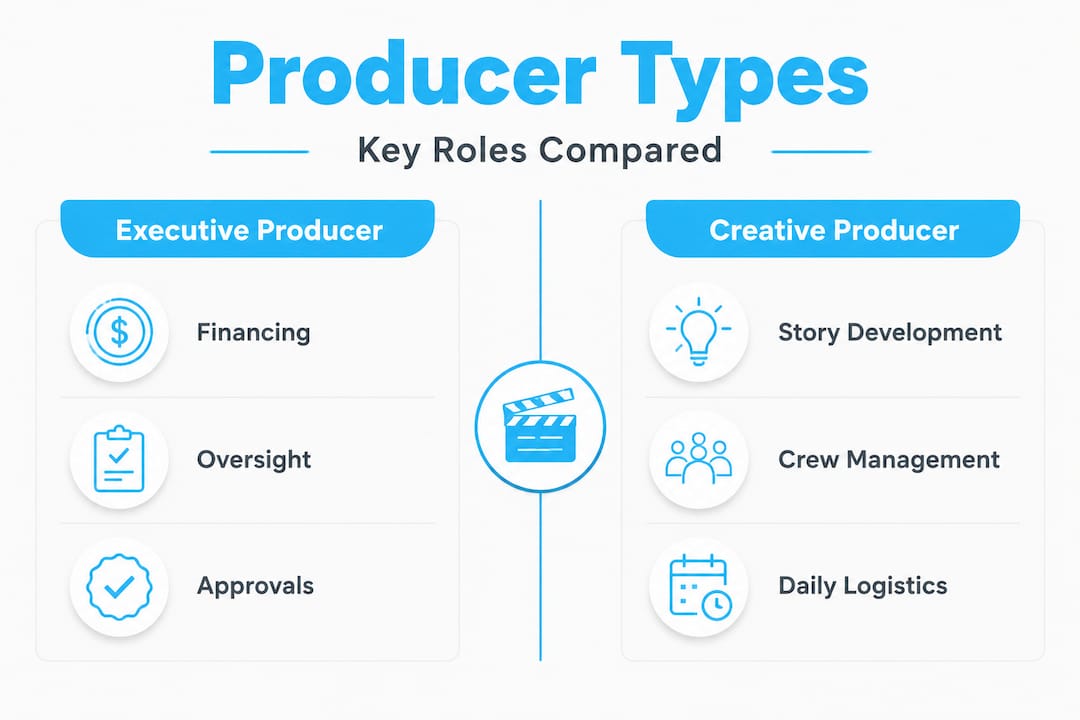
Clear role definitions are not just organizational niceties. When two producers assume they own the same decision, or when no one has claimed ownership of a specific task, that gap becomes a production problem. Productions that define roles precisely at the start avoid the most predictable and costly forms of breakdown.
How AI is changing the producer’s job
The producer’s job description is shifting at a pace that would have seemed unlikely five years ago. AI adoption in video production is shifting the producer’s role toward creative-tech hybrid positions, with a focus on workflow design and quality control of AI-generated outputs. The title beginning to appear in production companies is “AI Video Architect,” a role that blends creative direction with a working knowledge of AI tools.
What does that mean in practice? Consider the administrative load that has historically consumed a producer’s time:
- Scheduling coordination across multiple departments and vendors
- Bookkeeping and expense tracking throughout the shoot period
- Invoice generation and milestone payment tracking
- Progress reporting and status updates for clients or stakeholders
AI-driven operational tools are now cutting hiring timelines from weeks to days and automating bookkeeping, reducing the administrative burden that has historically consumed a significant share of a producer’s working hours. Production companies are using AI for project-level profitability dashboards and automated invoicing tied to milestone delivery, which means producers spend less time on spreadsheets and more time solving creative and strategic problems.
“The producer who understands AI tools isn’t just more efficient. They are fundamentally redesigning what a production pipeline looks like, and the gap between those producers and those who haven’t adapted is widening quickly.”
One company, BearJam, reported 87% year-on-year growth after hiring an AI Video Architect to bridge their creative and AI-driven workflows. That number reflects a structural advantage, not just a technology upgrade.
Pro Tip: If you are a producer still managing schedules manually in spreadsheets, explore AI project management tools built specifically for production workflows. The time recaptured in a single project often justifies the learning curve.
For content creators and filmmakers working at Bonomotion’s scale, understanding AI-powered video production means recognizing that the producer of tomorrow is as comfortable reviewing an AI-generated storyboard as they are negotiating a location permit.
Working with producers effectively
Knowing what a producer does and knowing how to collaborate with one are two different things. The following practices make a measurable difference in outcomes, regardless of whether you’re a solo content creator working with a freelance producer or a marketing director managing a full production company relationship.
-
Hire the producer before anyone else. Producers provide strategic oversight and project management before videographers or editors join the team. Their input during planning prevents costly scope changes later.
-
Define communication channels on day one. Establish who approves what, how feedback is communicated, and how often status updates happen. Ambiguous authority structures are the single most common source of production friction.
-
Build buffer time into every milestone. Scheduling buffer between milestones mitigates risks like editing delays and scheduling conflicts that are especially common in newer production teams. A two-day buffer between picture lock and final delivery has saved more than a few client relationships.
-
Let the producer own the budget conversation. Producers who manage finances without interference from clients or directors make better financial decisions. When everyone is negotiating every line item, no one is managing the whole.
-
Respect the producer’s function as creative problem solver. When a location falls through or a talent cancels, the producer is not just a logistics fixer. They are the person who reads the project well enough to find a solution that preserves the creative intent. Give them room to do that work.
Pro Tip: Before your project kicks off, ask your producer to walk you through the risk register: the three to five things most likely to go wrong and their contingency plans. Producers who can answer that question confidently are the ones worth working with.
For teams working with video production agencies, understanding the producer’s role within the agency structure helps you become a better client, which directly improves the quality of your final product.
Remote productions add another layer of coordination complexity. Producers managing dispersed creative teams benefit from structured remote collaboration practices, particularly when coordinating audio and video elements across locations. Remote music collaboration techniques, for example, offer practical frameworks that producers can apply to any distributed production workflow.
A framework for understanding producer contributions
At every phase of a video project, the producer is present and accountable. The table below captures the functional contribution of producers across production stages, which helps both filmmakers and educators frame producer impact on film and video clearly.
| Production Phase | Producer Contribution | Impact on Project |
|---|---|---|
| Development | Concept feasibility, budgeting, financing | Determines whether the project is viable |
| Pre-production | Crew hiring, scheduling, logistics, permits | Builds the foundation for an organized shoot |
| Production | Real-time problem solving, budget control | Keeps the project on track despite variables |
| Post-production | Editorial coordination, delivery management | Ensures the final product meets brief and deadline |
| Distribution | Client delivery, licensing, reporting | Closes the loop between production and audience |
Effective video production relies on constant collaboration and clear role delineation, with producers coordinating between creative and operational teams at every stage. The producer’s contribution is not concentrated in one phase. It runs through the entire lifecycle of the project, which is precisely why their absence is felt so acutely when it happens.
The importance of video producers becomes most visible in the gap they leave when a project runs without one. Shoots run over budget. Deliverables arrive late. Creative decisions get made by committee rather than by design. Recognizing the producer as a strategic partner, not just an operational resource, is the shift that separates well-run productions from ones that survive on adrenaline.
My honest take on how producers get misread
I’ve watched producers get introduced at kickoff meetings as “the logistics person” while the director gets framed as the creative visionary. That framing does real damage to productions. In my experience, the best producers I’ve worked with are often the most creative people in the room. They just express that creativity through constraints.
What I’ve found is that most project problems attributed to budget or scheduling are actually communication problems that a strong producer would have caught in week one. The shoots that spiraled were never missing money or time. They were missing someone whose job it was to hold the whole picture.
The uncomfortable truth about producer impact on film is that audiences don’t notice great producing. They notice great movies. That invisibility is a trap for people trying to understand the role, because it makes producing look passive when it is anything but. A great producer sets up every condition for the director, the crew, and the talent to do their best work. That’s not support. That’s architecture.
I’m also watching the AI transition closely. Producers who learn to direct AI tools with the same fluency they bring to directing people are going to build productions that smaller teams simply cannot match on quality or speed. The ones who resist that shift are not protecting craft. They are protecting habit.
— Bernard
Work with producers who lead your project from day one

At Bonomotion, every project is led by an experienced producer who works directly with your team from the first briefing call through final delivery. We’ve been building producer-led corporate video productions for startups, growing brands, and Fortune 100 companies since 2003, and the approach has not changed: your producer understands your objectives, your audience, and your timeline before a single crew member is booked. Whether you need commercial video services, livestream coverage, or branded content, our producers manage the full workflow so your team stays focused on the business. Reach out to discuss your next project.
FAQ
What does a video producer do?
A video producer manages every phase of a production, from budgeting and crew hiring in pre-production through editorial coordination and final delivery in post-production. They function as the primary link between creative vision and practical execution.
What is the difference between a producer and a director?
The director controls the creative execution of the content on set; the producer controls the conditions that make that execution possible. Both roles are interdependent, but they operate on different planes of responsibility.
How do producers influence the final quality of a video?
Producers influence quality by setting realistic schedules, protecting the budget, resolving logistical problems before they reach the director, and holding the production accountable to its original creative brief throughout every phase.
Why should content creators hire a producer early?
Hiring a producer first establishes strategic oversight before other crew members join, which prevents costly scope changes and creates a structured workflow that scales as the team grows.
How is AI changing the role of video producers?
AI tools are automating scheduling, bookkeeping, and invoicing, which frees producers to focus on creative problem solving and workflow design. The emerging “AI Video Architect” role reflects this shift toward hybrid creative-technical producer functions.