

Most businesses upload videos and wait. They post a product demo here, a testimonial there, maybe a trending short-form clip, and wonder why results stay flat. A video marketing strategy is not a content calendar or a posting schedule. It is a deliberate framework connecting every video your brand produces to a specific business goal, a defined audience, and measurable outcomes. When that framework is in place, video stops being an expense and starts operating as one of the most powerful growth levers you have. This article breaks down exactly how to build one.
Table of Contents
- Key Takeaways
- What is video marketing strategy: the foundation
- Content that actually holds attention
- Using AI and technology to scale production
- Applying video strategy across platforms and funnel stages
- My honest take on where most video strategies fail
- Ready to put this into production?
- FAQ
Key Takeaways
| Point | Details |
|---|---|
| Strategy beats volume | Posting more videos without clear goals wastes budget; every video needs a defined purpose tied to business outcomes. |
| Emotion drives sharing | The brain processes emotions faster than logic, making emotional storytelling the core engine of video engagement. |
| AI multiplies your output | One long-form video asset can be repurposed into 5 to 10 platform-specific clips, maximizing production ROI without extra shoots. |
| Platform context shapes format | Awareness, consideration, and decision-stage audiences need different video types; distributing the wrong format in the wrong place reduces conversions. |
| Metrics close the loop | Tracking view duration, conversion rates, and brand lift together reveals what is working and where to invest next. |
What is video marketing strategy: the foundation
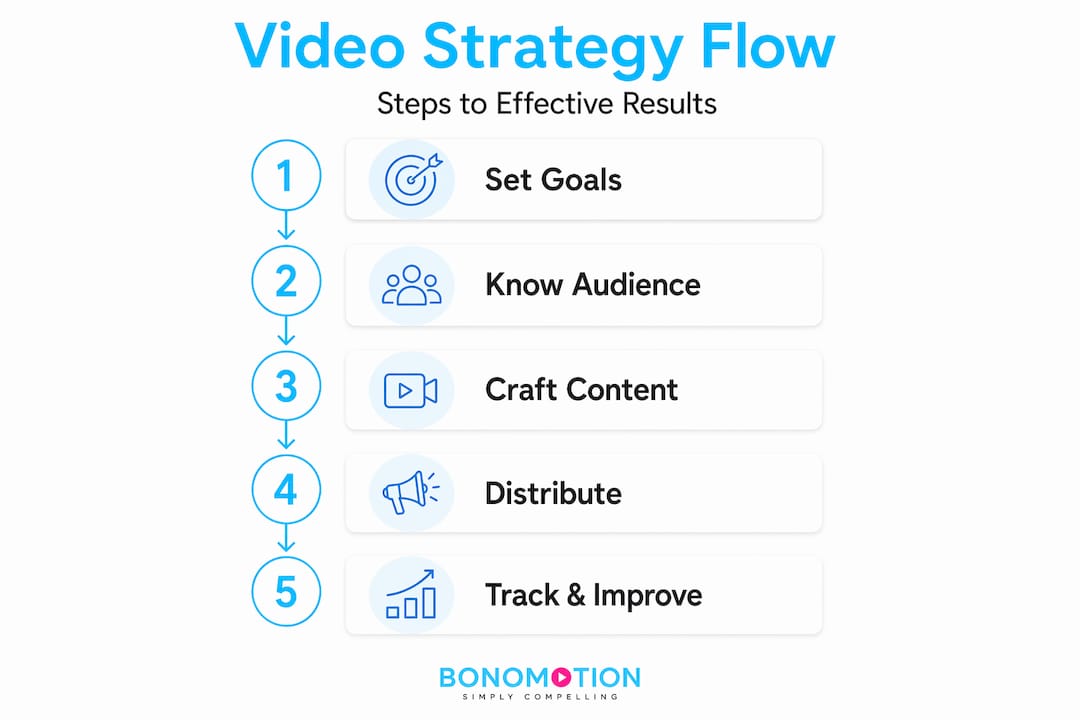
A video marketing strategy is a documented plan that aligns your video content with specific business objectives, defined audience segments, and trackable performance metrics. Think of it as the operating system underneath all your video activity, rather than the videos themselves.
Goal-setting is where every solid video content marketing plan begins. Before production starts, you need to answer one question precisely: what business outcome does this video support? Lead generation, brand awareness, customer retention, and product education all require different content approaches, different formats, and different distribution channels. Conflating these goals is one of the most common reasons video programs underperform.
Understanding your audience with real specificity matters just as much. Demographics tell you who they are; psychographics and behavioral data tell you what they care about and how they make decisions. A B2B software company targeting IT directors needs different messaging, tone, and visual language than a direct-to-consumer brand speaking to first-time buyers. Both need video strategies, but those strategies should look nothing alike.
Key performance indicators (KPIs) close the planning loop. Relevant metrics depend entirely on your goal:
- Awareness stage: View counts, reach, and brand recall lift
- Consideration stage: Watch time, click-through rate, and website sessions from video
- Decision stage: Conversion rate, cost per acquisition, and assisted revenue
Pro Tip: Match your KPI selection to funnel stage before production begins. Measuring conversions on a top-of-funnel brand video will produce misleading data and erode confidence in the program.
Content that actually holds attention
Here is what separates videos people finish from videos people abandon in the first four seconds. The science of attention does not reward production budgets or posting frequency. It rewards human-centric storytelling, authentic connection, and emotion. Content strategist Hilary Billings has documented this extensively: sustained engagement comes from making viewers feel something, not from flashy transitions or trending audio.
The neurological case is compelling. Emotional content triggers viewer responses at a speed that logic-based messaging cannot compete with, making emotion the primary engine for sharing, commenting, and brand recall. When you strip emotion out of a video in favor of feature lists or corporate talking points, you are working against the way attention actually functions.
Practically, this means your script and story structure matter more than your lighting package. Before any scripting begins, marketer Emilie Brown advises clarifying viewer transformation: what should your viewer think, feel, or do differently after watching? That answer shapes everything from length to format to where you place the call to action.
“Authenticity and brand voice combined create a frequency that resonates deeply with the right audience.” — The Science of Attention
One pitfall worth naming directly: over-investing in production polish at the expense of genuine connection. Research confirms that high production values can actually undermine credibility on social platforms where authenticity is the dominant currency. A founder speaking directly to camera with clear messaging and a real point of view will frequently outperform a glossy brand film with no emotional anchor.
Pro Tip: Hook viewers in the first three seconds by immediately identifying a problem they recognize or asking a direct question. Skip the logo animation. Start with something that makes them say “that’s exactly my situation.”
Also worth understanding: authenticity directly influences how often viewers share your content. When a creator or brand spokesperson appears genuinely disconnected from the content they are delivering, share likelihood drops measurably. Real alignment between the messenger and the message is not a soft concept. It is a performance variable.
Using AI and technology to scale production
The production economics of video have shifted significantly. AI tools now compress traditional video workflows from weeks and large budgets to days and a fraction of the cost, which is particularly meaningful for small and mid-sized businesses competing with enterprise-level content output. Scripting, auto-captioning, background removal, multi-platform formatting, and voiceover generation have all become accessible through AI-powered tools.

The repurposing model is where AI delivers its strongest ROI argument. One long-form video can yield 5 to 10 short-form clips for social platforms, blog post transcripts, email-ready excerpts, and pull quotes for paid ads. A single webinar or executive interview becomes a multi-channel content engine without requiring additional shoots. This is the repurposing multiplier, and it changes how teams should think about production planning. Learn more about how AI-powered video production creates this kind of scaled output.
| Production Task | Traditional Approach | AI-Assisted Approach |
|---|---|---|
| Script drafting | 2 to 5 days with copywriter | Hours with AI drafting tools |
| Caption generation | Manual transcription | Automated in minutes |
| Multi-format resizing | Manual editing per platform | Automated batch export |
| Translation/localization | Separate vendor or delay | AI translation tools |
| Performance analysis | Manual spreadsheet review | Real-time dashboard insights |
That said, AI does not replace brand judgment. Compliance and ethical considerations matter here. AI-generated content still requires human review for accuracy, brand voice consistency, and legal compliance, especially for regulated industries. Brands that automate without oversight risk publishing content that is technically polished but strategically off-target.
Tracking engagement and conversion metrics across all distributed assets closes the optimization loop. View duration data tells you where viewers drop off. Conversion data tells you which videos move people to act. Brand lift studies tell you whether perception is shifting. Together, these metrics give you the data you need to allocate production budget toward what is actually working.
Applying video strategy across platforms and funnel stages
Effective video marketing for businesses requires matching content formats to where buyers are in the purchase journey and where they spend time online. Distribution without this mapping is how brands end up with high production costs and low business impact.
Here is a practical framework for funnel-to-format alignment:
-
Awareness stage: Short-form social videos (15 to 60 seconds), brand documentaries, and thought leadership clips work best here. The goal is recognition and reach, not conversion. LinkedIn, YouTube pre-roll, and Instagram Reels are natural homes for this content.
-
Consideration stage: Longer explainer videos, product walkthroughs, customer testimonials, and webinar recordings serve buyers who are actively evaluating options. YouTube, your website, and email sequences are high-value distribution channels at this stage.
-
Decision stage: Case studies on video, personalized executive messages, and demo recordings address the final objections holding buyers back. These videos often perform best embedded in landing pages, sales emails, and proposal follow-ups.
-
Retention and advocacy stage: Onboarding videos, feature update announcements, and behind-the-scenes content deepen customer loyalty and turn satisfied clients into referral sources. This stage is chronically underfunded relative to its revenue impact.
Building a content calendar around this framework creates consistency, which compounds over time. Consistent video branding across all stages can increase revenue by up to 23%, which is a return that justifies the planning investment many teams skip. Explore how B2B video marketing strategy applies this framework for professional services contexts.
The measurement cadence matters too. Review platform analytics monthly at minimum, not quarterly. Video content performs differently across its lifecycle, with some assets accelerating in performance weeks after publication. Staying close to the data lets you amplify what is gaining traction before the moment passes.
My honest take on where most video strategies fail
I have worked with brands ranging from early-stage companies to Fortune 100 organizations, and the pattern I see most consistently is not about production quality or budget. It is about planning depth. Most teams start with “we need more video” rather than “here is the specific outcome we are trying to drive and the audience we are trying to move.” That backward approach creates a content library full of videos that exist but do not work.
The second failure I see regularly is treating authenticity as a production style choice rather than a strategic commitment. Teams will greenlight a polished brand film, see mediocre results, and assume the issue was execution. Often, the issue is that the content had no genuine point of view. It said the expected things in a visually expensive way. Viewers retain far more from video than from any other format, but only when the content actually resonates.
My honest recommendation for small teams: do not wait until you have a large production budget to build your video strategy. Use AI tools to produce at scale, repurpose aggressively, and spend your real investment on the one or two cornerstone videos per quarter where production quality genuinely moves the needle. The brands that win at video are not the ones spending the most. They are the ones thinking the most clearly about what they are trying to accomplish and for whom.
— Bernard
Ready to put this into production?
Building a video marketing strategy is one thing. Executing it at the level your brand deserves is another challenge entirely. At Bonomotion, we have spent over 20 years helping growth-stage companies and Fortune 100 brands produce video content that is strategically aligned, visually compelling, and built to perform across every channel.
Whether you need a single flagship brand film or a full corporate video production program with multi-platform distribution planning, our team of experienced producers works directly with your marketing leadership to translate strategy into polished, results-driven media. From Miami to nationwide, we bring production discipline and strategic clarity to every project. Explore our corporate video solutions to see how we approach video as a business growth tool, not just a creative output.
FAQ
What is a video marketing strategy in simple terms?
A video marketing strategy is a structured plan that connects every video your brand produces to a specific business goal, audience, and measurable outcome. It goes beyond content scheduling to address why each video exists and how success will be measured.
How do you create a video content strategy from scratch?
Start by defining the business outcome you want video to support, then identify the specific audience segment you are addressing, select KPIs that match your funnel stage, and map content formats to distribution channels before producing a single frame.
What video types work best at different funnel stages?
Short-form awareness videos work best at the top of the funnel; explainers, testimonials, and webinars perform well in the consideration stage; and case studies, demos, and personalized messages convert best at the decision stage.
How does AI fit into a video content marketing plan?
AI tools accelerate scripting, captioning, formatting, and repurposing, allowing teams to produce more platform-specific content from a single shoot. However, human review remains necessary to maintain brand voice and accuracy across all published assets.
What are the best practices for video marketing ROI?
The strongest return comes from repurposing long-form assets into multiple short clips, maintaining consistent branding across all video content, tracking view duration and conversion data together, and aligning every video to a specific business objective rather than producing content reactively.