

Without a structured plan, even the most well-funded video campaigns can miss their mark entirely. Marketing teams invest significant budget and time into production, only to publish content that generates views but no measurable business outcomes. That cycle of effort without results is frustrating and expensive. 93% of marketers report strong ROI from video, yet many brands still struggle to connect their content to clear goals. The difference between those who win and those who waste budget almost always comes down to planning discipline. This guide breaks down a step-by-step approach that aligns every video project with measurable outcomes.
Table of Contents
- Clarify goals, audience, and stakeholder alignment
- Map out timelines, budgeting, and choose the right platforms
- Craft compelling messaging and select impactful video formats
- Define and track video success: Metrics that matter
- Common missteps and advanced planning tips
- What most corporate teams miss about sustainable video content planning
- Partner with proven experts for seamless execution
- Frequently asked questions
Key Takeaways
| Point | Details |
|---|---|
| Plan before you film | Structured planning around goals, audience, and buy-in prevents wasted effort and off-brand messaging. |
| Budget and timeline matter | Careful resource planning ensures on-time, on-budget delivery aligned with campaign objectives. |
| Format-fit maximizes engagement | Match messaging and video format to the audience and business stage for better results. |
| Metrics drive improvement | Clear, actionable KPIs let you measure what works and optimize future videos. |
| Treat video as a program | Video wins most when built as a repeatable, measurable process tied to business priorities. |
Clarify goals, audience, and stakeholder alignment
With the need for structured planning established, let’s break down the critical first steps that anchor success.
Every effective video campaign begins long before any camera rolls. The first decision your team needs to make is deceptively simple: what do you actually want this video to accomplish? That question sounds obvious, but we’ve seen many experienced marketing teams skip it or answer it too vaguely. “More awareness” or “better engagement” are not goals. They’re directions. Goals have numbers, timelines, and accountability attached to them.
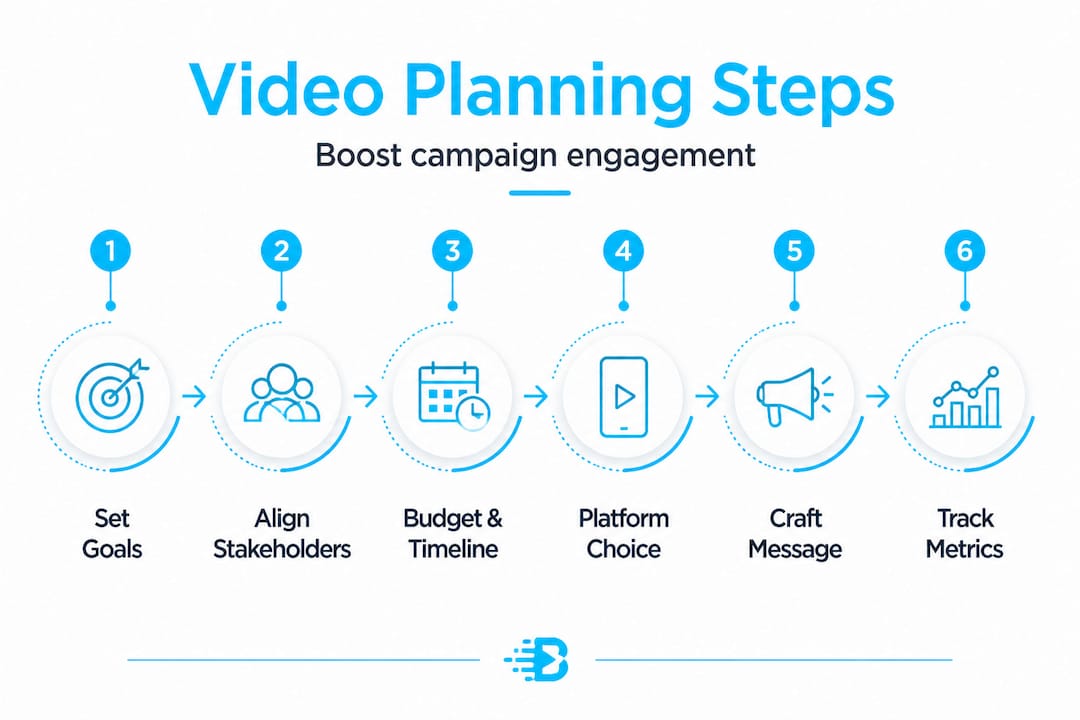
Video marketing strategy planning, according to HubSpot, should be anchored in goal-setting, audience and stakeholder alignment, budgeting, platform selection, messaging, and defined success metrics. That framework exists because each element directly affects every downstream decision. Miss one, and the gaps compound.
Define your objective first. Are you building brand awareness in a new market? Moving prospects from consideration to conversion? Educating existing clients on a product update? Each goal calls for a different format, length, tone, and distribution channel. Trying to accomplish all of them in one video is a recipe for content that accomplishes none of them.
Once your goal is fixed, turn your attention to audience research. You need to understand:
- Where your target audience consumes video content (LinkedIn, YouTube, internal portals, live events)
- What content format they prefer at each stage of the buyer journey
- What questions or objections they carry into each interaction
- What motivates them to engage, share, or act
This research doesn’t need to be exhaustive, but it does need to be intentional. Survey your sales team. Review past engagement data. Check platform analytics for your existing content. That intelligence shapes every creative decision that follows.
Stakeholder alignment is the third pillar, and it’s the one most likely to derail projects when ignored. Legal, compliance, executive leadership, and department heads often have opinions about messaging and brand representation. Getting their input after production wraps creates expensive revisions. Getting it before production starts creates clarity.
“Aligning stakeholders upfront avoids costly midstream changes.”
Pro Tip: Circulate a concise one-page project brief before any creative work begins. It should capture the goal, audience description, key message, required approvals, and timeline. That single document can prevent three rounds of post-production revisions and keeps everyone operating from the same foundation. Learning more about effective corporate video planning can give your team a practical model for structuring this process from the start.
Brands working with external agencies can also benefit from reviewing how video marketing for agencies operates at the production level, as it helps internal teams understand what information their production partners actually need to deliver strong results.
Map out timelines, budgeting, and choose the right platforms
Once your objectives and stakeholders are aligned, it’s time to equip your campaign with the practical details that enable smooth execution.

Budget and timeline decisions are where strategy either holds together or falls apart. Underestimating production costs is one of the most common reasons corporate video projects go over schedule and over budget. A realistic budget accounts for three distinct phases: pre-production (scripting, storyboarding, location scouting, talent), production (crew, equipment, studio or on-location costs), and post-production (editing, color grading, motion graphics, sound mixing, revisions).
Here’s a practical approach to building your project timeline:
- Set your publication or event date first, then work backward to establish every milestone.
- Assign stakeholder review windows at script approval, rough cut, and final cut stages.
- Build in buffer time between production and your first review. Rushing the edit phase introduces errors.
- Confirm asset delivery formats before production starts, since platform requirements vary significantly.
- Lock your distribution plan before final delivery, so the right file specs are baked into post-production.
Budget and timeline planning are critical steps that follow directly from goal and audience alignment. They’re not administrative formalities. They’re strategic constraints that shape what’s actually achievable with your creative vision.
Platform selection deserves the same level of intentional thinking. Not every channel fits every campaign goal. Below is a reference table to guide distribution decisions:
| Platform | Best video type | Campaign goal fit |
|---|---|---|
| YouTube | Long-form educational, product demos | Awareness, consideration |
| Executive thought leadership, case studies | B2B awareness, trust-building | |
| Instagram/TikTok | Short-form, brand stories | Reach, community engagement |
| Internal portal/LMS | Training, onboarding, town halls | Employee communication, retention |
| Company website | Testimonials, explainer videos | Conversion, lead nurturing |
| Webinar platforms | Live education, product launches | Consideration, engagement |
Choosing the wrong platform means your content reaches the wrong people at the wrong stage of their journey. A detailed product walkthrough video performs well on YouTube but typically underperforms as a LinkedIn feed post. Context matters enormously.
Pro Tip: Before setting engagement targets, spend 30 minutes reviewing platform-native analytics for any existing content your brand has published. Those baselines give you a realistic benchmark for what’s achievable, instead of borrowing industry averages that may not reflect your audience’s actual behavior.
Reviewing video production budgeting tips can help your team scope projects accurately and avoid the most common financial surprises before a single shoot day is scheduled.
Craft compelling messaging and select impactful video formats
Armed with logistics, you’re ready to develop creative approaches that drive engagement at each campaign stage.
Messaging is not the same as content. Your message is the single idea you want your audience to carry with them after watching. Content is how you deliver that idea. Confusing the two leads to videos that feel busy and unfocused, where multiple points compete for attention and none lands clearly.
Every piece of video content your team produces should serve one of these core communication purposes:
- Inform: Deliver new knowledge your audience didn’t have before (market updates, research findings)
- Explain: Break down complex products, processes, or concepts into digestible steps
- Inspire: Connect your brand to values, mission, or aspirational outcomes
- Train: Equip employees or customers with skills and process knowledge
- Update: Keep stakeholders current on progress, changes, or announcements
Each purpose calls for a different emotional tone and a different format. Matching your message type to the right format is where good planning produces visible results.
Educational videos under five minutes hold audience attention about halfway through, while webinars outperform most long-form formats in sustained viewer engagement. That data has direct implications for your format choices.
| Video format | Ideal use case | Engagement strength |
|---|---|---|
| Educational series | Internal comms, onboarding | High for repeat viewing |
| Demo video | Product consideration stage | High for conversion intent |
| Testimonial | Late-stage sales support | High for trust-building |
| Webinar | Client education, launches | High for sustained attention |
| Explainer/animated | Awareness, complex topics | High for simplifying ideas |
| Executive message | Leadership comms, town halls | Moderate, high for culture |
A short educational series works particularly well for internal communications, where employees need repeated exposure to new processes or policies. Webinars serve client engagement more effectively because the live format creates accountability for attendance and real-time interaction.
When you’re planning impactful corporate video formats, think about which format your audience actually has time and bandwidth for, not just which format is trending. And when developing your scripts and talking points, focusing on effective video messaging will help you sharpen each video’s central idea before production begins.
Define and track video success: Metrics that matter
The right formats and messaging mean little without understanding if your videos actually drive results.
Measurement is where most corporate video programs lose discipline. Teams celebrate view counts without examining whether those views came from the intended audience. They report on shares without connecting engagement back to conversion outcomes. Metrics are only useful when they’re tied to the goal you defined at the start.
Here’s a practical measurement setup process:
- Define your baseline: Pull current benchmarks for views, watch time, and conversions on comparable content before launching anything new.
- Implement tracking tools: Use UTM parameters for video landing pages, enable platform analytics, and integrate with your CRM where possible.
- Set milestone reviews: Schedule performance check-ins at 7 days, 30 days, and 90 days post-launch.
- Optimize based on data: Adjust distribution, thumbnails, titles, or calls to action based on what the data reveals at each milestone.
The KPIs that matter most depend on your campaign goal. Awareness campaigns should track reach, impressions, and view-through rates. Consideration campaigns need watch time and return visits. Conversion-focused content demands click-through rates, form completions, and direct revenue attribution.
Social media engagement is now the fastest-rising success metric, and 93% of marketers report strong ROI from video. That combination tells a clear story: video works, but teams that track engagement signals alongside traditional reach metrics are better positioned to optimize in real time.
Engagement metrics deserve contextual interpretation. A leadership video with a 70% watch-through rate and 40 comments carries more strategic weight than a brand video with 10,000 views and no comments. The former signals genuine resonance. The latter may just reflect paid distribution. Understanding best video success metrics helps your team distinguish surface-level performance from actual business impact. For B2B-specific campaigns, building out a full B2B video strategy with tied metrics can accelerate your reporting credibility internally.
Common missteps and advanced planning tips
Perfecting your plan calls for learning from common challenges and building in operational excellence.
Even experienced marketing teams repeat the same planning mistakes. Recognizing them before they surface in your workflow saves both budget and morale. The most damaging pitfalls we’ve observed consistently include:
- Rushing the planning phase to hit an arbitrary launch date, which leads to misaligned messaging and off-brand execution
- Ignoring audience insights in favor of internal assumptions, resulting in content that resonates with the team but not the viewer
- Skipping stakeholder review cycles, which guarantees revisions after delivery and damages trust with production partners
- Launching without defined success metrics, making it impossible to report meaningful results or justify future video investment
- Treating each video as a standalone asset rather than part of a connected content ecosystem
That last point is where many sophisticated brands still fall short. Treating video as a repeatable program tied to business stages, routed through stakeholder review and measurement definition, is what separates sustainable video operations from one-off campaigns.
“Build measurement into your workflow from day one for continuous improvement.”
Pro Tip: Document your video planning process as a reusable template. Every time you launch a new campaign, the team should fill out the same brief format, run the same stakeholder review cycle, and report against the same KPI framework. That consistency compounds over time, producing faster execution, stronger content, and cleaner reporting. Studying examples of stand-out corporate videos can also help your team calibrate what quality execution actually looks like before briefing any production partner.
What most corporate teams miss about sustainable video content planning
Here’s a contrarian take worth sitting with: most corporate teams treat video like a campaign tool when they should treat it like a business function.
Campaign thinking is episodic. It produces bursts of activity around product launches, quarterly events, or conference seasons, then goes quiet. The content gets created, published, and forgotten. Teams celebrate the launch and move on. Three months later, someone asks what the ROI was, and nobody has a clean answer because measurement was an afterthought.
Business function thinking is continuous. It means video has a dedicated budget line, a repeatable planning process, a stakeholder review cadence, and performance reporting built into regular team meetings. It means every video project is an opportunity to learn something about your audience and apply that knowledge to the next one.
We’ve seen this pattern play out across both growing brands and Fortune 100 companies. The teams that treat video as a function consistently outperform those running it as a series of projects. They produce more content at lower per-unit cost because the infrastructure is already in place. They also report better results because they’ve been measuring long enough to know what actually works for their specific audience.
The uncomfortable truth is that most planning failures aren’t creative failures. They’re operational failures. Unclear ownership, skipped reviews, undefined metrics, and last-minute timelines are process problems. Creative quality can’t compensate for process gaps.
Engagement metrics have also shifted the accountability conversation. As engagement metrics rise in importance relative to raw reach, teams need measurement systems that capture the quality of audience response, not just its volume. A video that generates 500 deeply engaged viewers who share it with their networks can outperform a video with 50,000 passive impressions and zero downstream action.
Teams that route every campaign through a consistent planning loop, with clear goals, aligned stakeholders, realistic timelines, matched formats, and defined metrics, outperform on both brand perception and measurable ROI. That’s not a creative insight. It’s an operational one.
Partner with proven experts for seamless execution
Whether you’re refining your in-house planning or seeking external expertise, consider what true partnership can offer for your next campaign.
Having a solid plan is step one. Executing it with the production quality your brand deserves is where many teams recognize they need experienced support.
At Bonomotion, we’ve spent over 20 years guiding marketing teams and brand managers through exactly this process, from goal definition to final delivery. Our corporate video experts work as a true extension of your team, bringing both strategic thinking and production precision to every project. Whether you need executive messaging, event coverage, or a full branded campaign, our business video solutions are designed to convert your planning into polished results. If you’re based in Florida or running campaigns in the region, our Miami corporate video production team is ready to bring your vision to life efficiently and on brief.
Frequently asked questions
What are the must-have elements in a video content plan?
A strong plan defines goals, audience, timelines, budget, messaging, format, distribution, and clear KPIs. HubSpot’s video strategy framework confirms these as the core pillars that support measurable video performance.
How should success be measured for video marketing in 2026?
Track engagement alongside view and conversion metrics, since social engagement is rising as a primary performance indicator for both brand and ROI reporting.
How long should corporate videos be for best engagement?
Educational videos under five minutes hold attention well through the midpoint, while webinars outperform most long-form content formats for sustained viewer attention across the full session.
Is video truly necessary for all corporate communication in 2026?
With 93% of marketers reporting strong ROI from video, it has become a near-essential component of any modern corporate communication and marketing strategy.
What’s the biggest mistake teams make in video content planning?
Skipping formal stakeholder alignment and measurable KPIs consistently leads to poor results. Routing every project through both steps before production starts is the most reliable way to protect your investment.