

Video storytelling is defined as the strategic use of narrative structures, combining sound, visuals, and emotion to create meaningful connections between a brand and its audience. Unlike conventional promotional content focused on features and price, video storytelling prioritizes human-centric narratives that build trust, drive engagement, and improve conversion rates. Platforms like Vimeo and tools like Adobe Premiere Pro have made professional-grade narrative video production accessible to brands of every size. Viewers retain 95% of a message delivered through video storytelling, compared to just 10% through text. That gap alone explains why marketers are shifting budgets from static ads to story-driven video content.
What is video storytelling and how does it work?
Video storytelling is the practice of using structured narrative to guide a viewer through an emotional experience, not just a product pitch. The industry term for this discipline is narrative video communication, though “video storytelling” has become the standard working phrase across marketing and production teams. It works by combining cinematography, sound design, pacing, and dialogue to intentionally guide viewers’ emotions and responses. Every visual choice, from camera angle to color grade, serves the story’s emotional goal.
What separates this approach from a standard brand video is intent. A product demo shows features. A story makes the viewer feel something about those features. Vimeo’s research confirms that multisensory storytelling communicates character and tone more effectively than any static medium. That emotional depth is what drives recall, sharing, and purchase decisions long after the video ends.

What are the core techniques and narrative frameworks?
The three-act structure
The most reliable framework in video storytelling is the three-act structure: beginning, middle, and end. The beginning establishes the problem or tension. The middle follows the character’s journey through that tension. The end delivers resolution. Effective video storytelling shows the story’s promise early, which signals to viewers that their time is well spent and keeps them watching through the middle.
Popular narrative frameworks compared
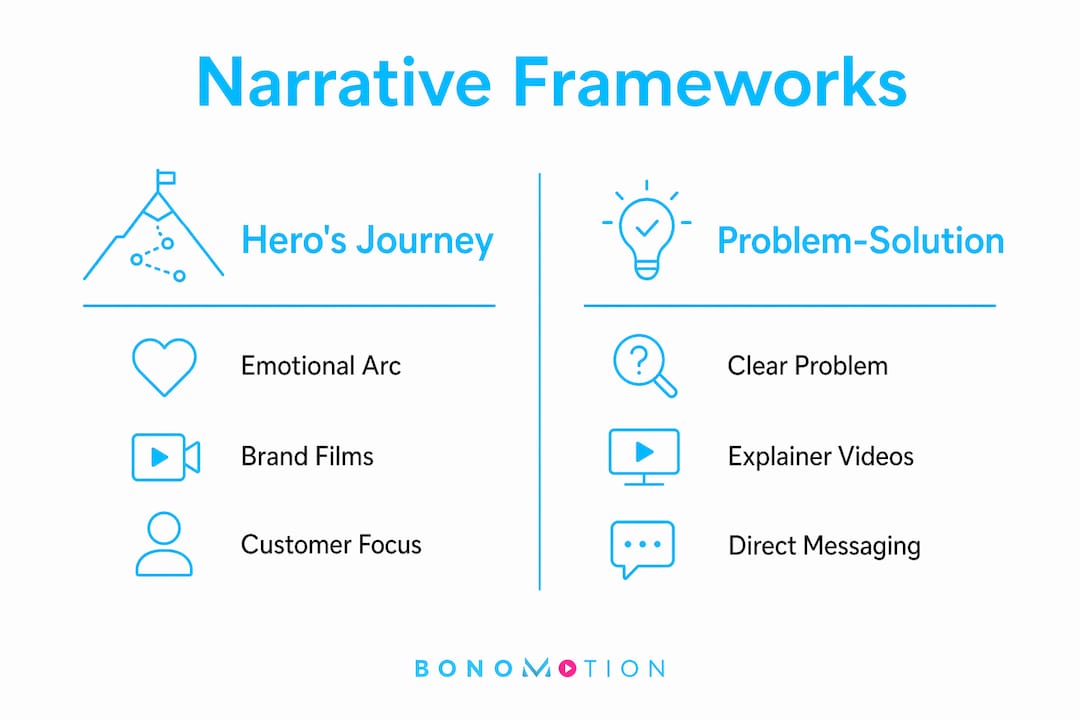
Beyond the three-act structure, three frameworks dominate professional video production:
| Framework | Core Strength | Best Use Case |
|---|---|---|
| Hero’s Journey | Emotional transformation arc | Brand films, thought leadership |
| Problem-Solution | Fast relevance and clarity | Explainer videos, product demos |
| Testimonial Narrative | Authentic, peer-level trust | Corporate testimonial videos, case studies |
The Hero’s Journey works best when a brand wants to position its customer as the protagonist who overcomes a challenge. Problem-Solution cuts straight to relevance, making it ideal for explainer content where attention is short. Testimonial Narratives let real customers carry the story, which builds credibility faster than any scripted message.
Multisensory reinforcement
Sound design and pacing are not production afterthoughts. They are storytelling tools. A well-placed music swell at the moment of resolution amplifies emotional impact beyond what dialogue alone can achieve. Cutting to a close-up at the right beat creates intimacy. Composition and motion guide the viewer’s eye and emotional state simultaneously. The best video stories show, rather than tell, using every frame as a deliberate narrative choice.
Pro Tip: Focus each video on one clear narrative goal. Trimming content that does not serve that single goal is the fastest way to improve viewer retention.
How does video storytelling differ from traditional video marketing?
Traditional video marketing leads with the product. Video storytelling leads with the person. That distinction changes everything about how a viewer receives the message. Feature-led ads inform. Story-driven videos connect. The shift toward narrative video directly influences consumer behavior and improves conversion metrics by creating memorable, personal connections that a product spec sheet cannot replicate.
The retention data makes this concrete. Viewers retain 95% of a message delivered through video storytelling versus 10% through text-based content. That is not a marginal improvement. It is a fundamental difference in how information sticks.
The benefits exclusive to storytelling-driven video include:
- Brand trust: Audiences connect with characters and narratives, not logos and taglines.
- Emotional recall: Story-driven content is remembered long after a direct ad is forgotten.
- Shareability: People share content that moves them, not content that informs them.
- Audience loyalty: Serialized or character-driven video builds ongoing viewer investment.
- Authentic brand personality: Narrative reveals values and culture in ways a product pitch cannot.
A well-crafted corporate storytelling example shows how brands integrate personality and purpose into video without a single hard sell. The result is content that earns attention rather than interrupting it.
What practical steps help you create compelling video stories?
Creating effective narrative video requires a clear process, not just creative instinct. Follow these steps to build a story that holds attention from the first frame to the last.
- Define your viewer’s problem first. Every strong video story starts with empathy. Know exactly what your audience is struggling with before you write a single line of script.
- State the outcome early. Show viewers what resolution looks like within the first 15–30 seconds. This is the “one main promise” rule: a single narrative goal reduces confusion and increases retention.
- Choose your framework. Match the narrative structure to your goal. Use Problem-Solution for quick engagement, Hero’s Journey for brand films, and Testimonial Narrative for trust-building content.
- Script for the ear, not the eye. Write dialogue and narration that sounds natural when spoken aloud. Read every line out loud before finalizing.
- Layer in multisensory elements. Select music, sound effects, and visual pacing that reinforce the emotional arc. Do not treat these as decoration.
- Edit ruthlessly. Cut every scene, line, or visual that does not serve the single narrative goal. Trimming unrelated content is the most underrated editing skill in video production.
- Add captions. A significant share of video is watched without sound, particularly on LinkedIn and Instagram. Captions keep the story intact regardless of viewing conditions.
Pro Tip: Tailor your narrative style to the platform. A 90-second Hero’s Journey works on YouTube. A 15-second Problem-Solution hook works on TikTok or Instagram Reels. The story structure stays the same; the pacing and length adapt.
Common pitfalls to avoid: overloading the story with multiple messages, starting with the brand instead of the viewer, and treating music as background noise rather than an emotional driver. Even tutorials and product demos benefit from applying hero, conflict, and resolution frameworks to keep audiences engaged through technical content.
What are the best practices and emerging trends for 2026?
The most significant shift in video storytelling right now is the rise of interactive and serialized content. Interactive video lets viewers make choices that affect the narrative, which deepens investment and extends watch time. Serialized content, structured like a short-form series, builds audience loyalty across episodes rather than relying on a single video to do all the work. AI-assisted tools like LunaBloom AI support rapid production while preserving narrative quality, making serialized content more feasible for mid-size brands.
Authenticity remains the non-negotiable priority. Audiences in 2026 are highly attuned to polished-but-hollow content. The brands winning on YouTube, TikTok, and Instagram are those whose videos feel genuinely human, even when produced at a high technical level.
Current best practices include:
- Data-story fusion: Combining narrative with informative data adds credibility without losing emotional engagement. Data-story fusion is particularly effective for thought leadership and analytical content formats.
- Platform-native storytelling: TikTok rewards raw authenticity and fast hooks. YouTube rewards depth and character development. Instagram favors visual-first narratives with strong opening frames.
- Emotional resonance as a KPI: Forward-thinking marketing teams now measure emotional response alongside click-through rates and view counts.
- Explainer videos with narrative bones: Problem-solution storytelling in explainer videos drives faster client engagement than feature-led walkthroughs.
- Brand building through character: Recurring characters or brand voices across a video series create the kind of familiarity that advertising alone cannot buy.
The brands that treat video storytelling as a discipline, not a tactic, are the ones building durable audience relationships in an attention-scarce environment.
Key takeaways
Video storytelling builds brand trust and drives message retention at a level that traditional video marketing cannot match, making narrative structure a core competency for any serious marketing team.
| Point | Details |
|---|---|
| Core definition | Video storytelling uses narrative, sound, and visuals to create emotional connections, not just product awareness. |
| Retention advantage | Viewers retain 95% of a story-driven video message versus 10% from text-based content. |
| Framework selection | Match your narrative framework to your goal: Hero’s Journey, Problem-Solution, or Testimonial Narrative. |
| One narrative goal | Focus each video on a single clear promise and cut everything that does not serve it. |
| Platform adaptation | Adjust pacing and length by platform while keeping the core narrative structure intact. |
Why most video storytelling falls flat before the first minute
After working in video production for years, the pattern I see most often is this: brands invest in production quality and neglect narrative clarity. They hire a great cinematographer, choose a compelling location, and then fill the script with three different messages because the marketing team could not agree on one. The result is a beautiful video that nobody remembers.
The “one main promise” rule is not a creative constraint. It is the most practical piece of advice I can give any marketer stepping into video storytelling for the first time. Every great story has a spine. When you try to tell two stories at once, you tell neither.
The other mistake I see constantly is treating the brand as the hero. The viewer is the hero. The brand is the guide. The moment you flip that dynamic, your content starts to feel less like an ad and more like something worth watching. That shift in perspective is what separates forgettable brand videos from the ones people actually share.
The future of this discipline belongs to teams that combine disciplined narrative structure with genuine creative risk. Experiment with format, platform, and character. But never experiment with clarity.
— Bernard
How Bonomotion brings your video story to life
Professional production does not just improve picture quality. It sharpens the narrative, controls the emotional pacing, and ensures every technical element serves the story’s goal.
At Bonomotion, we have spent over 20 years helping startups, growing brands, and Fortune 100 companies communicate through story-driven video. From executive messaging to branded lifestyle campaigns, every project is guided by an experienced producer who works closely with your team on objectives, audience, and timeline. If you are ready to move from promotional content to video that genuinely connects, our corporate video production team is built for exactly that. We also offer commercial video production services for brands that need narrative-driven marketing content at scale.
FAQ
What is the video storytelling definition?
Video storytelling is the use of narrative structures, combining sound, visuals, and emotion, to communicate a brand message and build audience connection. It differs from conventional video marketing by prioritizing human-centric stories over direct product promotion.
What makes good video storytelling?
Good video storytelling follows a clear narrative framework, focuses on a single promise, and uses multisensory elements like music and pacing to guide the viewer’s emotional response. Viewer retention and emotional recall are the clearest indicators of success.
How does video storytelling improve message retention?
Viewers retain 95% of a message delivered through video storytelling, compared to 10% through text. The combination of motion, sound, and narrative structure creates a multisensory experience that makes information far more memorable.
Which narrative framework should I use for my brand video?
Use the Hero’s Journey for brand films and thought leadership, Problem-Solution for explainer videos and demos, and Testimonial Narratives for trust-building content like case studies. The goal and audience determine the right framework.
How do I start creating video stories for my brand?
Start by defining your viewer’s core problem, then state the resolution early in the video. Choose a narrative framework, script for natural speech, and cut every element that does not serve the single narrative goal.