
Most marketing professionals assume that why invest in content creation is a question with an obvious answer. But the financial case is sharper than most realize. Content marketing generates 3x more leads at 62% less cost than paid advertising, making it one of the highest-leverage investments a business can make. The misconception that content is slow, expensive, and hard to measure keeps many brands trapped in pay-to-play cycles that stop working the moment the budget disappears. This article breaks down the real numbers, the right formats, and the strategic framework behind content investments that actually build compounding business value.
Table of Contents
- Key Takeaways
- Why invest in content creation: the financial case
- Brand authority and visibility in the AI search era
- Content formats and frameworks that compound results
- Pitfalls that stall content ROI
- Integrating content into your broader marketing strategy
- My take on content as a long-term business asset
- Elevate your content strategy with professional video
- FAQ
Key Takeaways
| Point | Details |
|---|---|
| Content delivers superior ROI | Content marketing averages a 647% ROI for B2B companies, far outpacing most paid channels. |
| Lower cost per lead | Content generates leads at $47 each versus $121 for paid search, a significant cost advantage. |
| Long-term compounding returns | Content assets work continuously, unlike paid ads that stop delivering the moment spend halts. |
| Strategy documentation matters | Companies with a documented content strategy are 3.5x more successful than those without one. |
| Video is a top-performing format | 87% of businesses report positive ROI from video marketing, making it a non-negotiable format. |
Why invest in content creation: the financial case
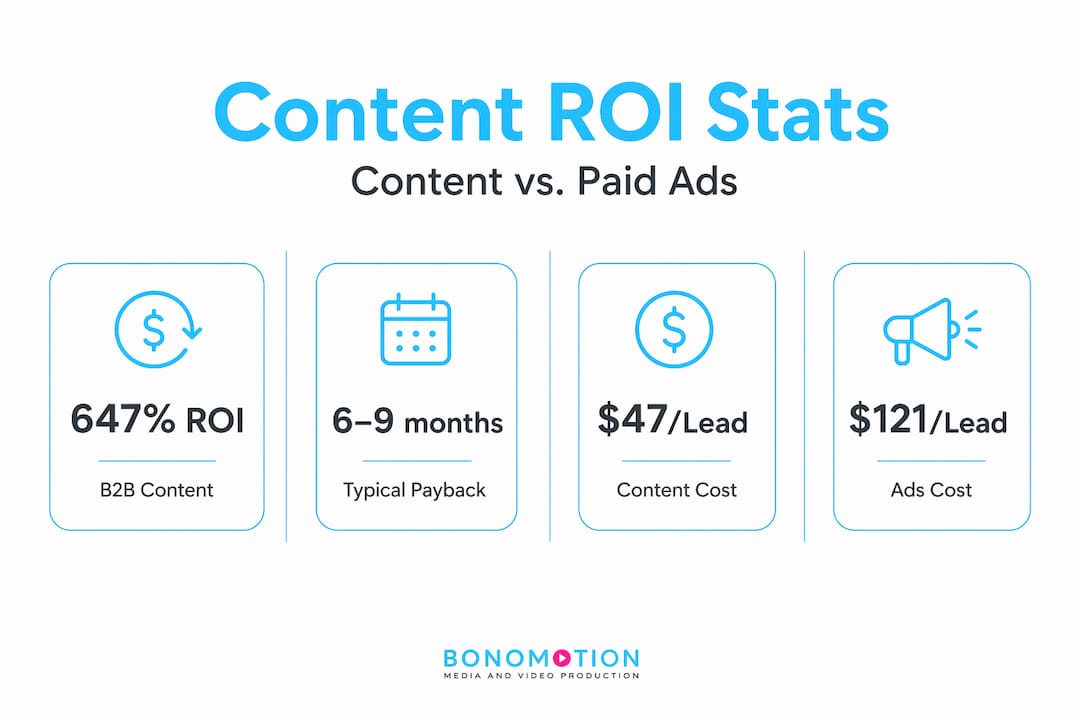
The cost comparison between content marketing and paid advertising is not subtle. Cost per lead runs $47 versus $121 for paid search. That gap does not just save budget; it fundamentally changes how much margin you have to scale lead generation across the organization.
| Metric | Content Marketing | Paid Advertising |
|---|---|---|
| Average cost per lead | $47 | $121 |
| Lead volume index | 3x more | Baseline |
| ROI (B2B average) | 647% | Varies widely |
| Longevity of results | Compounds over time | Stops at campaign end |
The B2B content marketing ROI averages 647% with payback typically beginning between six and nine months. That payback window surprises many business owners who are accustomed to seeing results from paid campaigns within days. But the returns that emerge after month twelve are a different category of asset entirely.

Here is the distinction that makes content marketing financially unique: a well-written article, a polished explainer video, or a comprehensive guide acts as a 24/7 digital asset that brings leads for years without additional spend. Paid ads stop the moment your credit card stops. Content keeps earning.
Pro Tip: Track content-attributed pipeline, not just pageviews. Connect your CMS to your CRM so you can see which articles, videos, or guides are influencing deal velocity and closed revenue.
The quality of leads also shifts meaningfully. Organic content attracts prospects who are actively searching for solutions, reading deeply, and arriving already educated. That translates into shorter sales cycles and higher close rates compared to cold audience paid traffic.
The importance of content marketing has grown more urgent as search behavior changes. 65% of all Google searches now end without a click to an external website, with the mobile zero-click rate approaching 77%. This means traditional traffic-based metrics are increasingly unreliable proxies for brand visibility.
What replaces traffic as the signal of content effectiveness? Presence. Being cited in AI-generated summaries, appearing in featured snippets, and earning what analysts now call “citation share” in AI-driven answers. Appearing in AI summaries is the new KPI that forward-thinking marketing teams are optimizing toward, not just click-through rate.
“The rise of AI search and zero-click behavior demands doubling down on content investment to maintain visibility.” — Forbes, 2026
Building genuine authority requires content that is original, deeply researched, and updated regularly. Google’s quality signals and AI citation algorithms both favor primary research, expert attribution, and content freshness. Brands that publish thought leadership backed by proprietary data get cited more often, both by journalists and by AI answer engines.
The strategic priorities for brand authority through content break down clearly:
- Publish original research or data-backed insights your competitors cannot easily replicate
- Build topical authority through consistent, interconnected content on your core subject matter
- Optimize for Answer Engine Optimization (AEO) by structuring content with clear definitions, direct answers, and structured data
- Update high-performing pieces regularly to maintain freshness signals in search algorithms
Pro Tip: Instead of publishing ten shallow posts per month, publish four deeply researched pieces and spend the remaining time updating your top-performing existing content. Freshness combined with depth is what earns AI citations.
Content formats and frameworks that compound results
Not every content format delivers equal returns. The benefits of content creation multiply significantly when you choose formats strategically and build systems for repurposing content rather than treating every piece as standalone.
-
Long-form pillar content and topic clusters. A comprehensive guide on a core industry topic, supported by a cluster of related articles, tells search engines and AI systems that your domain is an authoritative source. This architecture drives more impressions per content dollar than isolated posts.
-
Video as the anchor format. 91% of businesses now use video marketing, and 87% report positive ROI. Video earns higher engagement rates across every major distribution platform and converts at higher rates on landing pages. You can learn how content decisions around B2B video strategy affect organic and paid performance simultaneously.
-
Repurposing for reach without proportional cost. Repurposing content across formats, such as turning a webinar into a blog post, short clips, and a carousel, multiplies content reach without multiplying production cost. A single video shoot can generate a month of social content.
-
Blog consistency for compounding organic traffic. Brands that publish consistently build a content library that ranks across hundreds of long-tail queries. The traffic from post number fifty compounds with posts one through forty-nine, creating a flywheel that accelerates over time.
Pro Tip: Plan content in 90-day sprints organized around a single core topic. Every blog post, video, and social post within that sprint should reinforce the same pillar, creating cross-referencing content that strengthens your topical authority faster.
The timeline for content investment is worth stating plainly. Real compound benefits emerge in 12 to 24 months. That is not a slow marketing channel; that is a permanent, owned asset being built. CFOs who evaluate content investment on a 90-day horizon are comparing apples to infrastructure.
Pitfalls that stall content ROI
Understanding the reasons to create content is only half the equation. Knowing where investments go wrong protects you from the most common and costly mistakes.
-
Treating content as a short-term campaign. Brands that launch content initiatives expecting six-week results consistently underinvest and quit before compounding begins. Content is infrastructure, and it requires the same patience you would give an enterprise software implementation.
-
Over-relying on AI tools without human expertise. AI-assisted content is produced 65% faster, but purely AI-generated content scores 23% lower on engagement metrics. In 2026, 83% of marketers use AI tools, yet the highest-performing content teams use AI for research and drafts while relying on experienced editors and subject matter experts to shape the final output.
-
Prioritizing volume over quality. Publishing daily with thin, undifferentiated content accumulates no authority. Businesses investing $4,000 or more per post are 2.6 times more likely to report strong strategy success. Depth and originality scale results; frequency alone does not.
-
Measuring the wrong metrics. Pageviews and social impressions feel like progress but rarely correlate with revenue. Content ROI is best measured by leads, conversions, and revenue attribution. If your content dashboard does not connect to pipeline data, you are flying without instruments.
Pro Tip: Set a content performance review at month six, not month one. Assess which pieces are generating leads, not just traffic, and double down on the formats and topics that are producing pipeline.
Integrating content into your broader marketing strategy
The impact of content on business accelerates dramatically when content is treated as strategic infrastructure rather than a standalone tactic. Here is a practical framework for integration:
-
Align content goals with sales objectives. Map your content topics directly to your sales team’s most common objections, most asked questions, and the pain points your CRM reveals from lost deals. Sales enablement content that educates prospects before the first call shortens the cycle measurably.
-
Document your content strategy. Companies with a documented content strategy are 3.5 times more successful than those that operate on instinct. Documentation forces clarity on audience personas, content pillars, publishing cadence, and distribution channels.
-
Use SEO and paid channels synergistically. Content that already ranks organically can be amplified with paid promotion to accelerate results. Similarly, paid search data reveals which search terms convert, informing your organic content priorities. The two channels are not in competition; they are complementary.
-
Build a measurement framework from day one. Quality, relevance, and alignment with sales are the three drivers of content performance. Your KPIs should reflect all three, tracking not just traffic and engagement but lead quality, sales cycle length, and closed revenue attributed to content-assisted journeys.
When content is woven into your marketing ecosystem at this level, it becomes what it should always be: a growth asset, not a cost center. Understanding how video supports broader content marketing ROI is one practical starting point for teams beginning this integration.
My take on content as a long-term business asset
I’ve watched brands pour six figures into paid search, generate short bursts of lead flow, and then watch pipeline evaporate the second budget shifted. I’ve also seen companies that committed seriously to content creation for 18 months build an audience so strong that their cost of acquisition dropped by 40% without cutting a single campaign.
What I’ve learned is that the businesses which struggle to see content ROI almost always have one thing in common: they treat content as a marketing expense rather than a business asset. The mental model matters enormously. Infrastructure gets maintained and invested in. Expenses get cut when things get tight.
The rise of AI search has made this distinction more consequential than ever. Being cited in an AI-generated answer requires the kind of depth, authority, and specificity that only comes from genuine subject matter investment. You cannot automate your way to that. Human expertise and editorial judgment are what separate content that gets cited from content that gets ignored.
My honest take: the brands that will own their markets in five years are the ones building their content moats right now. The compounding nature of quality content is the closest thing to a genuine competitive moat that a marketing budget can buy.
— Bernard
Elevate your content strategy with professional video
The data on content creation ROI is clear, but knowing which formats to prioritize is where many marketing teams get stuck. Video is consistently the highest-performing format across lead generation, brand trust, and engagement metrics. And not all video is equal. Professionally produced corporate video communicates authority in ways that smartphone clips simply cannot replicate.

At Bonomotion, we have spent over 20 years helping startups, growing brands, and Fortune 100 companies translate their content strategies into high-impact video productions. From executive messaging and product launches to multi-day conference coverage and branded lifestyle campaigns, every project starts with understanding your audience and business objectives. If your content investment plan includes video and you want a production partner who operates as a true extension of your team, explore our corporate video production services or review our commercial video production offerings to find the right fit.
FAQ
What is the average ROI for content marketing?
B2B content marketing averages a 647% ROI, with most companies beginning to see payback between six and nine months after consistent investment begins.
How long does content marketing take to show results?
Initial results typically appear within six to nine months, but compound returns emerge most strongly between 12 and 24 months of consistent, quality content publication.
Why does content creation cost less than paid advertising?
Content marketing generates leads at an average cost of $47 per lead compared to $121 for paid search, and unlike paid ads, content continues generating leads long after the initial production cost is absorbed.
How does video fit into a content marketing strategy?
Video is the top-performing content format, with 91% of businesses using it and 87% reporting positive ROI. It drives higher engagement, improves SEO, and converts at superior rates on landing pages and in sales outreach.
What metrics should I use to measure content marketing success?
Move beyond pageviews and measure leads, pipeline contribution, and closed revenue attributed to content. Citation share in AI-generated answers is also becoming a critical visibility metric for brands investing in thought leadership.