

Unstructured corporate interview shoots cost more than most communication teams realize. Beyond wasted budget, they risk inconsistent messaging, off-brand visuals, and executives who leave the set frustrated. For corporate communication managers and executives across South Florida, a repeatable filming workflow is not a luxury. It is the foundation of every credible, high-impact video your organization produces. This article walks you through a proven, step-by-step process covering project scoping, pre-production, shoot-day execution, and post-production sign-off, so your next interview production runs on time, on brand, and on budget.
Table of Contents
- Assessing your project scope and requirements
- Pre-production essentials for seamless interviews
- Filming your corporate interviews efficiently
- Post-production workflow and quality checks
- Why standardized workflows beat creative improvisation in corporate settings
- Get expert help for your next corporate video project
- Frequently asked questions
Key Takeaways
| Point | Details |
|---|---|
| Plan before you film | Alignment on objectives, scheduling, and assets before production saves time and ensures message clarity. |
| Preparation is critical | Thorough pre-production tasks and documentation minimize shoot-day surprises and reduce errors. |
| Use repeatable workflows | A step-by-step process maintains brand quality and speeds up delivery across multiple projects. |
| Double-check post-production | Brand checks and timely feedback prevent expensive re-edits and protect company reputation. |
Assessing your project scope and requirements
Every successful corporate interview production starts well before a camera is turned on. The first step is getting absolute clarity on what you are trying to achieve, who needs to be involved, and what assets you already have in place. Skipping this stage is the single most common reason shoots run over schedule and over budget.
Start by defining three things: the purpose of the video, the intended audience, and the core message each interviewee must communicate. A video meant to support investor relations has a very different tone and structure than one designed for internal employee communication. Knowing this upfront shapes every decision that follows, from location selection to question framing.
Next, inventory your stakeholders. Who are the interviewees? Who approves the final cut? Who owns the brand guidelines? A clear approval chain prevents the painful situation where a finished video gets rejected at the last moment because the wrong person was not consulted early enough. Planning your video project thoroughly minimizes reshoots and ensures aligned messaging across every stakeholder.
Here is a practical checklist of assets to confirm before moving forward:
- Confirmed interviewees with scheduled availability and backup options
- Approved messaging framework or key talking points per subject
- Brand guidelines including logo files, color palette, and approved fonts
- Location options with access permissions and technical specs
- Sample questions reviewed and approved by communications leadership
- Distribution plan so the editing team knows the final format and platform requirements
The table below separates what is essential from what is helpful but not critical:
| Requirement | Essential | Nice to have |
|---|---|---|
| Confirmed shoot date and location | Yes | |
| Approved question list | Yes | |
| Brand guidelines document | Yes | |
| Teleprompter or cue cards | Yes | |
| B-roll shot list | Yes | |
| Multiple camera angles planned | Yes | |
| Branded set design elements | Yes |
For corporate video solutions at scale, this scoping phase often determines whether a project finishes in days or drags on for weeks.
Pro Tip: Confirm executive schedules at least two weeks in advance and identify a backup interviewee or reschedule window. Executive no-shows are the number one cause of costly shoot-day delays.
Pre-production essentials for seamless interviews
After confirming your goals and resources, move to detailed pre-production planning. This is where most of the real work happens, and where most teams underinvest their time.
The most important document you will create is the shot list and question guide. Writing a production script with scripted questions and a detailed schedule streamlines production and reduces on-camera hesitation from your interviewees. Questions should be open-ended, sequenced logically, and reviewed by both the communications lead and the interviewer before shoot day.
Beyond the script, pre-production involves several logistical tasks that are easy to overlook:
- Location permits and access approvals confirmed in writing
- Talent release forms signed before the shoot begins
- Technology audit covering cameras, audio recorders, lighting rigs, and all backup gear
- Briefing packets distributed to each interviewee at least 48 hours in advance
- Wardrobe and branding review to prevent on-camera conflicts with background colors or logo placement
The briefing packet deserves special attention. It should include the video’s purpose, the topics to be covered, what to wear, where to arrive, and what time to expect to be released. Interviewees who feel prepared perform significantly better on camera, and that translates directly to fewer takes and a faster edit.
For teams producing multiple interview formats, reviewing effective marketing video tips can sharpen how you frame questions and structure the narrative arc of each piece.
“The secret to compelling interviews is 80% preparation, 20% on-camera skill.”
Pro Tip: Block out explicit setup and breakdown time in every schedule. Most teams plan for the interview itself but forget that lighting alone can take 45 minutes to configure properly. Build that buffer in, or you will lose it from your shooting time.
Filming your corporate interviews efficiently
With pre-production steps complete, you are ready to execute a flawless shoot day. A streamlined filming day prevents delays and keeps talent focused, which directly improves the quality of what ends up on screen.
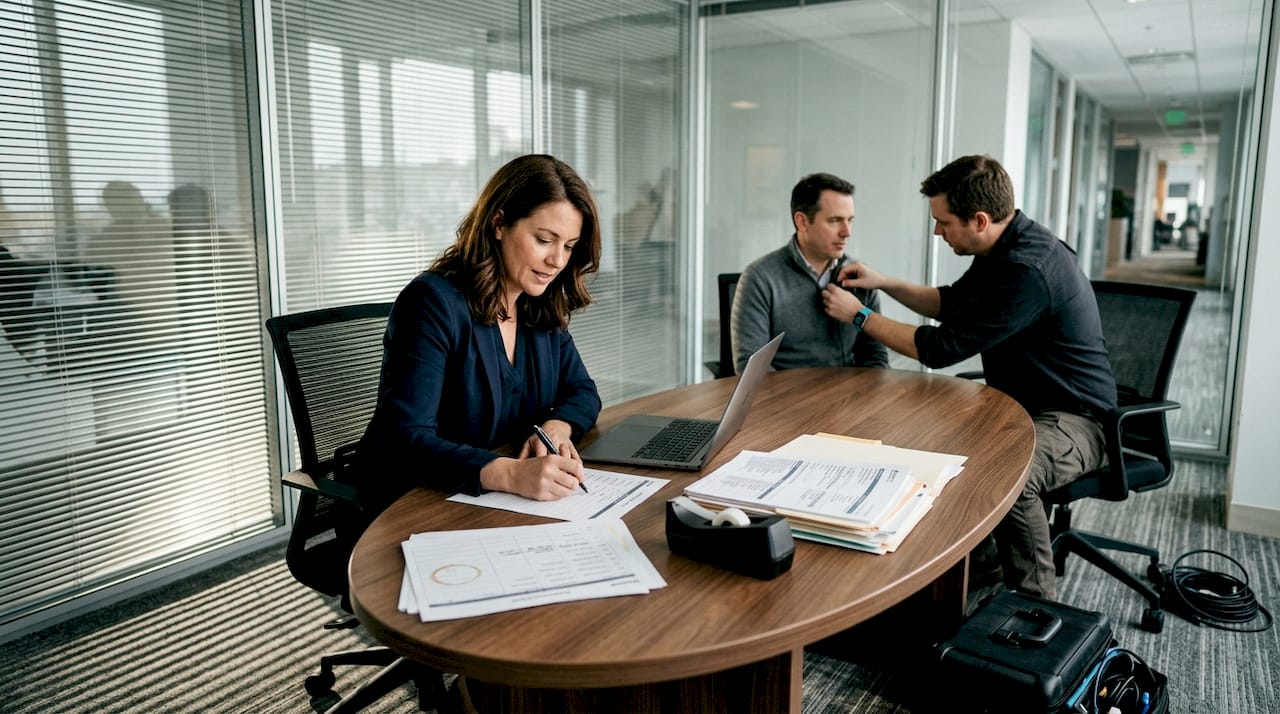
The key to shoot-day efficiency is a minute-by-minute run-of-show. Every person on set should know exactly what is happening and when. Here is a numbered walkthrough of the core sequence:
- Crew arrival and equipment setup (allow 60 to 90 minutes before first interviewee)
- Technical checks including camera framing, audio levels, and lighting balance
- Location walkthrough with the director to confirm angles and background
- Interviewee briefing on arrival, covering tone, pacing, and what to expect
- First interview block with live audio monitoring throughout
- Footage review after each interview to confirm usable takes before releasing talent
- B-roll capture while the set is still configured
- Data backup to at least two separate drives before the crew leaves the location
Role clarity matters just as much as the timeline. Assign a director to manage creative decisions, a technician to own all equipment, and a dedicated interviewer so the director can focus on performance rather than questions.
Here is a sample shoot-day timeline for a single-location, three-interview production:
| Time | Activity | Responsible |
|---|---|---|
| 7:30 AM | Crew arrival and setup | Technician |
| 9:00 AM | First interviewee arrives | Director |
| 9:15 AM | Interview 1 | Interviewer |
| 10:00 AM | Footage review and reset | Director + Technician |
| 10:30 AM | Interview 2 | Interviewer |
| 11:30 AM | Interview 3 | Interviewer |
| 12:30 PM | B-roll capture | Full crew |
| 1:30 PM | Data backup and wrap | Technician |
For guidance on what separates average from outstanding productions, reviewing best corporate video features provides a useful benchmark.
Pro Tip: Run redundant audio recording at every interview, using both the primary boom microphone and a lavalier mic clipped to the interviewee. If one fails, you will not lose the take.
Post-production workflow and quality checks
Once filming is wrapped, post-production becomes your next critical focus. This phase is where messaging is either reinforced or diluted, and where brand standards are either protected or quietly violated.
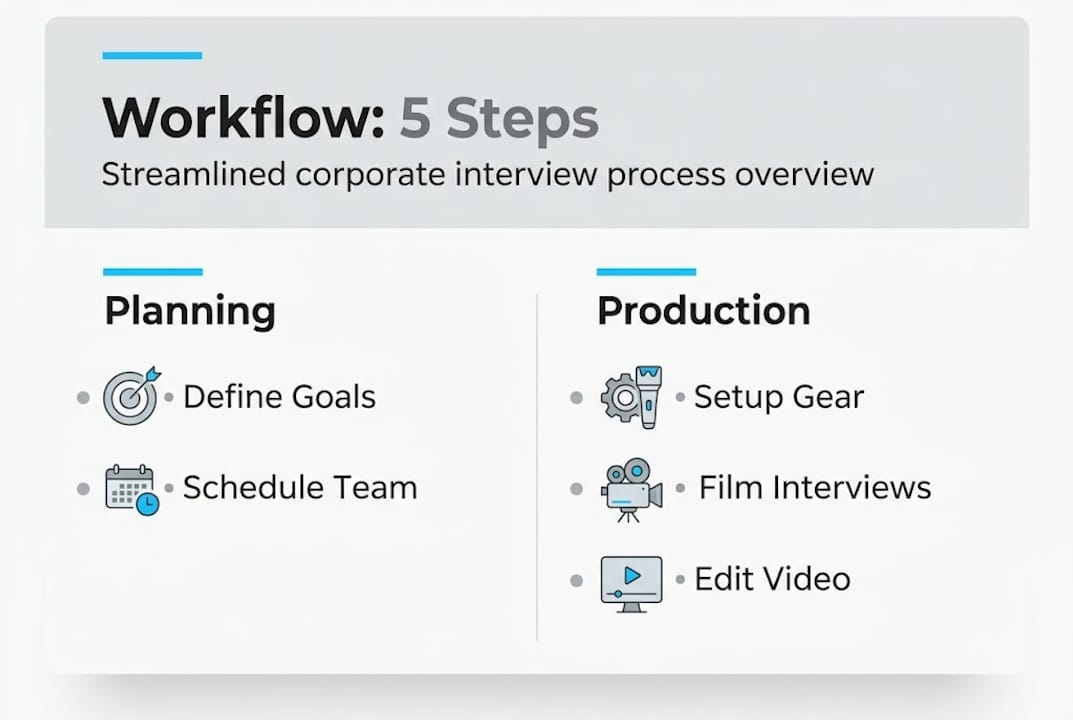
The first action after any shoot is immediate footage transfer and backup. Copy all files to at least two separate storage locations before anyone leaves the building. Losing footage to a drive failure is a recoverable situation if you planned for it, and an unrecoverable one if you did not.
From there, efficient post-production speeds up turnaround and protects brand messaging through a clear editorial sequence:
- Rough cut assembled from the best takes, shared with the communications lead for structural feedback
- Client review round with specific, timestamped notes rather than general impressions
- Revisions applied with a defined scope to prevent scope creep
- Brand and legal quality check covering logo usage, lower-third graphics, music licensing, and voice alignment
- Final delivery in all required formats for each distribution channel
The top four post-production pitfalls to avoid:
- Skipping the legal review on music and any third-party footage used
- Allowing unlimited revision rounds without a defined change-order process
- Delivering only one file format when the video will be used across multiple platforms
- Rushing the color grade to meet a deadline, resulting in inconsistent visual tone
“Brand consistency is won or lost after the cameras stop rolling.”
Pro Tip: Before editing begins, get written agreement from all stakeholders on review deadlines. A two-week review window that has no deadline attached will quietly stretch to six weeks.
Why standardized workflows beat creative improvisation in corporate settings
There is a persistent belief in some creative circles that structure kills authenticity. We have heard it often: “We want the interviews to feel natural, not scripted.” That instinct is understandable, but in a corporate context, it regularly produces unusable footage, inconsistent messaging, and frustrated executives who had to give the same answer four times because no one prepared the right questions.
The most authentic-feeling interviews we have produced were also the most carefully planned. Preparation removes anxiety, and relaxed subjects speak more naturally and confidently on camera. Standardized workflows do not constrain creativity. They protect it by eliminating the friction that derails shoots.
Look at how high-stakes industries like aviation and surgical medicine operate. They rely on checklists not because their practitioners lack skill, but because consistency saves outcomes. Brand storytelling deserves the same discipline. “Consistency is the most underrated quality in brand storytelling.”
For South Florida businesses operating in competitive markets, working with Miami video production services that bring proven systems to every project is a strategic advantage, not just a production convenience.
Get expert help for your next corporate video project
A structured workflow makes every corporate interview production faster, cleaner, and more effective. But having the right production partner amplifies those results significantly.
At Bonomotion, we have guided corporate communication teams through exactly this process since 2003, from scoping and scripting to final delivery. Our business video solutions are built for organizations that need reliable, repeatable results without the overhead of managing every production detail in-house. Whether you need a single executive interview or a multi-day conference capture, we operate as a true extension of your team. Ready to boost your brand’s image with a production partner who brings both the systems and the craft? Let’s talk.
Frequently asked questions
What is the most important step in a corporate interview filming workflow?
Thorough pre-production minimizes reshoots and confusion, making it the single most critical phase. Clear planning and communication before shoot day set the foundation for everything that follows.
How can I ensure consistent quality across multiple interview shoots?
Standardized workflows ensure consistency for brands by using repeatable checklists, defined role assignments, and structured review processes across every production.
What common mistakes should corporate teams avoid when filming interviews?
Skipping backup equipment, failing to schedule enough setup time, and neglecting proper post-production review are top pitfalls. Preparation and review stages reduce costly mistakes that affect both budget and brand quality.
When should external video production partners be brought in?
Bring in expert partners from the start if your team lacks specialized crew, high-end gear, or needs a faster turnaround than internal resources can support.