

The best customer testimonial questions ask about events, not opinions. “What do you like about us?” invites “Great team, highly recommend.” “Tell me about the week you realized the old process was costing you” invites a story. If you want testimonials that persuade buyers, build the interview around the customer’s before, their decision, their experience and their result, then add follow-ups that turn praise into specifics. On camera, a trained producer makes that conversation far easier, which is why many South Florida businesses and event organizers bring in our testimonial and interview video production team.
TL;DR
- Ask about specific moments, not feelings. Stories are believable, adjectives are not.
- Follow a four-part arc: before, the decision, the experience, the result.
- Always ask what almost stopped them from choosing you. That answer speaks to your next buyer’s doubt.
- Keep it to about six to eight core questions, send topics ahead, and never hand over a script.
- For video, ask each answer as a full sentence that restates the question, so it can be edited cleanly.
Table of Contents
- Why the wording of the question decides the quality of the testimonial
- The four-part arc to build your questions around
- Follow-up questions that turn praise into proof
- Questions for B2B and event clients specifically
- How many questions to ask, and in what order
- Preparing the customer before the camera rolls
- Turning the interview into a finished testimonial
- Where a producer changes the outcome
- Perspective
- Ready to capture testimonials that sell?
- FAQ
Why the wording of the question decides the quality of the testimonial
Customers rarely volunteer detail. Left alone, most will say something warm and general, and a warm, general quote does little for a prospect comparing three vendors. The question sets the ceiling.
Three habits separate strong testimonial interviews from weak ones:
- Open questions. Anything that can be answered yes or no gets a yes or no.
- Event-based prompts. “Walk me through the day your registration system failed” beats “What challenges did you face?”
- A reason behind every claim. When the customer says “faster,” the next question is “faster than what?”
This matters for event planners and marketers in Miami, Fort Lauderdale and Palm Beach, where buyers often choose on trust and referrals. A testimonial that names the problem, the stakes and the outcome does that work for you.
The four-part arc to build your questions around
Good testimonials follow a simple story. If you ask questions in sequence, the answers assemble into something you can use almost as spoken. Organize your list into four blocks.
Before: what was happening
This is the context that makes everything after it matter. Ask:
- What was happening in your business when you started looking for help?
- How did you handle this before? Who was involved?
- What was the hardest or slowest part of that process?
- What was it costing you in time, money, or stress?
- What had you already tried?
A testimonial without a problem is an endorsement, not a story. Event organizers can adapt these directly: “What was your last event like, and where did production fall short?”
The decision: why they chose you
This block carries the positioning value. Ask:
- How did you first hear about us?
- What were you looking for in a provider?
- Which other options did you consider?
- What almost stopped you from signing on?
- What made you decide?
Resist a single “why did you choose us?” It tends to produce a tidy summary. Separate questions about what pulled them in and what held them back give you the raw material behind it.
The experience: what working together was like
Make this concrete. Ask:
- What did the process look like from your side?
- Describe a moment when something went wrong or changed, and what happened next.
- Who on your team worked with us, and what did they notice?
- What surprised you?
For event clients, ask about the day itself: load-in, speakers, guests, last-minute changes.
The result: what changed
This is where numbers belong, but only numbers the customer can explain. Ask:
- What changed after we finished?
- Is there a number you can point to: hours saved, leads, attendance, registrations, a closed deal?
- What was that number before, and what is it now?
- Where does that number come from, and over what period?
- Who would you recommend us to?
If the customer cannot say how they know a figure, leave it out of the video.
Follow-up questions that turn praise into proof
The first answer is usually general. The follow-up is where the testimonial is made. Keep follow-ups neutral so you are not putting words in the customer’s mouth.
| The customer says | Follow up with |
|---|---|
| “It was so easy.” | “Which part was easier than you expected? What did the old way involve?” |
| “It saved us a lot of time.” | “Whose time, on which task, and over what period?” |
| “The team was great.” | “Tell me about a moment when you saw that.” |
| “Faster than before.” | “Faster than what?” |
| “Our numbers went up.” | “What were they before? What else changed in the same period?” |
| “Highly recommend.” | “Who would you recommend us to, and what should they know going in?” |
The last two rows do double duty. They add credibility and protect you from publishing a result that the customer’s own team knows had another cause. A claim in a testimonial should be backed by the same evidence you would need if you made the claim yourself, and the Federal Trade Commission’s endorsement guidance treats it that way. Confirm each figure with the customer before it goes public.
If you want to see how verification fits into a wider social proof approach, this look at social proof strategies that lift engagement is a good companion.
Questions for B2B and event clients specifically
Our readers are mostly marketing teams, event organizers and local businesses, so generic consumer prompts only go so far. Adapt them.
For a corporate client
- What internal goal was this video or project supporting?
- How did the project fit into your launch, campaign or quarter?
- How did your leadership or sales team use the finished piece?
For an event organizer or planner
- What was the scale of the event: attendees, sessions, rooms, days?
- What worried you most about capturing it?
- What did you do with the footage and photos afterward?
- Would you book coverage again for next year’s event?
For a real estate or yacht client
- How were you presenting listings or vessels before?
- What kind of inquiries did you get after the new content went live?
These questions point toward business outcomes, which is what buyers in these categories care about. For more on where testimonial footage fits in your content mix, see our guide to what a testimonial video is.
How many questions to ask, and in what order
People will give you a limited amount of time. For a quick written testimonial or a short survey, keep the list to six or seven questions. For a recorded video, plan a 30 to 45 minute conversation, which gives you room for follow-ups and a couple of retakes.
A practical order for a recorded interview:
- Easy warm-up: name, role, company, what they do.
- Before: the problem and its cost.
- The decision, including what almost stopped them.
- The experience, with one specific moment.
- The result, with a number and how they know it.
- Recommendation and who it suits.
- A closing check: is there anything they would rather not have mentioned?
Match the subset to the placement. A homepage clip might use only before, result and recommendation. A longer case study video can use all four blocks.
Preparing the customer before the camera rolls
Most weak testimonial footage is a preparation problem, not a question problem.
- Do your homework. Review the project history, notes and any support conversations so you can ask about real moments.
- Choose the right person. The decision maker explains the why. A daily user explains the how. Interviewing both gives you range.
- Send topics, not a script. Share the themes a few days ahead and write out any number questions so the customer can look up figures. A memorized script sounds like one.
- Get permission in writing. Confirm recording consent and how the footage will be used, before the shoot.
- Coach the answer format. Ask customers to answer in complete sentences that include the question’s words, so a clip makes sense without your voice.
Turning the interview into a finished testimonial
After the shoot, work from the transcript. Mark every line that does one of six jobs: the result, who the customer is, the problem, how they use the service, what changed, and the recommendation. Note timecodes, arrange the lines in story order and read them aloud against a timer. A strong cut of around 75 seconds can open on the result in the customer’s own sentence, then back up to the problem.
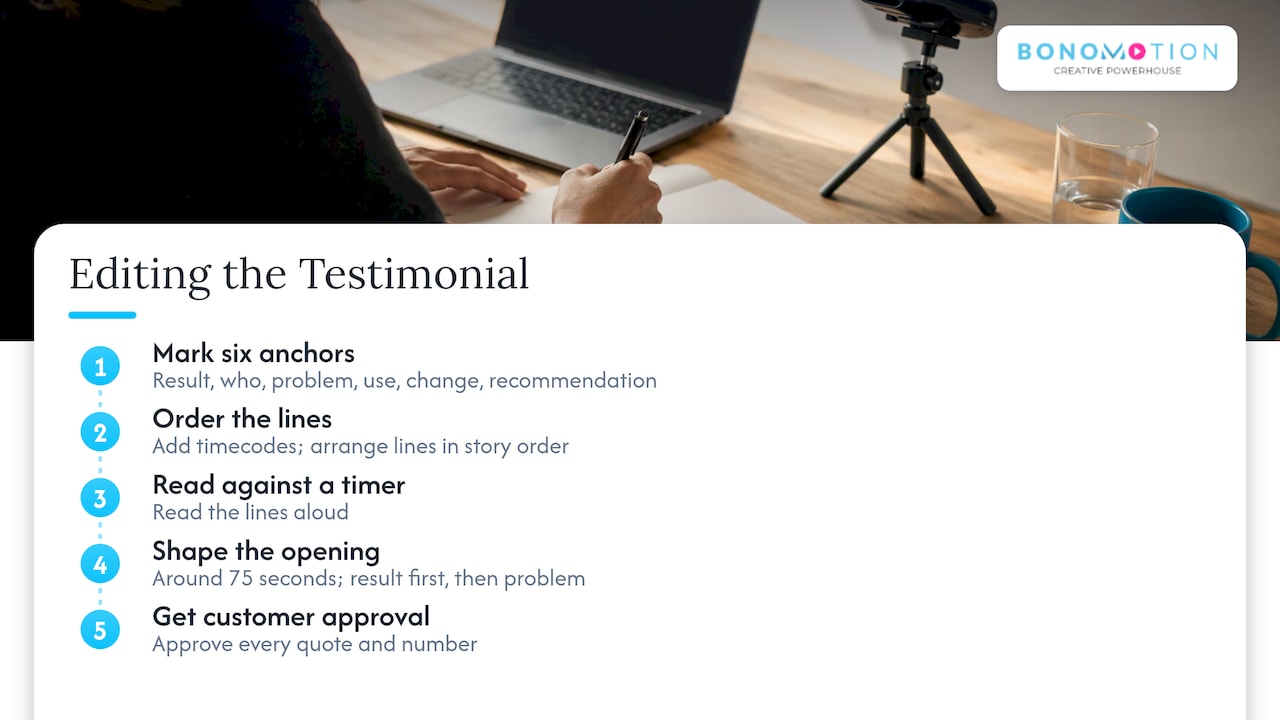
Send the draft to the customer for approval of every quote and number before publication. It protects the relationship, and it protects the accuracy of what you publish.
Where a producer changes the outcome
The questions are the script behind the scenes. The rest is lighting, sound, framing, pacing and putting a nervous customer at ease. Our testimonial and interview work is guided by an experienced producer who works with your team to understand your objectives, audience and timeline. You can see how that looks in our interview demo, and read more on building trust with real voices.
If you are gathering testimonials from event attendees, sponsors or exhibitors, our event videography and photography service can capture those conversations on site while the energy is fresh.
Perspective
We have been producing video in South Florida since 2003, and the pattern is consistent: the testimonials that move buyers are not the most polished ones, they are the most specific ones. A customer who describes the week their event nearly fell apart, and what changed, is more persuasive than any narrator.
That is why we build interviews around a producer who understands your goals before the camera turns on. The producer shapes the questions, listens for the detail behind each answer and knows which follow-up to ask. The result is a story your next prospect recognizes as their own.
Great testimonials are collected, not scripted. Our job is to make the customer comfortable enough to tell the truth well.
Bernard Bonomo
Ready to capture testimonials that sell?
If you have the customers and the questions but want the footage to look and sound the part, we handle testimonial and interview production for businesses and event organizers across Miami, Fort Lauderdale, Coral Gables and Palm Beach, and nationwide. Start with our testimonial and interview video service and tell us about the customers you want to feature.
You can also browse our video production portfolio to see the range of work.
FAQ
What are good questions to ask for a customer testimonial?
Start with what was happening before they chose you, then ask why they decided, what the experience was like and what changed. Include one question about what almost stopped them, and one asking for a specific result and how they measured it. Those five themes cover most of what a prospect wants to know.
How many questions should a testimonial interview have?
For a written or survey testimonial, six or seven is enough. For a recorded video, prepare around eight core questions and leave room for follow-ups in a 30 to 45 minute session. More than that tends to produce rushed, repetitive answers.
How do I get a customer to give specific answers instead of general praise?
Ask about events rather than opinions, such as a specific time a problem cost them. Then follow vague words with neutral prompts like ‘faster than what?’ or ‘what happened next?’. Sending topics a few days ahead also gives them time to find real numbers.
Can I use the same questions for video and written testimonials?
Yes, the core arc of before, decision, experience and result works for both. For video, add a request to answer in full sentences and allow more time for follow-ups, since the best moments often come after the first answer.