
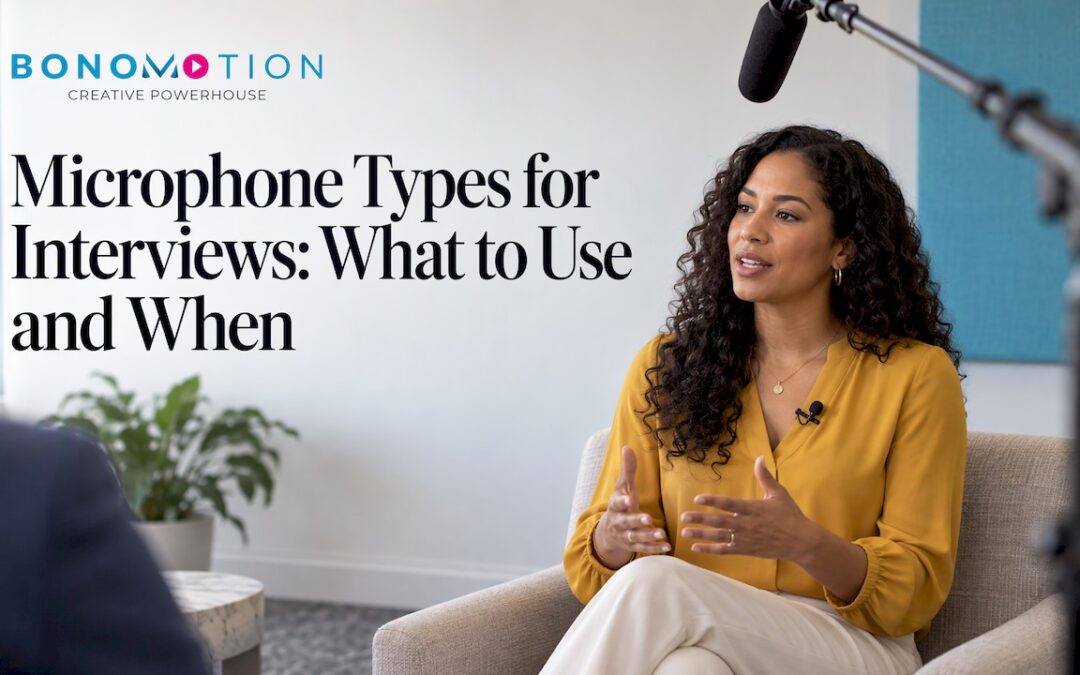
For most business interviews, the best setup is a lavalier clipped to the speaker plus a shotgun microphone just out of frame. The lav gives you close, consistent voice. The shotgun gives you a natural-sounding backup. A handheld dynamic mic is the right tool when you are moving, shooting in a loud room, or running a quick on-the-spot interview. Below, we explain how each type works, where it shines, and how we think about audio on interview shoots across Miami, Fort Lauderdale, Coral Gables and Palm Beach.
TL;DR
- Lavalier mics are small, sit 6 to 8 inches from the mouth, and keep your sound consistent no matter how the camera is framed.
- Shotgun mics are directional, pick up what they point at, and sound more natural, but they need to be placed close and kept out of the shot.
- Handheld dynamic mics are rugged, need no battery, and suit noisy events and fast, run-and-gun interviews.
- Two mics beat one. Recording a lav and a shotgun on separate channels protects you when clothing rustles or a transmitter gets bumped.
- Streaming an interview live? Your audio chain matters first, then your protocol: RTMP is widely supported, SRT handles unstable networks better.
Table of Contents
- The three ways to capture interview audio
- Pickup patterns: why mics hear differently
- Lavalier vs. shotgun: which one for your interview?
- Handheld interview mics: the reliable workhorse
- Choosing the right mic for the situation
- Placement that makes the mic sound better
- Our perspective on interview audio
- Audio for corporate video: a short checklist
- Streaming an interview live: RTMP vs. SRT
- Let us handle the audio on your next interview
- FAQ
The three ways to capture interview audio
Every interview setup comes down to where the microphone sits relative to the speaker’s mouth. Sound quality depends mostly on distance: the closer the mic, the louder the voice is compared with the room. That is why a cheap mic placed well often beats an expensive one placed badly.
There are three common approaches:
- On-camera mic. Mounted on the camera. Convenient, but usually too far from the speaker, so it picks up room echo, air conditioning and traffic along with the voice.
- Lavalier (lapel) mic. A small clip-on mic attached to clothing, wired or wireless.
- Shotgun or boom mic. A long, rod-shaped directional mic held or mounted just above or beside the frame.
A fourth option, the handheld interview mic, is the classic choice for reporters and event interviews. We cover it below.
Pickup patterns: why mics hear differently
A pickup pattern describes the directions from which a microphone captures sound. Understanding four of them solves most buying and renting decisions.
- Omnidirectional: hears equally from all directions. Most clip-on lavs work this way, which is why placement close to the mouth matters so much. Omni designs also tend to handle wind and breath pops well.
- Cardioid: most sensitive in front, with the least pickup directly behind. It is the most common directional pattern and a strong choice when the room is noisy or several people are talking close together.
- Supercardioid and hypercardioid: narrower in front than cardioid, with more rejection to the sides but a small pickup lobe at the rear. Many boom mics use these patterns.
- Shotgun: the most directional design. It rejects sound from the sides and focuses on where you aim it, a bit like looking through a paper towel tube. A longer barrel means a tighter focus.
One common misunderstanding: a shotgun does not make a distant voice sound close. It simply ignores much of what is off to the sides. If you aim it from too far away, you still get room sound.
Lavalier vs. shotgun: which one for your interview?
This is the question we hear most from marketing teams planning a corporate interview. Here is a side-by-side view.
| Factor | Lavalier (lapel) | Shotgun (boom) |
|---|---|---|
| Placement | Clipped about 6 to 8 inches below the chin | Overhead or just out of frame, typically within a foot or two of the speaker |
| Consistency | Constant close sound, whatever the framing | Changes if the speaker moves out of the aim |
| Visibility | Visible on wide shots unless hidden | Never in frame when placed correctly |
| Tone | Narrower, can sound boxed in from chest resonance | Fuller and more natural |
| Risks | Clothing rustle, bumps, jewelry, transmitter issues | Room echo, handling noise, needs a boom operator or stand |
| Best for | Sit-down interviews, wide shots, moving speakers, multiple speakers | Fast interviews, scenes where a visible lav would distract, clients who do not want clips on wardrobe |
When the lavalier wins
Choose a lav when the camera framing will change, when your subject walks or gestures a lot, when the shot is wide, or when you are interviewing several people who each need their own mic. A hard-wired lav clipped to a lapel is often an excellent choice for a seated interview, because there is no battery or radio signal to worry about.
Professional interviewers widely mic most of their interviews this way. The lav may not offer the same tonal range as a shotgun of similar price, but its convenience and consistency make it an industry standard.
When the shotgun wins
Choose a shotgun when you have no time to mic the subject, when you want the cleanest, most natural tone, or when an executive prefers nothing attached to a jacket. For stationary speakers, the shotgun can sit on a stand or C-stand pointing toward the mouth. For moving subjects, you need an experienced boom operator.
A shotgun works best when it is close. As a working rule, keep it roughly 8 to 16 inches from the speaker for sit-down interviews. Go much farther and you start hearing the room.
Lav vs. boom: the honest answer
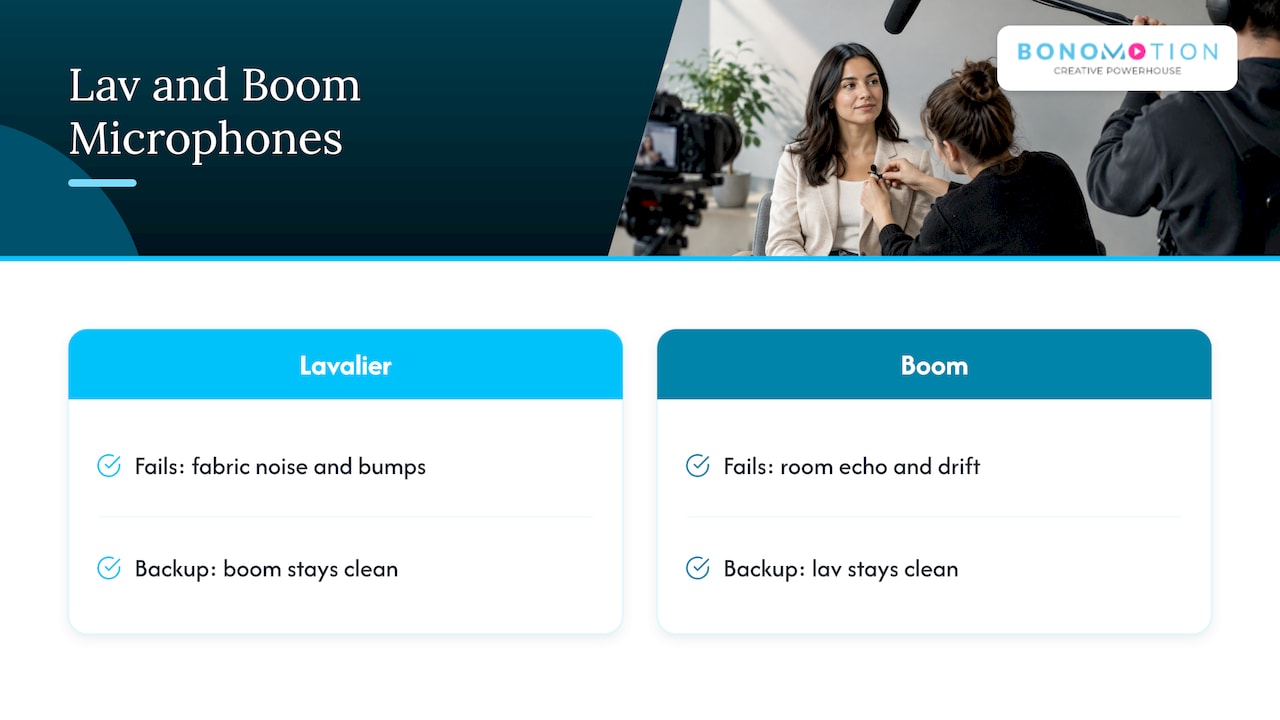
When people search for lav vs. boom, they are usually hoping for a single winner. On a professional shoot, the answer is both. The two mics fail in different ways. A lav fails with fabric noise and bumps. A boom fails with room echo and placement drift. Using both means one of them is almost always clean.
Handheld interview mics: the reliable workhorse
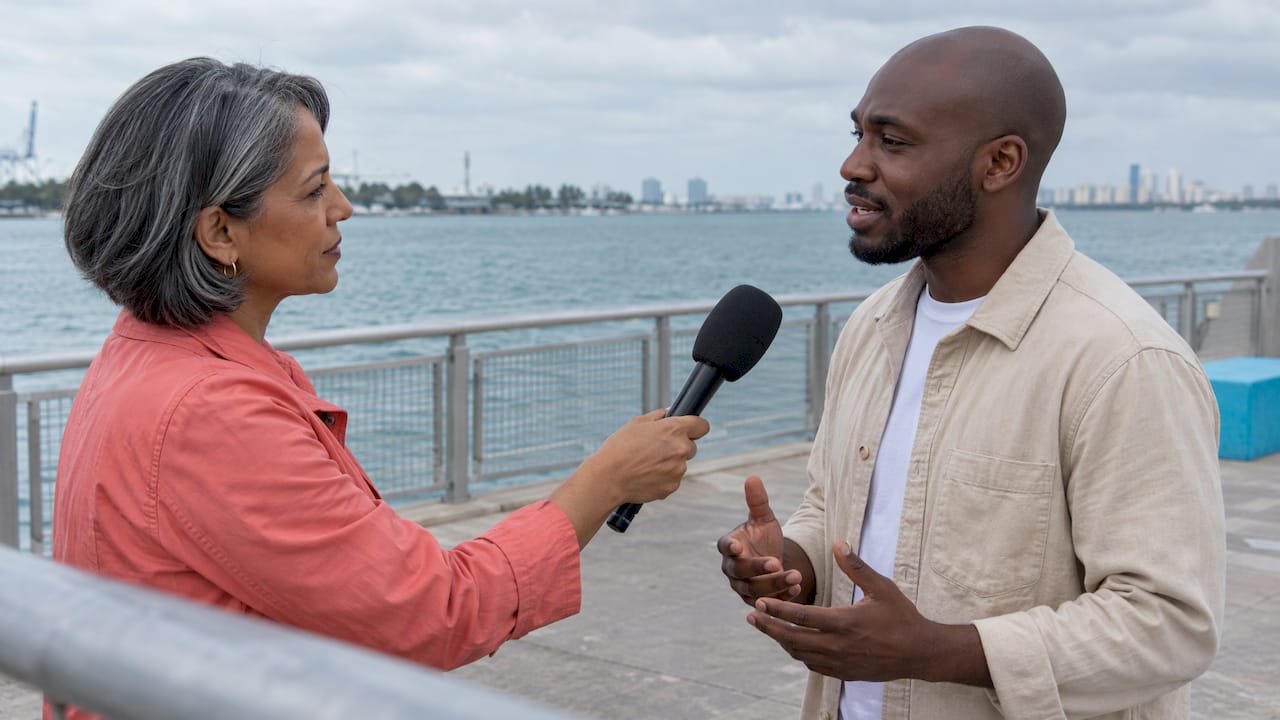
The handheld dynamic microphone is the classic news and event interview tool, and for good reason. It uses a dynamic element that needs no battery or phantom power, so there is less that can go wrong. It is built for rough handling, and the design keeps handling noise, wind and breath pops low.
Two patterns dominate:
- Omnidirectional handhelds let the interviewer and guest share one mic and tolerate wind and pops well. Because they hear everything, you must hold them close to the person talking.
- Cardioid handhelds isolate the voice better in a loud environment. They are the better pick at a crowded expo, a trade show floor or a noisy reception.
On-camera handhelds also double as a visual cue. A branded mic flag tells viewers who is interviewing, which is useful for event interviews, conference coverage and on-site testimonials.
Choosing the right mic for the situation
A quiet office in Brickell or Coral Gables
Office interviews are where most corporate video happens, and the main enemies are echo and air conditioning. Glass walls and hard floors reflect sound. A lav keeps the mic close enough to beat the room. If you want a second source, add an overhead shotgun. Turn off any noisy HVAC cycle if building management allows it, and ask for a quieter room away from elevators.
Outdoors on a Miami waterfront or a Palm Beach terrace
Wind, boats, traffic and the occasional low-flying plane make outdoor interviews unforgiving. Use windscreens on every mic. An omnidirectional lav held close under the chin, or a handheld mic, is typically more forgiving of wind than a long shotgun. Pick your spot with the wind at the speaker’s back when you can, and avoid facing the highway.
Conferences and live events
Multi-speaker, noisy environments reward directional handhelds and wireless lavs. For panel discussions, give each speaker their own mic and record each on its own channel. Our guide to choosing video equipment for corporate events covers how that fits into a full event kit, and our conference video production page shows how we document key moments.
Quick, run-and-gun interviews
If a speaker walks up and you have two minutes, a shotgun on a boom pole or a handheld is faster than pinning a lav. When time allows, add the lav.
Testimonials and customer interviews
Testimonials usually need warmth and consistency, since the clip may be reused on your website, in ads and at events. A lav plus a backup shotgun is a sensible default. If you are planning a testimonial series, see how we handle interview and testimonial video production.
Placement that makes the mic sound better
The right mic in the wrong spot still sounds wrong. These steps apply to nearly every interview.
- Scout the room first. Listen for fans, refrigerators, fluorescent buzz, hallway noise and echo. Fix what you can before you set up.
- Place the lav 6 to 8 inches below the chin, centered on the chest, in a thumbs-up distance from the mouth. Too high and you get breath noise. Too low and the voice thins out.
- Hide the cable and dress the clothing. Run the cable under a shirt, secure it with tape or a clip, and avoid placing the mic where a jacket lapel or necklace can brush it.
- Position the shotgun above the speaker and aim it toward the mouth, out of frame. A stand or boom works for a seated guest. Keep it as close as the shot allows.
- Record on separate channels. Put the lav on one channel and the shotgun on another so you can choose the cleaner track in editing. This is the safety net that saves interviews.
- Monitor with headphones. Do not trust the meters alone. Listen for rustle, hum and echo during the first answer, not after the shoot.
- Run a short sound check. Have the speaker say their name and what they had for breakfast. Natural speech reveals problems that counting does not.
A producer who has done this hundreds of times learns the small habits that matter: asking guests to remove noisy jewelry, checking for a phone buzzing in a pocket, and pausing the interview when a helicopter passes.
Our perspective on interview audio
Viewers forgive a slightly soft image. They do not forgive bad sound. In more than 20 years of producing corporate, event and testimonial video, we have seen a strong interview lose its impact because the audio was thin, echoey or full of rustle.
That is why we treat sound as a production decision made in the planning stage, not a fix for post-production. When a producer plans an interview with you, we look at the room, the speaker, the framing and the final use of the video, then choose the mics to match. For most sit-down interviews, that means two sources recorded separately.
The goal is simple: your executive, customer or expert should sound as credible as they look. Clear audio builds trust, and trust is what turns a video into a sales tool.
Bernard Bonomo
Audio for corporate video: a short checklist
Corporate video has its own rules. Interviewees are often not used to being recorded, schedules are tight, and the video may live for years on a website and in presentations.
- Plan the use. A homepage brand film, a recruiting video and an internal training clip may need different mic choices and framing.
- Ask about wardrobe. Silk, stiff fabrics and heavy jewelry create noise near a lav. Cotton and soft knits are quieter.
- Give people a moment. A speaker who is comfortable talks more naturally, which also helps the mic. Tools such as a teleprompter can help executives stay relaxed, as we explain in our guide to teleprompters for interviews.
- Keep a backup. Always have spare batteries, a spare lav and a second recording source.
- Follow a workflow. A clear process from pre-interview call to final delivery keeps audio problems from showing up late. Our corporate interview filming workflow breaks that down in five steps.
- Think about music. Under an interview, music must never compete with the voice. See our notes on choosing music for video production.
If you are building a kit rather than hiring a crew, our essential video production equipment guide is a useful starting point.
Streaming an interview live: RTMP vs. SRT
Live interviews add a second question: how does the audio and video travel from your location to the platform? Two protocols come up most often.
RTMP is the long-standing standard for sending a stream to a platform. It runs over TCP, and typical latency is a few seconds. It is supported by nearly every streaming service and encoder, which is why it remains the default for many corporate streams.
SRT is an open-source protocol built for sending video over unpredictable networks. It runs over UDP, recovers lost packets, lets you tune a buffer for the connection, and includes built-in encryption. Latency is generally lower than RTMP, and it is more stable on weak or long-distance connections, which makes it a good fit for outdoor or remote interviews.
How to decide:
| Situation | Better fit |
|---|---|
| Streaming to a platform that only accepts one option | Whichever the platform accepts, usually RTMP |
| Venue with a weak or shared internet connection | SRT, if your encoder and destination support it |
| Remote guest or outdoor location | SRT |
| Simple, well-supported setup with a stable wired connection | RTMP |
Neither protocol fixes bad audio. Whatever you pick, the same rules apply: close mic placement, separate channels where possible, monitoring on headphones and a tested backup connection. For live work, see our live streaming services, our live event streaming guide and our advice on choosing a camera for live streaming.
Let us handle the audio on your next interview
Getting interview audio right takes the right mics, the right placement and a producer who has solved these problems before. At Bonomotion, a dedicated producer guides your project from concept to delivery, and we serve businesses, event planners and marketing teams across Miami, Fort Lauderdale, Coral Gables, Palm Beach and beyond. We also offer studio and camera and equipment rentals.
If you are planning executive messaging, customer testimonials or a multi-speaker event, tell us about the room, the speakers and where the video will live. Explore our corporate video production service or contact Bonomotion to request a custom proposal.
FAQ
What is the best microphone type for a sit-down interview?
A lavalier on the speaker, paired with a shotgun microphone just out of frame, is the most dependable setup. The lav keeps the voice close and consistent, while the shotgun offers a more natural tone and a backup. If you can only use one, a lav is usually the safer pick for seated speakers.
Is a lavalier or a shotgun mic better for interviews?
Neither wins every time. A lav suits wide shots, moving speakers and multiple people. A shotgun suits quick interviews and situations where you do not want anything clipped to clothing. Professionals often use both and record them on separate tracks.
Where should I place a lavalier microphone?
Clip it about 6 to 8 inches below the speaker’s chin, centered on the chest, and hide the cable under clothing. Keep it away from jewelry, lapel edges and scarves that can brush it. Test it with a few sentences of natural speech before recording.
Do I need a handheld mic for event interviews?
A handheld dynamic mic is a strong choice at noisy events, since it is rugged, needs no battery and keeps the voice close. A cardioid handheld isolates the speaker better in a crowd. For polished sit-down interviews, a lav and shotgun combination usually sounds more natural.
Should I use RTMP or SRT for a live interview stream?
Use RTMP when you want the widest compatibility with streaming platforms and have a stable connection. Use SRT when the network is weak, the location is remote or you want lower delay and encryption. Check what your encoder and destination both support before the event.