

Most marketing professionals hear “event branding video” and picture a highlight reel or a speaker montage dropped on YouTube after the conference ends. That interpretation undersells what this medium can actually do. An event branding video is a strategically produced asset that communicates your brand’s personality, values, and market position through the context of a live experience. It captures not just what happened, but who you are as an organization. This article breaks down the definition, production standards, strategic benefits, and step-by-step creation approach so you can use event video as the business tool it was always meant to be.
Table of Contents
- Key takeaways
- What is an event branding video?
- Production standards for professional event videos
- Strategic benefits of event branding videos
- How to create event branding videos
- Common mistakes that undermine event videos
- My honest take on event branding video
- Ready to produce your next event branding video?
- FAQ
Key takeaways
| Point | Details |
|---|---|
| More than a recap | Event branding videos communicate brand identity and values, not just document what happened. |
| Strategy before camera | Aligning your video brief with business objectives before filming determines whether the final product earns ROI. |
| Multi-phase content planning | Pre-event, live, and post-event content each require distinct formats and audience targeting to maximize reach. |
| Distribution drives results | A finished video without a distribution plan is an archive, not an asset. Plan channels before production begins. |
| Avoid aesthetics-first thinking | Leading with visuals over strategy is the most common reason event videos fail to move business metrics. |
What is an event branding video?
An event branding video is a purpose-built production that captures a corporate event, conference, product launch, or brand experience and shapes that footage into a cohesive narrative aligned with your organization’s identity. The key word is purpose-built. Generic event documentation records what took place. An event branding video uses the event as raw material to tell a story about your brand, your people, and the value you deliver to your audience.
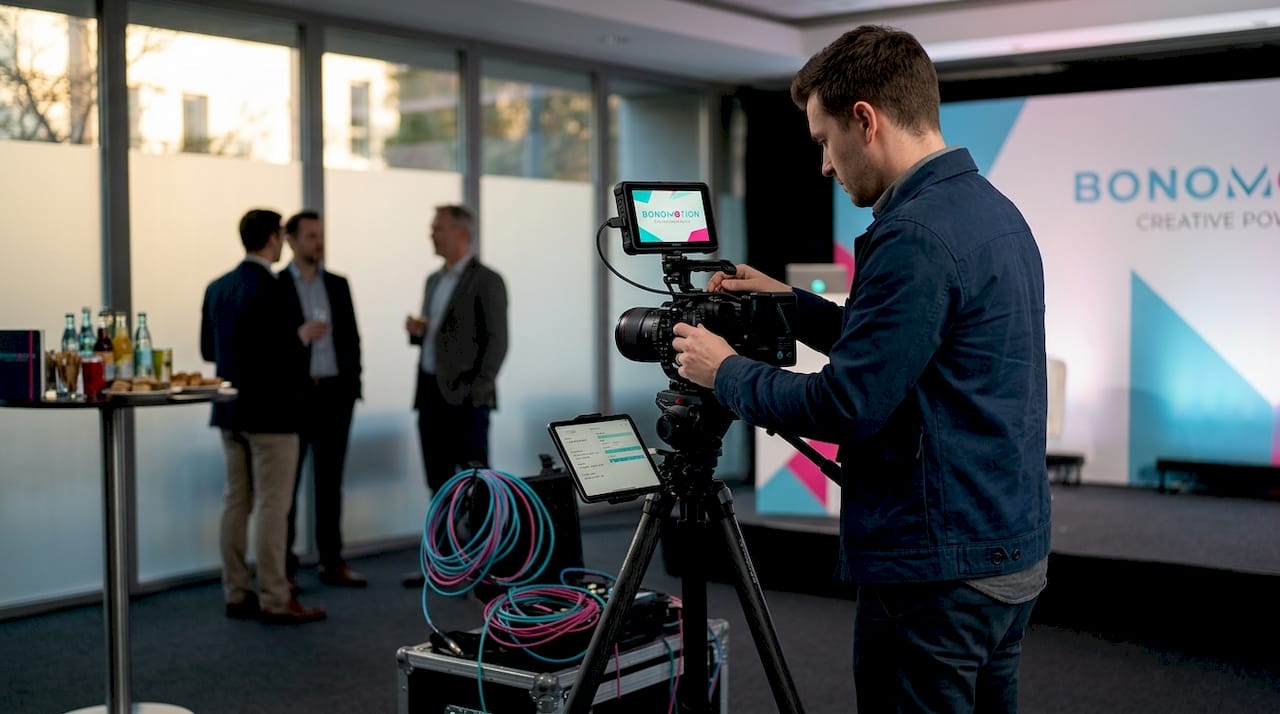
Think about the difference this way. A documentary crew at a music festival records performances. A brand film crew at that same festival captures the emotion, the community, the exclusivity, and the lifestyle the brand represents. Both crews point cameras at the same stage. Only one produces content that functions as a marketing asset.
This distinction matters because strong event branding answers a fundamental set of questions for your audience: who you are, what you stand for, and why someone should engage with you right now. When your video production is designed to answer those questions, every shot and sound bite becomes intentional.
Here is what separates an event branding video from a generic recap:
- Strategic framing. The narrative is built around a business objective, not just a chronological sequence of events.
- Brand visual language. Color grading, motion graphics, lower thirds, and typography reflect your established brand standards throughout.
- Targeted messaging. The content speaks to a specific audience segment, whether that is prospects, existing clients, sponsors, or potential hires.
- Multiple deliverable formats. A single production generates assets optimized for LinkedIn, sales decks, email campaigns, and your website simultaneously.
- Emotional design. The editing, music, and pacing are chosen to generate a specific feeling that reinforces brand perception.
When an event branding video hits all five markers, it functions as a persuasive tool long after the event ends.
Production standards for professional event videos
Quality matters in event branding video because production values communicate brand values. If your video looks like it was shot on a phone with inconsistent audio, it signals something about your organization that you almost certainly do not intend. Professional production sets the credibility floor.
Professional event videography packages typically include 4K multi-camera coverage and post-production services like color grading and motion graphics. Multi-camera setups allow editors to cut between wide establishing shots, tight interview framings, and crowd reaction angles. The result is a dynamic visual rhythm that holds viewer attention across a two to three minute brand film.
Audio capture deserves equal attention. Wireless lapel microphones on speakers, dedicated boom operators in breakout rooms, and room tone recordings all feed into a post-production mix that makes spoken content clear and authoritative. Poor audio kills viewer trust faster than shaky footage.
On the post-production side, the work that follows the shoot is where brand identity gets baked into the footage:
- Color grading aligns the footage to your brand palette and creates visual consistency across multiple cameras and lighting conditions.
- Motion graphics and lower thirds introduce speakers with their titles, reinforce key messages on screen, and maintain your brand’s typographic system.
- Music licensing sets emotional tone and pacing without copyright risk.
- Multi-format delivery produces vertical cuts for Instagram Stories, square cuts for LinkedIn feeds, widescreen versions for website embeds, and compressed files optimized for email.
Pro Tip: Build your multi-format delivery requirements into the production brief before filming begins. Trying to adapt a widescreen master cut into vertical formats after the fact often means losing critical visual information and reframing entire sequences.
Logistics planning is the unglamorous part that separates professional productions from expensive disappointments. Venue walkthroughs, equipment load-in timelines, run-of-show access for camera operators, and coordination with event AV teams all require advance planning. At Bonomotion, every event production is assigned an experienced producer who handles these logistics before a single camera rolls.
Strategic benefits of event branding videos
The business case for event branding video extends well beyond having content for social media. When aligned with business goals like lead generation or community building, these productions generate measurable ROI that justifies the production investment.
Here are the most concrete applications where event branding videos deliver compounding value:
- Sales and prospecting. A polished brand film from your annual summit, product launch, or client event gives your sales team a tool that communicates credibility instantly. Prospects who were not at the event experience the energy, the quality of your speakers, and the caliber of your attendees through the video.
- Sponsor acquisition and renewal. Sponsors need evidence that their logo placement reaches an engaged audience. A professional event video with clear sponsor visibility, distributed across your channels, is one of the most convincing assets in any sponsorship deck.
- Recruitment. Culture is hard to communicate in job postings. A video that captures your team in action at a company-hosted event says more about your organization in ninety seconds than three paragraphs of “we value innovation.”
- Community and brand recall. Professional editing and branded visuals increase viewer engagement and perceived professionalism. Attendees who see themselves represented in your video share it within their own networks, amplifying your reach organically.
“Event videos must align with the master brand to deepen relationships and drive recall.” — Miller Tanner Associates
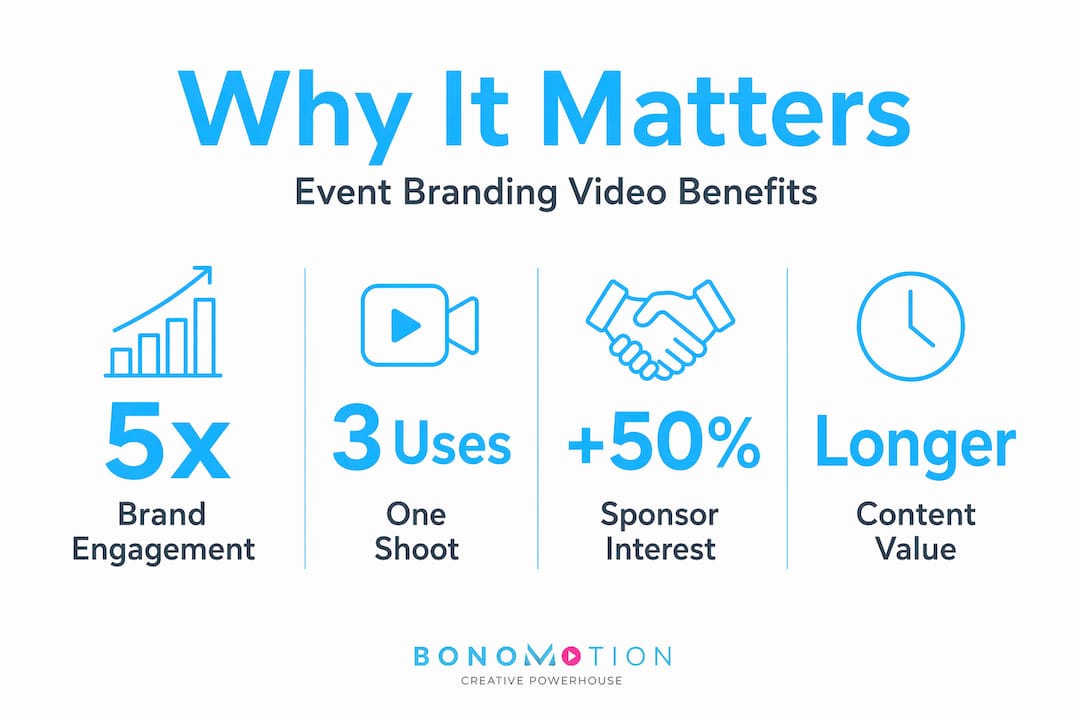
The compounding effect is real. A single day of filming at a well-run conference can produce a flagship brand film, ten to fifteen social clips, speaker spotlights for LinkedIn, a sizzle reel for next year’s sponsor pitch, and b-roll for future campaigns. The ROI of event video multiplies when you treat the production as a campaign rather than a one-off deliverable.
How to create event branding videos
The most common production failure happens before anyone calls action. Teams hire a crew, brief them on the schedule, and expect a great brand film to emerge from the footage. It does not work that way. Creating an effective event branding video starts with a documented brief that connects the production to specific business objectives.
Event video requires pre-event, live, and post-event content planning to optimize reach and ROI, with each phase requiring unique formats and audience considerations.
The table below maps each phase to its deliverables and primary function:
| Event phase | Content type | Primary function |
|---|---|---|
| Pre-event | Teaser clips, speaker announcements, countdown content | Build anticipation, drive registration |
| Live | Real-time social clips, same-day highlight reels | Capitalize on real-time buzz, amplify reach |
| Post-event | Brand film, speaker cut-downs, email nurture clips | Sales enablement, ongoing brand awareness |
Same-day highlight reels maximize social media engagement by capitalizing on real-time event buzz, and the demand for quick turnaround deliverables has grown significantly. Plan your crew and edit workflow in advance if you intend to publish within 24 hours.
Pro Tip: Map your video brief to one primary business objective and no more than two secondary goals. Trying to make a single video serve sales, recruitment, and PR simultaneously usually means it serves none of them well.
Your choice of video format should also match your event type. In-person conferences with high energy and large audiences lend themselves to cinematic brand films with crowd atmosphere. Virtual events work better with polished talking-head formats and screen-capture integration. Hybrid events require both approaches planned in parallel, with dedicated capture for both physical and remote audiences.
Post-event video treated as a structured content campaign with defined audience targeting extends content life and sales impact through channels like LinkedIn clips, email nurture sequences, and retargeting campaigns. Distribution planning is not an afterthought. It is part of the production brief.
Common mistakes that undermine event videos
Even well-funded event productions fall short when the process skips critical steps. Recognizing these patterns in advance gives you a real advantage.
- Aesthetics over strategy. The biggest mistake is letting visuals drive the video brief instead of business objectives. A beautifully filmed video that lacks a clear message or call to action is expensive wallpaper.
- Disconnection from master brand. Event branding efforts fail when videos feel disconnected from the broader company brand. If your event video could belong to any company in your industry, it is not doing its job. Visual language, tone, and messaging should be unmistakably yours.
- Treating video as an archive. Filing the finished production away rather than deploying it across channels is one of the most common and costly mistakes. The video is not a record of what happened. It is a living content asset.
- No plan for multiple deliverables. Briefing your crew for a single master video and nothing else leaves significant value on the table. The same shoot can produce a dozen distinct assets if the production is planned for it.
- Ignoring measurement. Defining success metrics before the event, such as video completion rates, click-throughs from embedded videos, or sales conversations attributed to event content, gives you the data to improve the next production.
Avoiding these mistakes is less about production skill and more about organizational discipline before the shoot begins.
My honest take on event branding video
I’ve sat through hundreds of event video reviews over the years, and the pattern that concerns me most is how often smart marketing teams defer the “what do we want this to accomplish?” conversation until after they’ve seen a rough cut. By then, it’s too late to capture the footage that would have answered that question.
In my experience, the productions that actually move business metrics are the ones where the producer and the marketing lead have a sixty-minute strategy conversation weeks before the event. That conversation covers audience, distribution channels, tone, and the one story the video must tell. Everything else flows from that alignment.
I’ve also noticed that brands with strong event video programs treat the production budget not as an event expense but as a content marketing investment. When you reframe it that way, event video production for a single conference can yield six months of marketing content. That math changes how much attention leadership is willing to give the brief.
My honest opinion on production quality: do not sacrifice it. Audiences have seen enough polished content that low production values register as a signal about your organization’s standards. That said, quality is not about equipment. It’s about intention. A well-directed single-camera shoot with great audio and a clear story outperforms a four-camera production with no narrative focus.
— Bernard
Ready to produce your next event branding video?
At Bonomotion, we’ve spent over 20 years helping brands turn corporate events into high-performing content assets. From multi-day conferences to product launches and executive forums, our producers work directly with your marketing team to align every production decision with your business objectives.
Whether you need a flagship brand film, a same-day social package, or a full event video production strategy built around your annual calendar, Bonomotion delivers productions that work beyond the event itself. Our corporate video production team is based in Miami and serves clients throughout Florida and nationwide. Reach out to discuss your next event and get a production plan built around your goals.
FAQ
What is an event branding video?
An event branding video is a strategically produced film that uses footage from a corporate event to communicate a brand’s identity, values, and market position. Unlike a generic recap, it is built around business objectives and designed to function as a long-term marketing asset.
How does event branding video differ from an event recap?
An event recap documents what happened chronologically. An event branding video uses the event as a narrative vehicle to reinforce brand personality, target specific audiences, and drive actions like sales conversations or sponsorship renewals.
What are the main benefits of event branding videos?
The core benefits include building brand credibility, generating sales enablement content, supporting sponsor acquisition, attracting talent, and creating a library of reusable content assets from a single day of filming.
How long does it take to produce an event branding video?
Timelines vary based on scope. A same-day highlight reel can publish within hours of an event. A polished flagship brand film typically requires two to four weeks of post-production including color grading, motion graphics, and revisions.
How much does professional event video production cost?
Production costs depend on crew size, shoot duration, deliverable count, and post-production complexity. Most professional packages covering a full-day corporate event with multi-format delivery start in the mid-thousands and scale with scope. Requesting a production brief consultation before quoting gives you the most accurate pricing.